
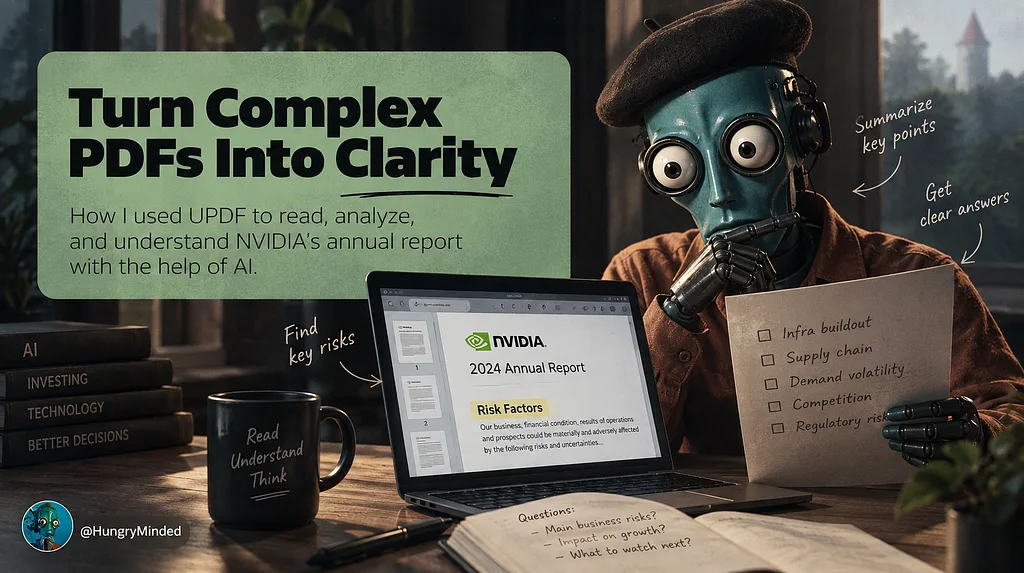
September 23, 2026 · 12 min read
AI PDF Reader Tested: UPDF on Papers and Reports
In partnership with UPDF, I tested an AI PDF reader on a research paper and NVIDIA's annual report, focusing on summaries, questions, and checking cited source pages.
Enoch is an agentic research control plane for teams that want AI research runs to be queued, supervised, and packaged with evidence instead of scattered across ad hoc prompts. The open-source system provides idea intake, dispatch gates, local AI run supervision, provenance capture, and artifact packaging so researchers can keep track of what an agent did and why. It is aimed at AI builders, research teams, analysts, and operators experimenting with autonomous research workflows but still needing governance and review points. Enoch is notable now because agentic research is moving from impressive demos toward repeatable pipelines where evidence, routing, and approval matter as much as the final answer. Its fresh Show HN launch and official README make the project verifiable and timely.
Reader rating
No ratings yet
You might also like
codemap is an MIT-licensed project brain for AI coding tools that gives LLMs instant architectural context from your codebase without burning tokens. It generates a fast tree/context view, dependency flow, dependency blast-radius analysis, and a layered handoff format for cross-agent continuation, then exposes everything through a JSON context bundle and an MCP server compatible with Claude Code and Codex. A built-in Codex plugin and community skill registry make it easy to install and share. Developers use codemap to onboard agents to large repos in seconds, keep session continuity across handoffs, and scope the impact of a change before running it.
Type.com is a multiplayer AI workspace where teams collaborate with Claude, Codex and other models in a shared company context. It brings conversations, files, skills, integrations and automations into collaborative Spaces instead of leaving useful work trapped in individual chat windows. Marketing, sales, support and operations teams can tag Type from Slack or email, share access through role-based permissions, and build custom dashboards or internal apps grounded in company knowledge. Type also supports OAuth, MCP and API connections, with granular controls for users and spaces. It is notable now because its Product Hunt launch presents a practical answer to the coordination problem emerging as teams adopt multiple coding and general-purpose agents. The official site confirms a shipped cloud workspace with desktop and mobile access, not merely an agent concept.
Ollama is a local AI platform for running, managing, and sharing open models on your own machine or private infrastructure. It makes it easy to pull models, serve them through an API, and integrate local inference into developer workflows without relying on a fully managed cloud stack. Teams use Ollama for privacy-sensitive assistants, internal tools, offline experimentation, and rapid testing of open-weight models across laptops, workstations, and servers. It is especially useful for developers, operators, and AI builders who want quick setup with less operational overhead. What makes Ollama distinctive is how approachable it is: it packages model runtime, distribution, and deployment into a streamlined experience that helps people get productive with local AI in minutes instead of spending days on configuration.
From the blog
In partnership with UPDF, I tested an AI PDF reader on a research paper and NVIDIA's annual report, focusing on summaries, questions, and checking cited source pages.
AI costs are no longer just a model-pricing problem. Routing, KV-cache movement, workflow handoffs, permissions, and infrastructure policy determine the real cost of completed work.
Jev is a new kind of AI model from TypeSafe that returns typed decisions instead of chat. Here is where constrained models fit, and where the vendor claims still need testing.