
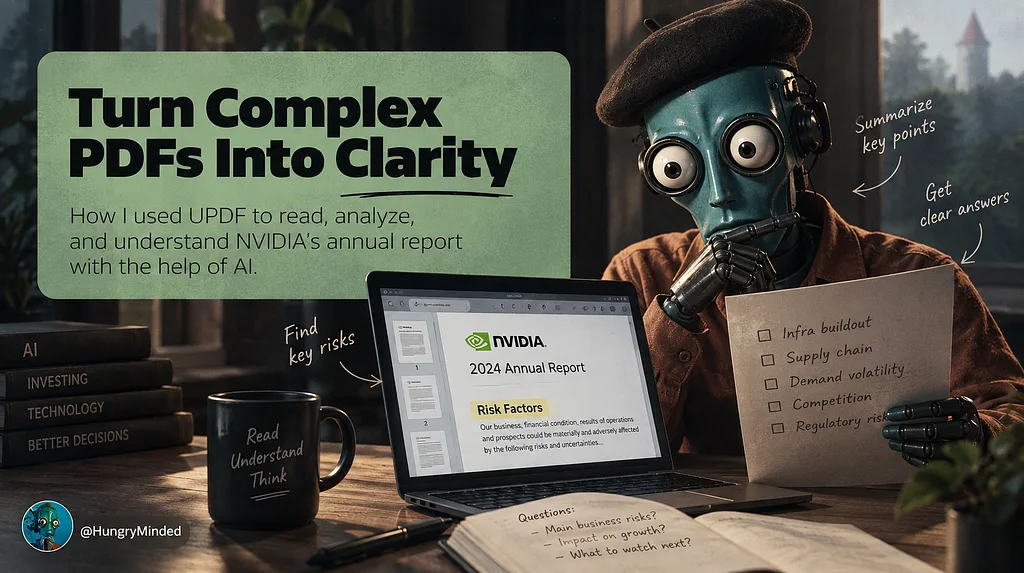
September 23, 2026 · 12 min read
AI PDF Reader Tested: UPDF on Papers and Reports
In partnership with UPDF, I tested an AI PDF reader on a research paper and NVIDIA's annual report, focusing on summaries, questions, and checking cited source pages.
Category
Tools for automating tasks, improving workflow efficiency, and enhancing personal and team productivity
847 tools in this category
codemap is an MIT-licensed project brain for AI coding tools that gives LLMs instant architectural context from your codebase without burning tokens. It generates a fast tree/context view, dependency flow, dependency blast-radius analysis, and a layered handoff format for cross-agent continuation, then exposes everything through a JSON context bundle and an MCP server compatible with Claude Code and Codex. A built-in Codex plugin and community skill registry make it easy to install and share. Developers use codemap to onboard agents to large repos in seconds, keep session continuity across handoffs, and scope the impact of a change before running it.
Type.com is a multiplayer AI workspace where teams collaborate with Claude, Codex and other models in a shared company context. It brings conversations, files, skills, integrations and automations into collaborative Spaces instead of leaving useful work trapped in individual chat windows. Marketing, sales, support and operations teams can tag Type from Slack or email, share access through role-based permissions, and build custom dashboards or internal apps grounded in company knowledge. Type also supports OAuth, MCP and API connections, with granular controls for users and spaces. It is notable now because its Product Hunt launch presents a practical answer to the coordination problem emerging as teams adopt multiple coding and general-purpose agents. The official site confirms a shipped cloud workspace with desktop and mobile access, not merely an agent concept.
FileForge Finder is an AI-powered local file search utility that optimizes search results for developer workflows. It uses natural language processing to understand query intent and prioritize relevant files, code snippets, and documentation. The tool integrates with popular IDEs and terminals to provide instant, context-aware file retrieval, reducing time spent navigating complex project structures. It supports multiple file formats and offers advanced filtering by content type, modification date, and relevance.
Mem is an AI-powered workspace that acts as a personal chief of staff: it connects to Gmail, Slack, Calendar, Todoist, and other tools to organize notes, meetings, and knowledge automatically. The new Mem Agent (launched on Product Hunt, August 2026) adds customizable Skills that teach the agent how you like information organized, routed, and resurfaced, plus sharable Routines so teammates can adopt your workflows with one click. Mem Chat answers questions across all connected sources, and the Calendar integration prepares meeting briefs and follow-ups. Available on web, iOS, Android, and desktop with a free tier and Pro/Team plans. A referral program offers cash rewards for referring new users.
OpenAgentd is a self-hosted AI-agent OS that runs entirely on the user’s machine. It provides a web cockpit, streaming chat, persistent editable memory, tool use, workspace file browsing, image viewing, local voice transcription, scheduling and multi-agent teams with lead-worker delegation. Agents can read and write files, run shell commands, search the web, generate media, manage todos and extend capabilities via skills or MCP servers. The tool is for users who want a local, inspectable alternative to cloud-only agent workspaces. It is notable now because privacy, long-running autonomy and multi-agent coordination are converging into desktop systems rather than isolated chat tabs.
RobotActions is a cloud device farm that gives AI agents and QA teams dedicated real iOS, Android, and browser hardware — no emulators — reachable via standard W3C WebDriver, Selenium, Appium, and Playwright. Its new Autonomous QA Agent connects to Jira, Azure DevOps, TestRail, GitHub, and Bitbucket to read user stories, generate test cases, execute them on live devices with vision, compare screens for visual regressions, and raise defects with evidence directly back into the ALM. Teams can bring their own AI keys (Anthropic, OpenAI, Google, xAI, OpenRouter) or use RobotActions' prepaid credits. An MCP server exposes device control to any MCP-compatible client (Claude Desktop, Cursor, Cline). Pricing is per device slot with a free trial and BYO-AI option for zero platform AI cost.
YUKTAAI is an AI commerce-agent platform for turning website, WhatsApp, app and social conversations into sales and support workflows. It deploys AI product advisors, conversational sales automation, smart upsell and cross-sell logic, support automation and omnichannel customer assistance so businesses can respond to visitor intent without adding headcount. The tool is most relevant for ecommerce teams, DTC brands and growth operators that already have traffic but need better conversion from product questions, hesitations and abandoned buying moments. It surfaced through the just-released agents list on There’s An AI For That and the official homepage verifies the agent positioning, commerce use case, product-advisor workflow and founder-led positioning around acting on consumer behavior signals.
phone-harness is an open-source tool that lets an AI agent take control of a real phone to perform tasks that need a mobile device. Rather than leaving agents stuck in a browser or terminal, it bridges them to touchscreens, apps, and SMS so they can complete flows that only exist on mobile. It is aimed at developers and automation builders who want agents that can operate the apps normal people use, from 2FA steps to on-device workflows. phone-harness is notable now because computer-use agents are expanding beyond the desktop, and phones are where a huge share of real-world actions happen. By making a handset a controllable surface for an agent, it unlocks automation that previously required a human holding the device.
OpenSparX is an on-device agent operating system for building AI agents that run 100% locally with no cloud dependency. It targets sub-100ms latency on device NPUs such as Qualcomm's, letting agents perceive, decide, and act on a phone or edge device while keeping data on hardware. Developers use it to ship agents that work offline, preserve privacy, and avoid per-call cloud costs. It is notable now because on-device inference has matured enough to host real agent logic, and there is growing demand for agents that are private by default and resilient when connectivity drops — moving intelligence from remote APIs into the device itself.
11x is an AI go-to-market platform that provides digital workers for revenue teams, including AI sales development and phone agents that operate across outbound and inbound workflows. Its flagship workers handle tasks like prospect engagement, meeting generation, pipeline building, lead follow-up, and real-time phone conversations, giving teams an always-on automation layer that behaves more like a specialized teammate than a rigid workflow bot. The platform is aimed at organizations that want to scale pipeline creation and customer contact without linearly expanding headcount. Because 11x positions its workers as enterprise-ready and deeply embedded in operations, it fits sales teams looking for AI agents that can run continuously, personalize outreach, and help revive dormant leads. It stands out as a practical agentic automation tool for GTM execution rather than a generic chatbot or simple rules-based automation product.
Maestro turns an issue tracker into an execution layer for AI coding agents. The project coordinates agent work by dispatching issues, managing runtimes, choosing providers, tracking evidence, and making autonomous engineering more operable at team scale. It is aimed at engineering teams, agencies, and technical operators who already use GitHub-style issue workflows but need a safer bridge between task planning and AI-agent execution. Instead of manually copying tickets into terminals, Maestro treats issues as the control surface and keeps proof, runtime state, and provider coordination attached to the work. The repository surfaced in fresh GitHub AI-coding and workflow-automation searches with clear docs and active stars, making it a strong developer-tool candidate for Smartoolbox.
pi-hosts is an MCP-style utility that gives the Pi coding agent structured, safer access to servers through named SSH targets. Instead of forcing an agent to rediscover hostnames, SSH syntax, OS details, package managers, service managers, or Docker status each time, pi-hosts exposes typed host tools with target resolution, cached facts, command risk checks, connection reuse, and JSONL audit logs. It is built for developers and operators who already use Pi for coding or infrastructure assistance and want remote server workflows to be faster, more repeatable, and easier to inspect. The recent Show HN launch makes it relevant to the growing ecosystem of agent-specific infrastructure tools around SSH, operations, and guarded execution.
Algolia AI Search is a search and discovery platform that combines fast retrieval, ranking, personalization, and AI-ready relevance controls for websites and applications. Teams can use it to build product search, documentation search, recommendations, hybrid retrieval, and RAG-style experiences where users need accurate answers from structured content. Ecommerce teams, SaaS companies, marketplaces, media sites, and developer platforms can use Algolia to improve discovery and reduce the engineering burden of maintaining search infrastructure. It is especially useful when speed, relevance tuning, and analytics matter at production scale. What makes Algolia AI Search stand out is its operational maturity: it blends traditional search performance with AI search patterns in a system built for high-traffic products.
Palmier is a Mac-native AI video editor that lets Claude, Codex, and other AI systems help create and refine footage directly inside the editing workflow. The app focuses on agent-assisted video production, including generating cuts, organizing clips, trimming footage, and coordinating with video model integrations from one native workspace. It is useful for creators, startup teams, editors, and marketers who want to move from raw material to publishable video without bouncing between chat tools, file managers, and timelines. Palmier stands out by treating AI as an in-app collaborator rather than a separate prompt box, making it especially relevant for people experimenting with automated or semi-automated video workflows.
Foreman by Northwood Systems is a self-hosted LLM gateway for routing coding-agent and application traffic across model providers with cost, cache and policy awareness. It runs as one Go binary inside a team’s network, keeps provider keys in environment variables, exposes OpenAI and Anthropic-compatible surfaces, pins conversations while prompt caches are warm, and records routing decisions in a queryable ledger. Developers can point Claude Code, Codex, OpenCode, Pi and similar harnesses at Foreman, then enforce budgets, inspect trace IDs, compare rejected alternatives, and decide when cheaper models are safe enough. The July 8 Show HN launch and official Apache-2.0 repository verify concrete docs for gateway APIs, policies, client setup, deployment and spend summaries.
Elpis is an open-source, provider-neutral terminal environment for coding agents that focuses on keeping working context small, inspectable, and useful across long sessions. Derived from the Codex execution foundation, it adds selective context pruning, an explicit context ledger, durable memory, portable continuity checkpoints, provider selection, permissions, retrieval, and evidence tracking. Developers can use it with OpenAI/Codex, Gemini, Claude, Ollama, and other providers while seeing which files, tool outputs, and instructions are admitted to the active context. Its pruning workflow keeps meaningful conclusions and evidence pointers while removing dead ends, rather than blindly summarizing the entire conversation. Elpis is for engineers who run long coding-agent sessions and need lower context costs, clearer continuity, and more deliberate control over what the model sees. The current repository and Show HN launch verify a substantial, installable developer tool rather than a concept page.
Butterbase is an open-source, AI-native backend-as-a-service that packages Postgres, authentication, storage, functions, an AI gateway and MCP support into a developer platform agents can operate against. It is designed for builders who want Supabase-like backend primitives with an agent-friendly control layer, especially teams experimenting with coding agents, MCP workflows and AI-generated applications. The GitHub repository was created in May 2026 and has already attracted significant attention, which suggests real demand around infrastructure that agents can inspect and modify during real app builds. For Smartoolbox users, Butterbase is most relevant as a developer productivity and agent-infrastructure tool rather than a consumer app.
BetterClaw is a no-code AI agent builder that deploys autonomous agents in about 60 seconds — no Docker, YAML, VPS, or coding. Describe the job in chat and your agent runs it on a schedule across Telegram, Slack, Discord, and Gmail with your tools connected. It runs any OpenClaw-compatible skill plus 18 curated, security-audited ones (824 malicious skills rejected), supports 28+ LLM providers with bring-your-own-key and zero inference markup, and enforces per-agent spending caps and auto-purging secrets. Built on the open-source ZeroClaw Rust runtime, it gives non-technical teams the same agent capabilities as self-hosted frameworks without the maintenance. A genuine free-forever tier (1 agent, 500 credits) and Pro at $49/mo make it approachable.
Humwork A2P Marketplace connects AI agents with verified human experts when autonomous workflows hit a wall. The platform is designed for coding agents, research agents, and operations agents that need fast human fallback on tasks they cannot resolve alone, passing context through MCP so the handoff feels native instead of manual. That makes it useful for teams deploying AI agents in production who want stronger completion rates across software engineering, design, strategy, and other knowledge work. Humwork positions itself as an always-available human layer rather than a general freelancer marketplace, with rapid matching and direct expert intervention inside agent workflows. What makes it unique is the agent-to-person model itself: it extends AI systems with on-demand human judgment instead of pretending every hard edge can be solved by automation alone.
Undermind is an AI research assistant designed for scientists, R&D teams, and technical professionals who need deeper literature discovery than a standard academic search engine can provide. The platform explores large bodies of scientific work, reads hundreds or thousands of papers, follows citation trails, evaluates relevance, and returns grounded answers with inline citations back to source material. That makes it especially useful for literature reviews, technical due diligence, drug discovery research, and highly specific search tasks where missing an important paper can slow down serious work. Undermind stands out by mimicking a structured expert research process instead of simply retrieving keyword matches. For researchers who want faster discovery without sacrificing depth or traceability, it offers a strong standalone AI product focused on scientific search and evidence-backed synthesis.
Documentation.AI is an AI-native documentation platform for product teams that need to create, publish, and maintain docs, API references, and help centers without letting content go stale. The platform combines docs-as-code and browser-based editing with an AI agent that suggests updates, rewrites unclear sections, improves structure, and helps keep product documentation aligned with changes over time. It also includes an embedded AI assistant that answers user questions directly inside the docs with cited responses, which can reduce support load and improve onboarding. Documentation.AI is especially relevant for SaaS companies, developer tools, and technical product teams that treat documentation as part of the product experience. It stands out by combining publishing, maintenance, AI search readiness, and in-doc assistance in one focused workflow.
Guesty MCP Server is an open-source Model Context Protocol server that connects AI clients to Guesty property-management accounts. It exposes tools for reservations, listings, guests, calendars, financial reports, operations, reviews, messaging, pricing, tasks, webhooks, IoT, and property-health workflows, letting Claude, ChatGPT, Copilot, Cline, and other MCP-compatible clients answer questions or perform property-management actions from structured Guesty data. The project is useful for short-term-rental operators, property managers, automation builders, and agencies that manage Guesty portfolios and want AI assistants inside operational workflows. It launched on Show HN as the first MCP server for Guesty, and the npm registry plus official GitHub repo verify installability, README details, MIT licensing, and production use on real rentals.
skills.sh is a platform for discovering, sharing, and reusing skills that extend AI agents with repeatable capabilities. It helps builders package prompts, procedures, tool instructions, and workflow knowledge into portable skills instead of burying them inside scattered chat histories or project notes. Developers can use it to standardize coding-agent behavior, share internal operating patterns, and give assistants consistent ways to perform specialized tasks. It is useful for teams adopting Claude Code, Cursor, Codex-style CLIs, and custom agent stacks that need reusable context. skills.sh stands out because it treats agent behavior as an ecosystem artifact: skills can become installable, inspectable building blocks that make AI workflows easier to maintain across tools and teams.
Selvedge is a local MCP server that captures why AI agents change code, creating long-term memory for AI-coded codebases. Its official site describes an agent-callable system for Claude Code, Cursor and Copilot that logs reasoning into a SQLite file under a project-local .selvedge directory. That is valuable for teams using AI coding assistants because the final diff often shows what changed but not why the agent chose that path, rejected alternatives, or followed certain assumptions. Selvedge helps preserve design rationale, auditability and handoff context inside the repository workflow. It is notable now because agent-generated code is becoming common enough that codebases need memory for decisions, not just commits and comments.
SVAHNAR is a platform for building and deploying AI agents as working products instead of one-off chat demos. Its homepage positions the service around declarative Agents as Code, a visual Agent Console, serverless isolated agent infrastructure, native chat UI, API endpoints, observability, auditability and an Agent Store. That makes it relevant for teams that want to move from an internal agent idea to a deployable workflow without spending months wiring custom infrastructure, UIs and governance. The Show HN launch on 2026-06-07 framed it as serverless infrastructure for running AI agents in isolated VMs, which makes the product timely for builders looking for safer agent execution, faster prototyping and repeatable deployment paths.
AIMX is a self-hosted email server designed specifically for AI agents that need to send, receive, and reason over mail without depending on a user’s personal inbox. It provides an agent-oriented SMTP/mail exchange layer so developers can give assistants controlled email identities for workflows such as support triage, notifications, task intake, or automated correspondence. The product is for agent builders and technical teams that need email as infrastructure rather than a consumer app integration. It solves a practical gap: agents often need mail capabilities, but normal inbox access is too broad, brittle, or hard to audit. AIMX is notable after its Show HN launch because agent communication tools are becoming first-class infrastructure pieces.
agentacct is local-first Agent Work Intelligence for coding agents that reads the session logs that Claude Code and Codex already write on your machine, joins them with the work each session records, and shows the result—tokens, estimated cost, tasks, and evidence—on a local dashboard. Private by design, everything stays on your machine: state is plain local files, the dashboard binds to 127.0.0.1, and there is no phone-home telemetry, no account, and no cloud sync. agentacct never stores or requests a provider API key, giving you honest usage and cost metrics per agent, model, and day—read from the clients' own local session files. Ideal for developers and teams who want transparent, private accounting of their AI agent spend and productivity without relying on vendor-provided dashboards or exposing usage telemetry to third parties.
Perseus Vault, formerly surfaced as Mimir, is a local-first MCP memory server for AI agents packaged as a single Rust binary. It gives agents durable memory across sessions using SQLite, full-text search, vector search, encryption, and dozens of MCP tools without requiring Docker, Postgres, or a hosted backend. Developers can use it with MCP-capable assistants and frameworks such as LangGraph, CrewAI, and AutoGen to preserve notes, facts, and long-running context while keeping the storage file under local control. The project is especially useful for privacy-conscious builders who want persistent agent memory but do not want a cloud account or heavyweight database stack. It appeared in current Show HN LLM/agent searches and was verified against the official Perseus Computing GitHub README.
Segue is a lightweight context-passing utility that lets you save a block of context from one AI assistant and load it into another via a short handle, eliminating the need for copy-paste or re-explaining. Works with any MCP-capable AI (Claude, ChatGPT, Cursor, etc.) over OAuth. The problem Solved: every AI keeps your work in its own silo; when you switch tools, you lose fidelity because each assistant rebuilds context from memory. Segue solves this by letting you connect any MCP-capable AI to Segue over OAuth, then let it carry context from one assistant to the next. You get a short handle back that you can use to load the same context in another assistant—no copy-paste, no re-explaining. Your context, carried across tools. Start free.
WorkOS is a developer platform that adds enterprise-ready features such as single sign-on, directory sync, role-based access control, audit logs, and admin portals to software products. It helps startups and SaaS teams sell to larger customers without building every enterprise requirement from scratch. Developers can integrate identity and organization-management capabilities through APIs, while product teams can unlock procurement, security, and compliance requirements faster. WorkOS is especially useful for AI app builders moving from consumer prototypes to company-wide deployments that require SAML, SCIM, and granular permissions. Its main advantage is speed: it packages the enterprise infrastructure layer so teams can focus on the core product experience.
NoodleTomato is an AI video-generation product for creating full-length faceless YouTube videos from a topic prompt. The official homepage says it handles the script, narration, visuals, subtitles, music, and editing, then outputs production-ready videos that can be uploaded quickly. It is aimed at creators, niche-channel operators, and marketers who want long-form documentary-style content without manually assembling footage, voiceover, captions, and soundtrack. The lead came from today’s X launch artifact with a direct homepage link, and it was selected only after the non-ref official homepage verified the product identity, pricing/navigation, multi-step workflow, niche examples, and monetization positioning. For Smartoolbox, NoodleTomato belongs in AI video generation and productivity because it packages idea-to-video production into a single creator workflow.
Volrix is an MCP-enabled finance research and backtesting tool that connects AI agents such as Claude and ChatGPT to workflows for index and commodity derivatives research. The launch evidence describes an MCP server that lets users run backtests and strategy research through natural language, which makes it a specialized bridge between agent interfaces and quantitative finance tasks. It is most relevant for traders, analysts and technically confident finance teams who want to test ideas faster without building every data/research workflow manually. Volrix came from today’s X launch leads and was selected only after its official homepage resolved successfully at volrix.ai.
DocuPipe PDF to Excel is a free AI converter that turns PDFs, scanned documents, and photographed paperwork into organized Excel workbooks. Unlike simple table extractors, the tool reads the whole document, designs a custom extraction plan, creates separate sheets for each table, carries multi-page tables across breaks, extracts summary fields, and preserves numbers and dates for formulas. It is useful for analysts, finance teams, accountants, operations staff, and developers who need quick structured data from statements, reports, filings, invoices, or scanned paperwork before considering a larger document-intelligence workflow. The July 3 Show HN result linked directly to the official converter, and the page verifies no-signup usage, OCR support, SOC 2/ISO/HIPAA security claims, platform positioning, and API/workflow upsell.
Generalized is a community platform for discovering and validating reusable AI-agent skills. It approaches skills like a package ecosystem: builders publish capabilities, users can inspect what a skill does, and community activity provides evidence before someone installs it into an agent workflow. The project is aimed at developers and advanced AI users who are moving beyond one-off prompts and need repeatable procedures, tools, and knowledge packages that can be shared across agents. Its core problem is trust and discoverability: an agent skill should have a clear identity, usage trail, and proof of usefulness rather than being copied from an unknown snippet. Generalized is notable because it connects the emerging agent-skills format with community validation, creating a potential distribution and quality layer for agent extensions. The official homepage and Show HN listing make the product identity clear enough for a Smartoolbox entry.
Phixo is an AI phishing-detection browser extension for Gmail and Outlook on the web that catches malicious emails your normal spam filter misses — in about three seconds, before you click. It analyzes a message's content and headers against 1.4M+ tracked threat indicators and five intelligence sources, then tells you plainly whether an email looks safe or is a sophisticated impersonation of PayPal, Google, or your bank. A free tier includes ten scans per day with sign-in via Google or Microsoft and no credit card. Beyond the extension, Phixo ships free utilities like a phishing email checker and header analyzer, plus an educational blog. For individuals and small teams drowning in convincing phishing, Phixo adds a fast, privacy-minded safety net that flags danger at the moment of decision.
Clarm is an AI inbound conversion platform that captures visitor questions across websites, Discord, Slack, and GitHub, then qualifies buyer intent and routes revenue opportunities automatically. Instead of treating inbound as a support-only problem, it aims to convert conversations from both humans and AI agents into faster responses, better qualification, and clearer pipeline generation. The product highlights instant response times, support deflection, and the ability to identify high-intent buyers without adding headcount, making it especially useful for technical B2B companies with active communities and documentation-heavy products. Clarm also positions itself as relevant for machine visitors doing product research, which is increasingly important in an agentic web. For teams balancing support, community engagement, and demand capture, it acts as a 24/7 AI layer for inbound revenue operations.
StateSpace is a search engine for the agentic web, focused on discovering llms.txt-enabled sites and resources that AI agents can understand and use. The homepage advertises a web search interface plus a CLI, SDK, and MCP server on GitHub, so it is aimed at developers, AI builders, and agent workflow designers who need structured discovery rather than another general web search box. It solves a growing problem: as more websites publish machine-readable context for LLMs, builders need a way to find, query, and integrate those sources into tools. The Show HN launch framed it specifically as a search engine for llms.txt sites, and the official page backs that with product links to GitHub, Discord, npm, and X.
CloudPostOffice is a lightweight messaging service for connecting AI agents, scripts, apps, and devices without setting up MQTT, Redis, queues, or a broker. It supports simple send-and-receive patterns from Python, Node.js, and Go, so developers can create a postbox, send JSON messages, and have another process or agent receive them with a few lines of code. That makes it useful for prototypes, small automations, multi-agent experiments, IoT-style notifications, and background jobs that need realtime coordination but not a full infrastructure stack. The official page describes it as a super-simple messaging platform for AI agents, apps, and tools, and the HN launch positioned it as agent messaging in four lines.
MLJAR Studio is a local AI data analyst that turns analysis work into reproducible notebooks instead of leaving results trapped in a chat transcript. It is designed for analysts, data scientists, founders, and operators who want to ask questions over data, generate charts, inspect calculations, and keep the underlying Python notebook as an auditable artifact. The product fits Smartoolbox’s productivity and code-assistant categories because it combines a natural-language analyst interface with executable analytical workflows. MLJAR Studio is timely because teams are adopting AI for data exploration but still need transparency, reruns, and versionable outputs. Its Show HN launch and official MLJAR homepage/docs establish it as a real product rather than a one-off demo.
Sim is the open-source AI workspace where teams build, deploy, and manage AI agents at production scale. Backed by a $7M Series A (YC X25, led by Standard Capital with Paul Graham and Perplexity) and trusted by over 100,000 builders, Sim unifies four surfaces in one SOC2-compliant workspace: a visual agent builder, conversationally-described agents, structured tables your agents can query, files, knowledge bases, and calendar-style scheduled tasks. Connect 1,000+ integrations (Slack, HubSpot, Salesforce, Notion, databases) plus every major LLM via one API key, then watch every run block-by-block with live traces, logs, and real cost. Self-host via `npx simstudio` or Docker, or use the cloud at sim.ai. The Apache-2.0 monorepo (29.1k GitHub stars, v0.7.37 Jul 15 2026) makes Sim the leading open-source n8n/Claude Cowork alternative for teams that want a governed, monitorable agent workforce instead of isolated prompt loops.
Supafax is an email-native AI agent that treats your inbox and outbox as the operating surface for personal automation. Instead of asking users to move routines, reminders, and relationship context into a separate dashboard, Supafax lets people email themselves to talk to the agent and uses email threads as memory, configuration, and task history. That makes it interesting for founders, operators, salespeople, and busy professionals who already run their day from email but want agentic follow-through without another workspace to maintain. It surfaced today through Show HN as a new agent experiment with a concrete workflow: storing rules, reminders, and context in a familiar append-only system. The product is early, but the homepage and HN launch make the identity clear enough for Smartoolbox discovery.
Boxes.dev provides cloud dev environments purpose-built for agentic coding workflows. Each Claude Code or Codex chat session runs on its own isolated cloud computer, letting developers connect from mobile and desktop without local resource constraints. The platform targets engineers who use AI coding agents extensively and hit rate limits or machine-switching friction — spin up a dedicated box, run your agent, and access it from anywhere. Launched on Show HN on June 4, 2026 with 103 points, Boxes.dev addresses a real pain point for the growing population of agentic-coding power users who need persistent, accessible, and isolated environments. The product is live and accepting users with a clean web console.
Tested is an AI-tool evaluation site where products are scored by a panel of major LLMs including Claude, GPT, Gemini and Grok. The idea is to give buyers and builders a comparative signal that is more structured than a marketing page or a single reviewer’s opinion: tools can be tested, scored and positioned based on how multiple frontier models judge their utility. It is useful for founders researching competitors, tool buyers shortlisting options, and marketers who want to understand how AI systems describe their product category. Tested surfaced on Show HN on 2026-06-27 and the official site is reachable as a standalone product. For Smartoolbox, it is a meta-discovery and evaluation tool that complements directories by adding model-panel scoring.
LeanCtx is an open-source Python SDK for drop-in prompt compression in production LLM applications. Instead of asking teams to redesign their stack, it wraps familiar OpenAI, Anthropic, Gemini, LangChain, and LangGraph-style interfaces and compresses long inputs before they are sent to the model. It is aimed at developers running RAG, document analysis, support automation, or agent workflows where input-token costs and context-window pressure keep growing. The README reports 40–60% input-token savings and local-by-default compression using open models such as LLMLingua-2. It is notable now because cost optimization is becoming a practical bottleneck for real LLM apps, and LeanCtx offers a code-level mitigation rather than a dashboard-only analysis tool.
FixYou is a free AI-assisted health screening tool that helps people understand which cancer screenings are recommended for them based on factors like age, smoking habits, and family history. After a short onboarding flow, it generates personalized screening guidance and tracks progress with a simple Shield Score, giving users a clearer picture of what screenings they may still need. The product focuses on six commonly screened cancers, including colorectal, breast, lung, cervical, prostate, and skin cancer, and is designed to remove confusion around preventive care by translating medical guidance into an easy-to-follow checklist. FixYou also emphasizes privacy, stating that user data remains on the device and is not shared. It is best described as a consumer-facing preventive health guidance app rather than a general medical chatbot.
Referent is an AI-native practice management platform that helps law firms run operational workflows through legal AI agents. Instead of acting as a generic legal chatbot, Referent connects matter context, Gmail, Calendar, Drive, client intake, task creation, proposal drafting and case organization into one controlled workspace where lawyers approve critical actions. It is built for solo lawyers, boutique firms and larger practices that want AI to handle routine firm operations while preserving audit trails, permissions, confidentiality and lawyer sign-off. The official site verifies a private beta, Google for Startups and Nvidia Inception signals, practice-management positioning and concrete workflows such as AI client intake, auto-filing emails and files, matter updates and voice-driven legal operations.
Slashspace is a canvas-first agentic harness designed for power AI users who want to replace fragmented tool UIs with a single, unified interface for the AI era. Originally started as RabbitHoles AI, it evolved into a canvas-as-context platform with agentic nodes — visual building blocks that represent AI capabilities, data sources, and workflow steps. Slashspace integrates the Cursor AI SDK and Composio tools, enabling users to build complex agent workflows on a visual canvas rather than writing code or chaining prompts. Featured in X Social posts in June 2026, it targets developers, designers, and knowledge workers who want to orchestrate multiple AI tools and agents in a single visual workspace. After an 18-month bootstrap build, Slashspace represents a new paradigm where the canvas becomes the context for AI collaboration.
Creator Judge is an AI-powered campaign intelligence tool for scoring and ranking creator content against a brand’s campaign criteria. Users can choose judging criteria, submit creator content, and get structured evaluations intended to help decide which posts or creators best match a campaign brief. It is aimed at creator marketers, agencies, and founders who need a lightweight way to compare influencer content without building a custom rubric spreadsheet for every campaign. It is notable now because it surfaced as a fresh X launch with a concrete public site and a free tier, fitting the growing niche of AI tools that turn subjective marketing review into repeatable scoring workflows.
Apple Extensions Platform lets third-party AI providers operate natively on iPhone, enabling apps like Claude to integrate directly into the iOS experience. Announced at WWDC 2026, this platform opens up system-level AI extensibility so users can invoke external AI assistants from within Safari, Messages, and other first-party apps. Developers can register their AI services as extensions, giving them access to on-device context while maintaining privacy boundaries. It marks Apple's shift from a closed AI ecosystem to one that embraces multi-model interoperability. For AI builders, this creates a new distribution surface on billions of active devices.
Browzer is an AI-native developer-relations studio that turns a GitHub repository into a continuously updated stream of technical content. Connect a codebase and it can draft demo videos, launch posts, changelogs, cookbooks, quickstarts, and API documentation from the actual source, comments, and structure. When code changes, Browzer detects documentation drift and prepares corrections or new release content for review, while teams retain control through a review inbox and pull-request-oriented workflow. It is designed for DevRel leads, solo developer-experience engineers, OSS maintainers, and technical marketing teams that cannot keep docs current manually. Browzer is notable now because it connects agentic code understanding with content operations, solving the common problem of documentation going stale immediately after a release.
Pacific Slate is a self-hosted, model-agnostic personal AI system that packages a multi-agent assistant architecture for people who want control over their own AI workspace. The official site presents it as a personal system rather than a generic demo, with design notes around self-hosting and avoiding lock-in to a single model provider. It is useful for technical users, builders, and privacy-minded operators who want to run a configurable AI assistant stack on their own terms. The Show HN launch made it timely because personal agent platforms are shifting from hosted chat products toward composable local systems. Pacific Slate fits Smartoolbox as an AI-agent productivity tool for users who want an inspectable architecture and the flexibility to swap models instead of buying into one closed ecosystem.
Google Workspace is a cloud productivity suite that brings email, documents, meetings, storage, and AI-powered collaboration into one connected work platform. Teams use it to manage communication in Gmail, create and edit files in Docs, Sheets, and Slides, run video meetings in Meet, and organize shared knowledge across Drive with built-in Gemini assistance. It is well suited for businesses, startups, distributed teams, educators, and organizations that want a familiar office stack with strong real-time collaboration and admin controls. What makes Google Workspace stand out is the way its apps work together as a single system rather than a collection of separate tools, helping teams move faster across writing, planning, communication, and coordination without constant context switching.
OpenRouter is a unified API platform that gives developers access to many leading AI models through one endpoint, making it easier to compare providers, manage fallbacks, and route traffic without rebuilding integrations each time. Teams can use it to prototype faster, optimize model cost and quality, and keep application logic more portable across model vendors. It is especially useful for startups, AI product teams, developers, and experiment-heavy builders who want flexibility when working with multiple frontier and open models. What makes OpenRouter stand out is its model marketplace approach combined with practical routing and compatibility features, letting users treat model access as an interchangeable layer instead of getting locked into one provider from the start.
LiteHarness is an open-source SDK from LiteLLM Labs that gives developers one unified interface for running agent harnesses such as OpenCode, Claude Code and Codex. It follows the Claude Agent SDK message format, supports TypeScript and Python interfaces, and lets builders switch harnesses and models without rewriting orchestration code. LiteHarness is aimed at engineers building agentic developer tools, internal automation, or experimentation platforms where the agent backend may change over time. The project is still in preview, but it has clear setup instructions, active commits, and a concrete workflow problem: the AI coding ecosystem is fragmenting across many agent runtimes. LiteHarness is notable because it treats those runtimes as interchangeable backends behind one API, which can reduce lock-in for agent builders.
Hey Noah is an innovative AI-powered executive assistant designed specifically for startup founders and busy executives. Unlike traditional scheduling or automation tools, Noah acts proactively by engaging with your network through SMS, email, WhatsApp, and text, ensuring that your meetings, follow-ups, and relationship management are handled seamlessly. Its autonomous nature means it doesn't just react to commands but actively manages your calendar, coordinates logistics, and maintains communication, freeing founders from time-consuming administrative tasks. By integrating deeply into messaging channels, Noah provides an always-on, intuitive assistant that helps maintain professional relationships and stay organized without constant manual input. Its unique approach, likening itself to Tesla's Full Self Driving, positions Noah as a proactive, autonomous AI that lives within your communication channels, making it ideal for founders who want to focus on strategic work while Noah handles the operational details. Noah plugs in seamlessly across your entire ecosystem: WhatsApp, Gmail, Google Meet, Zoom, Notion, Granola, iMessage, Slack, and phone calls. It sends briefings before calls, telling you who you're meeting, what they've funded, your last interaction, and the context that matters. Noah makes real phone calls to restaurants, doctors, salons, and confirms the booking. It is the world's first SMS/Voice AI assistant, exclusively for executives to manage calendar, relationships, and communication with your team and clients.
Google Colab Learn Mode is an AI-guided coding feature that turns Colab into a more interactive learning environment for Python, data science, and notebook-based programming. Instead of only generating answers, it provides step-by-step explanations, instructional support, and a more educational workflow that helps users understand why code works. That makes it useful for students, self-learners, educators, and developers who want help while practicing inside real notebooks. It can support concept learning, debugging, and guided experimentation without leaving the coding workspace. What makes Google Colab Learn Mode distinctive is that it combines hands-on notebook execution with tutoring-style assistance, creating a stronger bridge between AI help and practical coding practice inside Google’s widely used Colab platform.
ZeroQuarry is an adversarial AI security platform that searches for vulnerabilities across source code, binaries, and live cloud assets. Its multi-agent loop analyzes attack surfaces, debates findings, filters noise, generates pentester-grade reports, and can draft patches for issues it discovers. The tool is aimed at security engineers, open-source maintainers, DevSecOps teams, and startups that want deeper vulnerability discovery than a static scanner but do not always have a full red-team budget. ZeroQuarry is timely because AI coding and dependency-heavy development increase the need for continuous offensive testing. Its Show HN launch emphasized free scanning for open-source projects, while the official page presents a polished platform with pricing, reports, source scanning, binary analysis, and live asset coverage.
Kagi Session2API MCP is an open-source MCP server that lets AI assistants access Kagi Search and Summarizer through existing session tokens rather than a separate API key. It is aimed at Claude Desktop, Cursor, Windsurf, Hermes, and other MCP-client users who want high-quality web search available directly inside agent workflows. The project is useful for research assistants, coding agents, and personal automation setups where search and summarization need to be called as tools. Its appeal is pragmatic: it bridges a paid search product into the model-context ecosystem with local configuration and no heavyweight platform. It is notable now because recent GitHub MCP searches showed strong early interest and stars for a very specific agent-tooling gap.
OpenHunt is an AI-native launch and discovery platform for new digital products, built around the idea that autonomous agents can evaluate launches alongside human users. Instead of relying only on upvotes and social momentum, OpenHunt analyzes submitted products from multiple perspectives to generate richer discovery signals and more structured feedback for builders. That makes it especially relevant for founders, indie hackers, and startup teams that want more visibility than a traditional launch board can provide. The platform also offers launch calendars, rankings, and product discovery workflows designed for the post-algorithm era, where both humans and agents increasingly influence what gets noticed. OpenHunt is best understood as a next-generation product launch layer shaped specifically for AI-mediated discovery.
MetaBrain is an open-source local document memory for AI agents, AI tools, and humans. It gives agents a durable place to store and retrieve notes, source snippets, task context, metadata, tags, links, and version history instead of scattering state across loose Markdown, JSON, and scratch files. The project targets developers who use coding agents and need private, searchable memory that stays on their own machine across sessions. It is also useful for researchers and operators who want structured local knowledge without a cloud database. MetaBrain is notable now because memory is becoming a core missing layer for autonomous agents: tools can write code or answer questions, but they still need persistent project context to avoid repeating mistakes and losing continuity.
AuthKit is a developer authentication toolkit from WorkOS for adding enterprise-ready sign-in flows to web applications. It gives teams hosted login, user management, organization support, single sign-on paths, and integration patterns that reduce the amount of custom identity infrastructure they need to build. SaaS founders, product engineers, and AI app builders can use it when moving from prototypes to production products that need secure onboarding and business-friendly authentication. AuthKit is especially useful for teams that want polished auth quickly while keeping a path toward enterprise features such as SSO, directory sync, and role-based access control. Its unique advantage is the connection to WorkOS: authentication starts simple, then expands into a broader enterprise platform as customers become more demanding.
Genspark AI is an agentic knowledge-work platform that uses many models to research, synthesize, and complete complex tasks for users. It helps people move beyond single-turn answers by coordinating searches, reasoning, document creation, and task-specific outputs across a broader model strategy. Knowledge workers, researchers, students, analysts, marketers, and founders can use Genspark AI for reports, comparisons, planning, and productivity workflows that require more than one model response. The platform is strongest when a user wants an AI system to assemble useful artifacts from multiple sources. What makes Genspark AI distinctive is its multi-model operating style, positioning model diversity as a feature for better task completion rather than relying on one flagship assistant.
Orbit UI is an open-source, self-hosted visual workflow builder for automating anything on a real desktop inside its own virtual computer. Each node is a plain-English instruction — Navigate, Do, Read, Fill, Check, Code, ForEach, Bootstrap — executed by an AI agent inside a Docker container with a full browser and desktop; because every step is independent, the agent stays on task instead of drifting. Build workflows to scrape structured data, fill and submit forms using a secrets vault, run inline Python on prior step outputs, monitor pages on a schedule, or apply to jobs automatically. Watch it work over VNC, pause to take control, then hand back. Supports any LLM via LiteLLM (Gemini, GPT-4o, Claude, Ollama, OpenRouter), webhook and cron triggers, persistent Chrome sessions, and human-in-the-loop confirmation per step.
Saidly is an AI visibility and sentiment monitoring service for companies, products, people, campaigns, and topics that want to know how major assistants describe them. It queries Claude, ChatGPT, Gemini, and Grok on a schedule with live web search enabled, preserves the exact answers and cited sources, and compares what each model says from current evidence with what it appears to believe from training. Users receive scores for sentiment, accuracy, and source quality, plus a weekly report explaining what changed and what to fix. Saidly is built for brand, communications, SEO, and reputation teams facing the shift from classic search results to AI-generated recommendations. The official homepage documents a free read, a 30-day trial, recurring reports, per-model breakdowns, and model-version tracking. Its fresh Reddit launch signal was used only as a lead; the official homepage independently verifies the product identity and workflow.
Salesman AI is an AI sales copilot built for Account Executives that connects the work before, during, and after every customer meeting so live opportunities keep moving toward closed-won. Before a call, it delivers a two-minute brief on the buyer's likely priorities, communication cues, potential objections, and meeting goal, then lets reps rehearse with a realistic AI buyer built from opportunity context. During the call it provides real-time coaching; afterward it handles follow-through, CRM updates, and next-step recommendations. Unlike meeting assistants that only record and summarize, Salesman AI treats the meeting as one stage in a larger deal workflow, keeping the same buyer, meeting, and opportunity context continuous from booked to won. It integrates with your CRM and is aimed at AEs, sales managers, and enablement teams wanting higher win rates without adding headcount.
OpenLoom turns Loom links into transcripts and frames that an LLM can actually inspect. It is built for developers, researchers, support teams, product managers and AI-agent builders who receive useful context in screen recordings but need searchable text and visual frames rather than a passive video URL. The tool can make bug reports, walkthroughs, customer demos and design reviews easier to feed into coding agents or research assistants. That is useful because videos often contain the missing state that written tickets omit. OpenLoom is notable now because it launched on Show HN as a focused bridge between async video communication and LLM workflows. Its official homepage was reachable, product-specific, and sufficiently clear for a truthful Smartoolbox listing.
GeoImageTagger is an AI-powered tool that automatically adds GPS coordinates, AI-generated tags, descriptions, and EXIF/IPTC/XMP metadata to photos online. It helps users geotag images for Local SEO, Google Business, and digital asset management. The platform supports bulk exports, map-based editing, and multi-language business SEO tags. With a free plan available, it serves photographers, marketers, real estate professionals, and businesses needing to organize and optimize their image libraries at scale.
BrandJet AI is a multi-channel outreach and brand-intelligence platform that consolidates email, LinkedIn, X, WhatsApp, Instagram, and Telegram, plus brand-mention and AI-search monitoring, into one workspace for GTM teams. Its GTM agent Artemis converts plain-language descriptions into structured sequences, runs natural-language lead searches against a 700M+ contact database, drafts replies from the unified inbox, and pulls analytics without leaving the chat. BrandJet was relaunched on Product Hunt on Aug 31 2026 (Turn public buying signals into sales pipeline) with a fresh emphasis on signal-to-pipeline; the underlying platform has been live since Sep 2025 and is also distributed on AppSumo. Plans are free for early users, with paid Starter and Pro plans surfaced via the marketing site.
Tangle is an open source experimentation platform for building and running machine learning and data pipelines through a visual interface. Developed to support reproducible workflows at scale, it lets teams design pipelines, manage experiments, and execute jobs in cloud environments without requiring every contributor to assemble a local development stack first. Organizations can use Tangle to coordinate ML experimentation, standardize data workflows, and make complex pipeline work more accessible across engineering and data teams. It is a strong fit for machine learning engineers, platform teams, and companies that want more structure around iterative experimentation. What makes Tangle different is its blend of visual workflow authoring and scalable execution, giving teams a more collaborative way to operationalize ML work across shared environments.
llmaker is an open-source platform for self-hosting a modern LLM application stack from one command. Its README describes provisioning large language models, vector databases, embeddings, caching, observability, retrieval, and an agent layer on private infrastructure without third-party API keys or data leaving the machine. The tool is aimed at developers, platform engineers, privacy-sensitive startups, and teams that want to build private RAG chatbots, FAQ assistants, and recommendation systems without assembling every component by hand. llmaker is especially relevant now because more organizations want local or self-managed AI infrastructure rather than only hosted SaaS model access. Its fresh Show HN appearance and GitHub metadata verify an active, installable project with concrete docs.
Kitaru is an open-source runtime for recording, replaying, and improving autonomous AI-agent runs in production. Built by the ZenML team, it sits under whatever harness a team already uses and captures model calls, tool calls, checkpoints, decisions, artifacts, and versioned deployments so failures can be diagnosed instead of guessed at. Developers can replay an agent run with different inputs or models, fork from checkpoints, resume long-running flows, and keep a durable execution record on their own infrastructure. It is especially useful for teams moving from prototype agents to production systems where observability, regression testing, and controlled updates matter. The fresh Show HN launch and official GitHub/docs pages make it a timely agent-infrastructure listing for Smartoolbox.
Don't Hit Send is a small, open-source AI chat interface where the model answers while the user types instead of waiting for a send button. It watches pauses in a draft, starts an OpenAI-compatible streaming completion, aborts an unfinished response when typing resumes, and stacks completed replies without rewriting earlier bubbles. The project is for developers, interface designers, and AI product teams exploring conversational interaction patterns beyond the conventional prompt-submit loop. It can run locally with a standard-library Python server, keep the provider key behind the proxy, and connect to Scalattice or any compatible endpoint. The fresh Show HN launch makes it timely as a focused interaction experiment, while the MIT repository provides runnable instructions, Docker support, configuration details, and measurable stream behavior rather than only a design mockup.
Famulor is an omnichannel AI assistant platform for phone, WhatsApp, live voice, and chat, built to automate customer communication with fast, human-like responses. The product focuses heavily on AI telephony, offering low-latency voice interactions, multilingual conversations, business tool integrations, analytics, a visual flow builder, and enterprise features like SIP connectivity and EU-hosted GDPR-compliant infrastructure. Famulor is aimed at companies that want AI agents to handle inbound calls, outbound campaigns, support questions, and lead qualification across multiple channels without forcing customers into a text-only experience. Its positioning is stronger than a basic chatbot because it connects voice, messaging, automation, and operational analytics in one system. For sales, service, and operations teams, Famulor looks like a practical voice-first AI operations layer.
SuperStudentAI is an AI study companion that turns any course material into active, spaced-repetition practice. Students upload notes, slides, or paste a topic, and the tool generates flashcards and quizzes in a swipeable, TikTok-style feed that keeps study sessions short and sticky. It builds personalised learning plans from performance, surfaces weak spots, and adapts question difficulty so revision targets exactly what a learner is about to forget. The mobile-first, free web app is aimed at students who abandon dense PDFs and long textbooks, giving them bite-sized recall workouts instead. It matters now because AI tutoring and adaptive learning are moving from expensive tutors into free, gamified daily habits, lowering the barrier for consistent exam prep.
Open WebUI is a self-hosted AI platform that gives teams and individuals a flexible interface for running language models on their own terms. Its pitch is clear: connect different models, extend the system with code, and keep stronger control over privacy, deployment, and customization than you get from closed consumer chat tools. That makes it attractive for developers, technical teams, and privacy-conscious organizations that want a customizable AI workspace instead of being locked into a single hosted provider. Because it supports model choice and local or controlled deployments, Open WebUI works well as a foundation for internal assistants, experimentation environments, and secure chat interfaces. For users who want the convenience of a polished AI frontend without giving up control over infrastructure, Open WebUI is a strong option.
Annotate is a free, local-only macOS application that turns screen recordings into agent-ready prompts for AI coding agents like Cursor, Claude, Codex, and similar tools, enabling developers to share visual demonstrations and annotated thoughts directly as inputs to their AI assistants without context-switching or manual transcription. Launched on Product Hunt on August 6, 2026, the app lets users record their screen, point by drawing and speak to explain what to build, toggle drawing tools with keyboard shortcuts (Ctrl+1/2 for standard drawings, Shift+click for permanent annotations), and export the recording as a video prompt that AI agents can consume directly. By eliminating cloud uploads, login requirements, and manual prompt engineering, Annotate streamlines the workflow for developers who want to show their AI agents what to build through visual examples and real-time annotations.
CMUX Agent MCP is a programmable terminal control plane for orchestrating multiple AI coding agents inside CMUX workspaces. An orchestrator can launch Claude Code, Gemini CLI, Codex CLI, OpenCode, or Goose sessions, inject prompts, read pane output, manage layouts, recover sessions, and coordinate separate projects without manually switching terminals. The project also exposes browser automation, notifications, sidebar metadata, and automatic session saving through a single MCP server. It is aimed at developers and technical leads who run parallel agent work and need a visible, inspectable control surface rather than a collection of disconnected terminal tabs. Its current repository is substantial, with documented installation, 81 tools, tests, TypeScript sources, and 176 commits. That makes it a more credible multi-agent infrastructure tool than a thin MCP demo.
Caliper is a local-first evaluation harness for testing Claude Code, Codex and Pi skills with repeatable pass@k measurements. It lets builders define tasks, run a skill multiple times, compare the result with and without the skill, and track whether prompt or workflow edits actually improve reliability. The README positions it around questions agent-skill authors face every week: did a change help, does the skill beat the base agent, and does it still pass after model updates? Caliper is useful for developers building agent skills, internal automations, or reusable AI workflows who need evidence instead of vibes. It is timely because skills are spreading across coding agents, but most teams still lack lightweight test harnesses for them.
HelloMinds, powered by Animoca Brands and Ethoswarm, is a platform for deploying persistent personal AI agents called Minds. Instead of limiting users to a chat window, it presents specialized agents for sales, research, content, operations, scheduling, and other recurring work that can remain active and interact through familiar channels such as Telegram or email. It is aimed at founders, small businesses, creators, and teams that want useful agent workflows without assembling infrastructure, model routing, memory, and skills themselves. The official homepage shows concrete Sales Mind and Content Mind use cases, while the builder hub documents a platform for creating and deploying additional Minds. HelloMinds is notable now because it combines consumer-style one-click agent deployment with a broader builder and investment ecosystem, making it more than a single-purpose chatbot or prompt wrapper.
HermesOffice is an AI-native office suite — Docs, Sheets, Slides, and PDF — where an AI agent is the brain rather than a side panel. It uses open standards and a byte-preserving round-trip so files stay faithful when edited by agents and by humans, and it runs 100% locally so documents never leave your machine. Knowledge workers and privacy-minded teams can draft, reformat, and analyze documents while the agent handles structure, rewriting, and layout. It is notable now because office suites are being rebuilt around agents that treat documents as living objects, and a local, standards-based alternative answers the demand for private, scriptable productivity without cloud lock-in.
Flowexec Flow is an open-source workflow automation tool designed to follow developers across projects from the command line. The official repository links to flowexec.io and positions Flow as a project-aware automation layer rather than a single-purpose script runner. It is useful for developers, platform teams, and AI-assisted builders who want repeatable workflows, release tasks, checks, or local automations that can move with a codebase. The Show HN launch framed it as workflow automation that follows you across projects, which fits the growing need for agent-friendly project operations. Flowexec Flow is notable now because coding agents increasingly need reliable commands and reusable workflows around repositories, not just ad hoc shell actions generated in chat.
MyWritingTwin is a writing-style profile system that helps professionals make ChatGPT, Claude, Gemini, and other AI tools sound like them instead of like a generic assistant. Users paste real writing samples, receive a Writing DNA analysis based on stylometry-style markers, and deploy the resulting profile across email, reports, LinkedIn posts, multilingual communication, and executive writing workflows. It is aimed at executives, sales leaders, consultants, founders, agencies, and anyone who spends too much time editing AI drafts back into their own voice. The July 2 Show HN launch made it timely, and the official site provides a clear product flow, pricing, guarantee, free snapshot, and research-oriented positioning. For Smartoolbox, it belongs with writing assistants and productivity tools focused on practical AI adoption.
Siri with Apple Intelligence is Apple’s AI assistant layer for iPhone, iPad, Mac, and the wider Apple ecosystem. It brings private, context-aware assistance to everyday tasks such as writing, summarizing, image creation, app actions, and conversational help while leaning on on-device processing and Apple’s privacy architecture. Consumers, creators, students, and professionals who already live inside Apple devices can use it to make routine interactions faster without switching to a separate AI workspace. Its unique advantage is distribution: the assistant is built directly into the operating system and native apps, so AI features can appear where users already work.
Braina is a versatile AI software enabling seamless interaction with your computer through voice commands in multiple languages. With speech-to-text conversion in over 100 languages, Braina stands out as a free, user-friendly tool for local AI language model deployment on Windows systems. Supporting both CPU and GPU for local inference, including Nvidia/CUDA and AMD, Braina offers flexibility and ease of use. It excels in unlimited dictation with up to 99% accuracy, AI correction, and supports various applications and websites. With features like OpenAI API integration, dictation templates, and webpage attachment for input, Braina is a comprehensive solution for AI-driven tasks, making it an essential tool for efficient and effective computer interactions.
AgentRQ is a human-in-the-loop task-management platform for AI agents, built around workspaces, scheduled tasks, real-time updates, and Model Context Protocol servers. It lets a supervisor agent inspect workspaces, create tasks, assign work, and report back, while human operators keep visibility into the task queue and agent activity. The open-source stack includes a Go backend, Vue frontend, SQLite persistence, Google OAuth, SSE notifications, and MCP endpoints designed for Claude Code, Gemini CLI, and similar coding agents. AgentRQ is useful for builders experimenting with persistent agent work rather than one-off chat sessions. Its Show HN release is notable because it packages a production-inspired agent operating loop into a reusable app.
PatchWork is an AI-assisted career profile builder that turns a scattered set of resumes into one structured, reusable source of truth. Instead of maintaining separate resume files for every job hunt, professionals can merge multiple versions, normalize repeated experience, and generate cleaner role-specific profiles from their full career history. It is useful for job seekers, career coaches, recruiters, and anyone who has accumulated overlapping resume variants across years of applications. The Show HN launch highlights a five-pass deduplication pipeline, which makes PatchWork more than a simple resume editor: it focuses on reconciling conflicting bullets, removing duplicate claims, and preserving evidence across versions. That makes it especially relevant as AI-driven job search workflows become more systematic and data-heavy.
OpenDream is a local-first memory layer for AI agents that helps useful context survive across sessions, tools and projects. It captures what happened, retrieves relevant memories later, and supports review of what changed so agents do not repeat the same discovery work every time they restart. The official repository and homepage position it as open, source-aware agent context rather than a generic notes app, with Python packaging and an Apache-2.0 license. It is useful for developers building coding agents, research assistants or long-running personal automations that need durable memory without sending every detail to a hosted service. OpenDream is timely because agent workflows are becoming longer-lived, and memory quality is now one of the biggest practical limits on autonomous AI usefulness.
Burrow is an open-source native macOS app that wraps the Mole CLI in a cleaner interface for maintenance, app cleanup, disk mapping, safe optimization and live system status. Its AI relevance comes from the built-in MCP server: Claude Code and other MCP-compatible agents can ask what has been happening on the Mac and use Burrow’s local SQLite metrics history as context. That makes it a practical bridge between local system maintenance and agent-assisted debugging or operations. The project is positioned as a free, independent alternative inspired by mole.fit, ships with screenshots and installation instructions, and emerged in recent GitHub MCP searches with enough adoption to qualify as a usable Smartoolbox developer/productivity listing.
BetterDB Agent Cache is a framework-agnostic package for reducing repeated work in AI-agent systems. The Node.js library places three exact-match cache tiers behind one Valkey or Redis-compatible connection: LLM responses, tool results, and session state. It supports vanilla Valkey without RedisJSON, RediSearch, or other modules, and emits OpenTelemetry spans plus Prometheus metrics for each cache operation. Developers can use it with familiar agent frameworks, including LangGraph, while preserving configurable TTLs, statistics, and production observability. The package is aimed at teams operating agents or LLM applications where duplicate calls increase latency and token costs, especially when tool workflows repeat or sessions resume. It is notable now because it treats caching as agent infrastructure, combining response, tool, and state caching with instrumentation in a focused installable package rather than a framework-specific adapter.
fenic is an open-source DataFrame framework from typedef.ai for building AI and agentic applications around structured and unstructured data. Instead of treating LLM calls as side effects glued around a pipeline, fenic puts semantic operators such as extract, classify, summarize, embed, and semantic join directly into a familiar DataFrame query model. Developers can use it to process documents, transcripts, logs, eval traces, tickets, tables, and APIs into reusable, inspectable pipelines. That makes it valuable for RAG builders, data engineers, AI application teams, and agent developers who need repeatable workflows rather than one-off prompts. It appeared in fresh Show HN results and was verified through its official GitHub README, docs, PyPI metadata, and typedef.ai homepage references.
Daytona provides secure, API-accessible development environments for AI agents and engineering teams that need isolated computers on demand. Teams can spin up sandboxes for coding agents, run tools inside controlled workspaces, and keep risky automation away from local machines or production systems. It is useful for agent builders, developer tooling teams, and companies experimenting with computer-use workflows. Daytona stands out because it treats the agent runtime as infrastructure: reproducible, sandboxed, and programmable instead of an ad hoc browser or developer laptop session. This makes it practical for teams that want stronger security boundaries, faster experiments, and predictable environments for autonomous software work.
DocsAlot turns scattered help-center articles, API references, and internal product knowledge into one polished documentation source of truth that both humans and AI agents can onboard from. Launched on the Product Hunt August 9, 2026 leaderboard, it connects GitHub MDX docs, help-center HTML, OpenAPI references, and Notion product notes, then publishes agent-facing outputs alongside the human site: hosted MCP tools, llms.txt, and skill.md. A GitHub app tracks multiple repositories many-to-one so docs stay synced as the product changes, and an AI-visibility audit shows what assistants can actually find and cite about you. Developers can follow normal onboarding or hand their coding agent the DocsAlot skill and have it generate docs straight from the repo. DocsAlot is ideal for developer-tool and SaaS teams whose onboarding now runs through ChatGPT, Claude, and coding agents, and who are tired of agents quoting stale limits and dead install paths.
API Ingest is an MCP server, web UI, and CLI that converts API specifications into token-efficient, LLM-friendly documentation for coding agents. It supports formats such as OpenAPI, RAML, WSDL, GraphQL, and API Blueprint, then chunks endpoints with auth details, parameters, schemas, and curl examples so agents can retrieve exactly the API surface they need. The tool is useful for developers using Claude Code, Codex, Cursor, or other agents that often hallucinate endpoints after scraping documentation pages. API Ingest is notable because it solves a concrete reliability problem in agentic software development: turning messy API docs into deterministic context instead of asking models to browse and guess.
JobLeads LLM is an AI-powered job search assistant aimed at helping people find better-fit roles faster and present themselves more effectively to employers. Instead of acting as a generic chatbot, it sits inside the job-hunting workflow by supporting search, role matching, and resume improvement in one experience. That makes it useful for professionals who want to reduce the time spent filtering listings, rewriting applications, and figuring out which opportunities are actually worth pursuing. The value is less about novelty and more about compressing a messy process into a guided system that keeps momentum high. For job seekers who want practical AI support around discovery and application quality, JobLeads LLM offers a focused productivity layer on top of a traditionally manual search process.
ExploreYC (exploreyc.com) is an open-source API and web app for exploring structured company data across Y Combinator and a16z portfolios - covering 6,600+ companies with funding stage, IPO/M&A exits, founders, batch, industry, and country. Developers grab a free API key at api.exploreyc.com, read the auto-generated Swagger/REST docs (curl, Node, Python), and query companies in under 30 seconds. The accompanying web app layers in a map view, analytics dashboards, funding data, a live hiring board, and AI tools on top of the same dataset, so founders, investors, and recruiters can research the two portfolios without bulk CSV exports. It is one of the highest-ranked developer-data products on the July 2026 Product Hunt monthly leaderboard and ships as both a hosted free service and an open-source repository, making it a useful building block for any agent that reasons about startup companies.
Codiff is a fast local diff viewer for reviewing staged and unstaged Git changes before committing. It gives developers a focused desktop interface for inspecting changes in any repository, adding inline review comments, and copying those notes as Markdown for follow-up work. A notable AI-specific feature is its LLM walkthrough mode, which can ask Codex to suggest a review order and explain context before a human checks the diff. Codiff is useful for solo developers, reviewers, and AI-assisted coding workflows where changes arrive quickly and need a calmer review surface than raw terminal output. Its recent Show HN launch and GitHub release availability make it a timely, practical coding assistant companion rather than a generic diff utility.
Agent Historian is a command-line utility and agent skill that lets AI coding agents search their own past conversation history before repeating the same research or debugging. It reads local stores such as OpenCode and Claude Code history, supports project-scoped or global searches, and outputs plain, context-friendly results that an agent can page, grep, or pipe into another command. The target user is a developer or AI-workflow operator who frequently restarts agents and loses hard-won context about commands, errors, and decisions. It is notable now because it launched on Show HN as a concrete solution to agent statelessness, with an npm package, documented CLI, and read-only design that makes adoption low risk.
OKF Agent Memory is a Git-native persistent memory layer for AI coding agents built around the Open Knowledge Format. It stores knowledge as portable Markdown in a repository, adds fast in-memory BM25 retrieval, embeds an MCP server, and supports progressive disclosure so agents receive relevant context without loading an entire knowledge base into every prompt. The Go implementation is aimed at developers and teams who want architectural decisions, operational facts, and project guidance to survive across sessions while remaining reviewable in Git and usable without an external database. It is notable now because it turns an emerging open knowledge specification into a concrete tool with benchmarks, command-line packaging, examples, and integrations for coding-agent workflows. The official repository shows active development, a permissive license, and a distinct owner/repository identity from other agent-memory projects.
DocStash is a publishing and hosting layer for the artifacts your AI agents create. Instead of leaving HTML, Markdown, Word, Excel, PDF files, and live multi-file apps (React, Vue, Svelte, Three.js, and more) trapped inside one chatbot, DocStash gives every document a stable, versioned URL you control. It is private by default, with one-click public sharing, social previews, and custom domains. Agents connect through a simple MCP or web integration — Claude, ChatGPT, OpenCode, Cursor, and Codex are all supported with tested setup guides — so any tool can stash, iterate, and retrieve work without lock-in. Free for personal use, with Pro and Enterprise tiers adding analytics, SSO, and bring-your-own-storage. For Smartoolbox visitors, DocStash solves a real pain: durable, shareable homes for agent-generated output.
Skydive is a cloud platform that lets anyone on a team build AI agents that do real work across the tools they already use. Instead of chatbots or static workflows, each agent gets its own identity, role, cloud computer (browser, terminal, file system), and memory, and can be reached from web, Slack, email, or iMessage. Agents handle multi-step work such as support queues, GitHub PRs, Figma exports, and Gmail drafts, and run routines on a schedule or event so work continues after laptops close. With 603+ integrations (Notion, Linear, Stripe, GitHub, Google Calendar and more) and sub-agent collaboration, Skydive turns repetitive cross-app work into named, learning teammates. It is notable now because teams are moving from single chat assistants to fleets of role-specific agents that deliver from day one. Ranked #1 Product of the Day on Product Hunt, August 27, 2026.
Lightfield is an AI-native CRM built for forward-deployed, sales-led teams by the founders who previously built Tome. Instead of asking reps to log notes and update fields, it auto-captures every email, meeting, and call and builds a living model of each customer, so the CRM reflects reality without manual entry. Agents work off that full context to generate pipeline, prep you for meetings, and draft follow-ups, board decks, and proposals in plain English. Founders doing their own sales get a system of record that compounds from day one, and as the team grows, knowledge transfer to the first AE or SDR is automatic. It is notable as part of the shift toward agentic CRMs where software does the admin, not the seller.
Skill Extractor is an open-source tool that mines reusable coding-agent skills from Claude Code, Codex CLI, or other agent transcripts. Instead of relying on opaque memory, it reads local traces, redacts secrets, scores candidate lessons by confidence and utility, weights them by whether the originating run succeeded, and puts each proposed skill into a review queue before anything becomes persistent instruction. Developers can approve, edit, or reject suggestions from a VS Code panel, a Claude Code slash command, or the raw CLI, with approved output written as normal SKILL.md files. It is useful for solo developers and teams that repeatedly teach agents the same project habits. The official Apache-2.0 GitHub repository verifies docs, hooks, examples, security notes, and a July 2026 release.
consult-llm is a developer tool for asking another AI model for a second opinion from inside an existing agent workflow. It can help plan architecture, review changes, debate implementation options, or unblock tricky bugs by routing context to a different model instead of letting one model judge its own work. The project supports OpenRouter models, major frontier models, API and local CLI backends, multi-turn threads, git diff context, clipboard-based web mode, and a live monitor TUI. It is notable now because serious agentic coding increasingly needs cross-model verification, and consult-llm gives developers a lightweight command-line pattern for model diversity without adopting a full orchestration platform.
OpenDocsWork MCP is a Rust-native Model Context Protocol server that enables AI assistants to read, write, and process Microsoft Office documents including Excel spreadsheets, Word documents, and PowerPoint presentations. It exposes structured tool calls that MCP-compatible hosts like Claude, Cursor, and other AI clients can invoke to create reports, fill templates, extract data from spreadsheets, and generate presentations without manual copy-paste workflows. The server runs locally with sub-millisecond response times, keeping sensitive documents on-device. It targets developers building document-heavy automation, enterprise teams processing reports, and anyone who needs AI agents to interact with Office formats natively. With 102 GitHub stars, GPL-3.0 licensing, and active development, OpenDocsWork MCP fills a practical gap in the MCP ecosystem where most servers focus on web APIs rather than desktop document formats.
FinSight AI is an open-source equity research agent for turning filings, financial reports, research notes, market data, and company events into source-grounded answers and versioned research reports. The project is intentionally infrastructure-heavy: it demonstrates resilient workflows, Redis Lua single-flight controls, pgvector-backed RAG, evidence tracing, report caching, and RAG evaluation rather than only a thin model wrapper. It is useful for developers, quant-minded analysts, fintech builders, and AI engineers who want a reference implementation for reliable financial research workflows. The repository surfaced in fresh GitHub AI-agent searches with substantial traction, and the official README verifies a runnable institutional research console plus backend patterns for evidence-grounded reports and agent orchestration.
Caddi is an AI platform for professional-services back-office automation, founded by Alejandro Castellano and Aditya Sastry (Ubiquity Ventures, Founders' Co-op, AI2). Its agent discovers repetitive work already running across a firm's CRM, email, document, and practice systems, ranks it by frequency and cost, then builds a deterministic agent for each chosen process from a narrated screenshare in Loop Studio, calling an LLM only where the work requires judgment. The result runs against scoped permissions for every system it touches, logs every run, and surfaces ownership, scope, and history in one console. SOC 2 Type II, integrated with Salesforce, DocuSign, Outlook, iManage, NetDocuments, Clio, and 100+ more. Plans start at $5,000/month (Business) and $10,000/month (Corporate); the new agent and Loop Studio are available today.
Vanta is an AI-assisted trust and compliance platform that automates security monitoring, audit preparation, vendor risk, and framework management. It helps companies pursue standards such as SOC 2, ISO 27001, HIPAA, and GDPR by connecting to cloud, identity, HR, code, and ticketing systems, then continuously collecting evidence. Security, compliance, finance, and startup operations teams use Vanta to reduce manual spreadsheet work and answer customer security questions faster. The platform is valuable for AI and SaaS companies that need to prove trust before enterprise buyers will deploy their products. Vanta stands out by combining compliance automation, risk workflows, and customer-facing trust center capabilities in one operating system.
Plaid is a financial data connectivity platform that lets apps securely link bank accounts, transactions, balances, identity data, and payment information. AI products can use Plaid to power personalized finance assistants, cash-flow analysis, budgeting guidance, underwriting workflows, and account-aware automation without building direct bank integrations from scratch. Fintech teams, personal finance apps, lenders, and AI builders working with consumer financial context can use Plaid as the data layer behind smarter financial experiences. The platform is strongest when a product needs reliable account connectivity, permissions, and compliance-friendly infrastructure. What makes Plaid stand out is its broad financial network and developer-ready APIs, which turn fragmented banking data into structured inputs that AI systems can reason over.
Markifact MCP is an open-source universal marketing MCP server that lets AI clients manage advertising, analytics, commerce and communication platforms through a controlled tool interface. The official repository lists Google Ads, Meta Ads, TikTok Ads, LinkedIn Ads, Microsoft Ads, Reddit Ads, Pinterest Ads, Snapchat Ads, Amazon Ads, DV360, GA4, BigQuery, Search Console, Shopify, HubSpot, Klaviyo, WhatsApp, Slack and more, with 300-plus operations and human-in-the-loop checks. It is useful for marketers, agencies, growth engineers and automation builders who want AI assistants to operate marketing systems without handing them raw dashboard access. Markifact is notable now because MCP tools are spreading beyond developer workflows into business operations, and this project targets a clear high-value marketing automation surface.
Centaur Loop is an open-source workbench for teams that want AI agents to operate inside human-governed feedback loops. It frames agent work as accountable cycles: agents plan and execute, humans approve key gates, and real-world outcomes become reviewed memory for future runs. The project targets operators, product teams, and developers experimenting with agentic workflows but worried about unchecked autonomy, unclear responsibility, or unreviewed memory accumulation. Its Studio interface and bilingual documentation make it more concrete than a methodology-only repo. It is notable now because the project appeared as a fresh May 2026 GitHub launch with a live official website and a clear stance on human judgment in production agent systems.
Oasis Studio is an AI video tool for turning professional knowledge and product expertise into cinematic short-form videos. The verified homepage describes a workflow that transforms insights into polished clips automatically, while the X launch artifact positioned the beta around one-click product demo video creation. It is useful for founders, consultants, marketers, and creator-educators who have domain expertise but do not want to script, edit, and package every short manually. Oasis Studio fits Smartoolbox as a video-generation and productivity tool rather than a generic social scheduler because the value is converting expertise into video assets. It is notable now because today’s X launch artifact surfaced a concrete beta URL, and the official homepage was reachable with matching product positioning.
Timbal AI is an end-to-end platform for building, deploying and governing production AI agents, workflows, interfaces and knowledge bases from one stack. It is aimed at enterprise teams that have moved past demos and need retrieval, orchestration, monitoring, evals, human approval and deployment to work together without gluing together a dozen tools. Developers can define agents in code or Studio, connect existing systems and MCP servers, ship chat, email, voice or product UI experiences, and keep runs auditable. It is notable now because its Product Hunt launch positions Timbal as a reliability and governance layer for AI applications, with exportable code, model-agnostic runtime support and EU/default enterprise deployment options.
Synoppy is a web-data API layer built for AI agents and LLM applications. It lets developers read, crawl, map, search, extract, classify and enrich websites through one key and one API, returning clean markdown, HTML, text or structured results that are easier for agents to consume. The homepage also advertises MCP support for plugging into Claude, Cursor and ChatGPT, which makes it relevant for agent builders who need reliable live web context without maintaining separate scrapers and parsers. It is notable now because the X launch artifact captured a June 24 launch post, and the official homepage confirms a v1.0 product with free starter credits, docs, pricing and a clear developer workflow.
Career-Ops is an open-source, AI-powered job search operating system built around Claude Code, OpenCode, Gemini CLI and a Go dashboard. It gives job seekers a structured workflow for researching companies, tailoring application materials, generating PDFs, tracking progress and running batch tasks instead of manually juggling spreadsheets and disconnected prompts. The project includes fourteen skill modes, browser automation with Playwright and multilingual documentation, making it useful for candidates who want repeatable leverage across many applications. It is notable now because it launched recently, has unusually strong GitHub traction for a new career tool, and packages agentic job-search work as a practical local system rather than another resume-template SaaS.
Glean is an enterprise AI search and assistant platform that connects to an organization's entire data stack — documents, communications, databases, and SaaS tools — to provide unified search, AI-powered answers, and agent-based automation. The platform has crossed $300M in annual recurring revenue and tripled its annual revenue, positioning it as one of the fastest-growing enterprise AI companies. Glean's Work AI platform includes an AI assistant, deep research capabilities, data analysis, agent builder, and agent orchestration for building custom AI workflows. It is aimed at enterprise teams across engineering, sales, marketing, and support who need AI-powered knowledge discovery and automation without building custom infrastructure. What makes Glean stand out is its combination of production maturity at scale, broad connector ecosystem, and the shift from pure search to agentic AI workflows that can act on enterprise data.
Zepee turns a live website into demo videos and screenshots without manual screen recording or editing. Users provide a website link and tell Zepee what to show; the product claims it can click, scroll, type, and navigate the real site like a visitor, including authenticated pages, then generate reusable video and screenshot assets for Product Hunt, X, websites, and launch materials. That makes it useful for founders, indie hackers, marketers, agencies, and product teams that need fresh demos whenever a site changes. It appeared in today’s X launch artifact as a website-to-demo-video lead and was selected only after the official homepage at zepee.com verified the product identity, workflow, screenshots, and waitlist. It fits Smartoolbox under video generation, design, and productivity.
Shotlist is an open-source screenshot automation tool for documentation, agent runs, and reproducible UI proof. A project defines a committed “shot list” that can capture web pages, real terminal windows, and stateful CLI sessions, making screenshots repeatable rather than manually staged. The workflow is valuable for developer teams, technical writers, and AI-agent builders that need visual evidence for generated work, release notes, tutorials, or regression checks. It surfaced on Show HN as “make your AI agent prove its work with real screenshots,” which is a concrete fit for agent verification workflows. The official GitHub repository provides the source, docs context, and product description, so the repo path is the meaningful canonical URL rather than the shared github.com domain.
ClawChat is an end-to-end encrypted coordination platform designed specifically for multi-agent AI systems. It provides secure communication channels where multiple AI agents can exchange messages, share context, and coordinate tasks without exposing sensitive data to intermediaries. The platform is aimed at developers and organizations deploying fleets of AI agents that need to collaborate on complex workflows while maintaining data privacy and security guarantees. ClawChat launched on Show HN and addresses an emerging need: as AI agents become more autonomous and multi-agent architectures grow, teams need encrypted, auditable coordination infrastructure rather than relying on plaintext messaging or shared databases. For enterprises running agent-based automation where data sensitivity matters, ClawChat offers a privacy-first communication layer purpose-built for agent-to-agent interaction.
Kikubot is an open-source framework that turns email inboxes into autonomous AI agents. Each running agent polls an IMAP mailbox, processes new messages through an LLM-driven loop, uses a configurable tool set, and replies through SMTP. Multiple agents can collaborate by emailing each other, using normal email threads as durable asynchronous context. This is useful for teams that want AI assistants to participate in existing workflows without installing a new chat platform or training users on another interface. It also gives builders a familiar identity and access-control model: accounts, addresses, threads and mail-server permissions. Kikubot’s Show HN launch and active GitHub repo make it a fresh example of agent orchestration built on boring, reliable infrastructure rather than a proprietary messaging surface.
Napkin AI transforms text into editable visuals like diagrams and flowcharts, enhancing business storytelling across presentations, blogs, and social media.
only-cli (oc, Aug 18, 2026) is an open-source (MIT) CLI that turns any website into a compact, token-efficient command interface for AI agents. Instead of fetching raw HTML (tens of thousands of tokens), `oc open <url>` returns a numbered view of actionable elements — links, inputs, text regions — typically fitting in a few hundred tokens. Agents like Claude Code, Codex, and Cursor invoke `npx @only-cli/oc open <url>` and then `oc do <n>` / `oc read <n>` to navigate. The tool impersonates Chrome to bypass basic bot blocks, requires no per-site adapters, and ships tuned shortcuts for Hacker News, Reddit, GitHub, X, LinkedIn, DuckDuckGo, Bing, Stack Overflow, Yahoo Finance, and YouTube. A session file under ~/.only-cli persists the rendered page so agents can follow links without handling URLs. Benchmarks show 1,936 tokens for 6 real pages vs 177K for raw HTML.
Mastra Factory is an open-source, agent-powered software delivery environment for engineering teams that want coding agents to operate inside a governed development lifecycle. It combines persistent agents, repository workspaces, issue intake, planning, implementation, and pull-request review in one configurable control plane. Teams define lifecycle stages and rules, connect issue and code sources, then move work from intake through triage, implementation, and review while retaining a human-controlled workflow. The product is aimed at teams running multiple agent tasks who need more structure than a terminal chat and more flexibility than a closed coding platform. Mastra Factory is notable now because it turns agentic coding into an operational SDLC surface, with official documentation describing an open-source environment, free starter tier, observability events, CPU-based execution, deployments, projects, and enterprise governance options.
Inbox Wars is an agentic A/B testing simulator for marketing email. Instead of splitting a real subscriber list and risking revenue on a weak variant, marketers can test two candidate emails against a simulated inbox populated with competitor messages and a fleet of 100 LLM persona agents. Each agent has attention, click, and purchase constraints, producing estimated open rate, click rate, and simulated revenue before a campaign is sent. The product is aimed at e-commerce marketers, growth teams, copywriters, and agencies that want directional feedback faster than live testing. It is notable because it uses agents as market-research simulators, turning qualitative customer personas into a structured pre-send decision workflow.
Hubble AI (YC Summer 2026) is the records layer for healthcare: a single API that retrieves a patient's medical records from across every provider they've ever used. Instead of building per-EHR integrations or falling back to faxes, a developer sends one verification and Hubble's AI browser, voice, and API agents assemble a normalized record where every field is tagged with its source. It is built on the patient's individual right of access, so patients authorize each source and can revoke at any time, with a full HIPAA-compliant audit trail. Provider-mediated write access is in beta. Hubble targets digital-health, life-sciences, legal-tech, and insurtech builders who need clean patient data to make decisions, and signed its first paying customers within three weeks of launch.
ego lite is a purpose-built browser for running AI agents alongside human users in parallel. Each agent gets its own isolated Space with independent tabs, sessions, and login state, so multiple AI coding or research tasks can execute simultaneously without interference. The product targets developers and power users who run Claude Code, Cursor, Codex, or similar agentic tools and need autonomous browser-based workflows without managing separate windows or containers. ego lite solves the growing problem of agent concurrency: as teams delegate more tasks to AI agents, those agents need real browser environments that do not collide with each other or with human work. Built by Citro Labs under an MIT license, the project has 46 GitHub stars and active development through June 2026. Its launch post on X received 36 likes with demo videos showing parallel agent execution.

SimGym is Shopify’s AI-powered storefront simulation tool that sends human-like synthetic shoppers through an online store to test themes, flows, and conversion ideas before launch. It helps merchants evaluate redesigns, compare storefront variants, and uncover friction in navigation or purchase journeys without waiting for live traffic. Teams can use SimGym for pre-launch experimentation, conversion optimization, and risk reduction when making bold merchandising or UX changes. It is built for Shopify merchants, ecommerce operators, and growth teams that want faster feedback on store decisions. What makes SimGym especially useful is its simulation-first approach: instead of relying only on historical analytics or expensive real-world tests, it gives brands a practical way to pressure-test storefront changes with AI-generated customer behavior.
DeepCloak is a local-first deep research agent for reading difficult web pages and producing cited reports. The project focuses on pages protected by anti-bot layers such as Cloudflare, Datadome, Turnstile, and reCAPTCHA, with MCP-native integration so AI agents can call it as a research tool. It is aimed at developers, analysts, and agent builders who need a self-hosted retrieval component for web research workflows where ordinary fetchers fail. The README includes a PyPI package, quickstart, live demo, multilingual docs, and agent integration notes, which makes it more usable than a thin scraper. It surfaced as a recent GitHub RAG candidate and fits Smartoolbox’s agent/developer audience.
Beevibe AI CTO is an architecture deep-research tool for engineering teams that want better decisions before coding agents generate code. It focuses on strategic system design, architecture decision records, pull-request review, and drift detection, giving AI-assisted teams a repeatable decision layer rather than another autocomplete surface. The official repository describes commands such as adr decide for live deep-research debates, suggesting a workflow where agents and humans can evaluate tradeoffs before implementation. It is notable now because agentic coding is moving from single prompts to coordinated engineering processes, and architecture quality is a common failure point. For Smartoolbox users, Beevibe AI CTO fits as a developer productivity and code-assistant companion for teams adopting AI coding agents seriously.
PraisonAI is an open-source multi-agent framework and runtime for building autonomous AI workforces that research, plan, code and execute tasks across apps. It serves developers who want to move from one-off prompts to structured agent teams, flows, MCP tools, memory, RAG, browser automation and deployment surfaces such as Telegram, Discord, Slack, WhatsApp or a local dashboard. The project provides a Python SDK, CLI, AgentOS web API deployment and integrations with more than 100 model providers. It is relevant now because the official repo and docs show a mature, actively updated agent stack with thousands of commits, MCP registry support, built-in onboarding and quick-start paths that make multi-agent automation approachable without heavy boilerplate.
Agent FM is a macOS companion that turns Claude Code and Codex sessions into an ambient radio feed. Instead of watching several terminals, developers can listen to a global mix across active agents or tune into one session for detailed progress, blockers, decisions, errors and attention requests. The app runs locally, uses your own Gemini or OpenAI keys, and adds a menu-bar remote for controlling broadcasts in the background. It is useful for builders running multiple coding agents in parallel who want situational awareness without reading every transcript. It is notable now because it appeared as a fresh Show HN launch and already provides a signed macOS download plus a public demo.
talat is a Mac meeting notes app that records microphone and system audio, transcribes conversations in real time, and turns meetings into searchable, editable notes without sending data to the cloud. It runs transcription on Apple’s Neural Engine and can generate summaries, decisions, and action items using a local model or a user-supplied cloud API key. talat works alongside Zoom, Teams, Google Meet, and similar conferencing tools, quietly capturing both sides of a conversation while letting users edit transcript segments, reassign speakers, and export notes afterward. It is positioned as a privacy-first alternative to cloud meeting assistants like Granola or Otter, with local storage, offline-friendly workflows, webhook support, MCP connectivity, and flexible integrations for users who want AI meeting intelligence while keeping control of their data.
A2A, or Agent2Agent Protocol, is an open interoperability standard that enables AI agents to communicate, delegate work, and collaborate across different systems and vendors. Rather than treating every integration like a custom tool call, A2A gives agents a structured way to discover capabilities, exchange tasks, and coordinate outcomes in more agent-native workflows. It is especially relevant for developers, platform teams, and enterprises building multi-agent products, business automations, or orchestration layers that need agents to work together cleanly. What makes A2A unique is its direct focus on agent-to-agent communication as a first-class problem, complementing tool protocols and helping move the industry toward more modular, connected, and production-ready agent ecosystems.
Clark Agent is a computer-use AI assistant from Clark Labs, positioned as part of an autonomous AI lab that builds agents, memory, compression, and byte-level reasoning models. The public homepage describes Clark Agent as an agentic AI product for broad users, with Android availability and a companion Clark Code coding IDE for macOS. The Show HN post described a Manus-like assistant with computer use, browser use in the same thread, deep research by spawning Clark itself, and Google-tool integration. It is relevant for Smartoolbox visitors who track general-purpose autonomous assistants that can operate browsers and computers rather than only answer questions. The listing is notable now because the founder is actively soliciting HN feedback and claims daily usage by thousands.
Dikaletus is an open-source meeting agent for teams and individuals who want local control over meeting capture without adopting a heavyweight SaaS recorder. The Codeberg project records system audio with FFmpeg and PulseAudio, then uses the Mistral AI API to transcribe and summarize the session into usable notes. It is useful for developers, researchers, founders, and small teams that want scriptable meeting memory, auditable code, and the option to adapt the workflow to their own environment. The tool is notable now because lightweight AI meeting agents are moving beyond calendar-integrated bots into transparent command-line utilities that can be inspected, self-hosted, and wired into custom knowledge workflows.
AnyCoder is an AI-powered full-stack coding agent that helps developers build, edit, and understand code through natural language interactions. The system provides a chat interface where users can describe desired functionality and receive generated code snippets, explanations, and modifications across multiple programming languages and frameworks. AnyCoder integrates with various AI models including Qwen, GLM, DeepSeek, and Kimi families to provide coding assistance. The platform features a split-interface design with backend APIs for code generation and frontend interfaces for user interaction, supporting tasks from code explanation to full application generation.
Capn-hook is a lightweight, git-ignored local CLI that acts as an inspectable, versioned memory layer for coding agents like Claude Code and Codex. When an agent spends minutes discovering answers (e.g., 'where are the payment webhooks?'), Capn records the shortest reproducible question plus the files that answer it. Future runs can capn init into a session to surface that discovery and avoid re-crawling the codebase, with automatic cache-bust when underlying files change. It is designed to slash token bloat from repeated file introspection and keep session context bounded, a concrete bottleneck in 2026 agentic coding. MIT.
Facio is an open-source proactive AI agent for secure, traceable, human-in-the-loop execution of long-running workflows. The GitHub project positions it as infrastructure for tasks that need more governance than a one-shot chatbot response: agents can execute work, preserve evidence, and keep humans involved when approvals or review are required. It is aimed at developers and teams experimenting with operational agents but worried about auditability, safety, and uncontrolled automation. Facio is useful when the job is not simply generating text or code, but coordinating a process over time with a visible trail. It surfaced in the GitHub recent AI-agent search with meaningful early traction, making it a qualified developer-tool listing for agent workflow builders.
StayAwake is a native macOS menu bar app that keeps your MacBook awake for AI coding agents like Claude Code, OpenAI Codex, and Cursor — even with the lid closed. It uses IOPMAssertion and a scoped sudoers rule for password-free pmset access, enabling overnight agent runs in clamshell mode without requiring an external display. The app includes timed auto-off, login item support, and crash-safe self-healing. With 31 GitHub stars and MIT licensing since May 31, 2026, StayAwake solves a practical problem for developers running long autonomous AI coding sessions: macOS aggressively sleeps the machine, interrupting agents mid-task. Built with SwiftUI, it targets the growing audience of developers who leave AI agents running overnight or during commutes. What makes it notable is the agent-specific focus: while generic sleep-prevention tools exist, StayAwake is purpose-built for the AI coding workflow.
Z.ai flagship coding model made available to all GLM Coding Plan users including Lite, Pro, Max, and Team.
e2a is an authenticated email gateway designed for AI agents that need to receive, verify and send email safely. It provides SPF and DKIM-verified inbound mail, HMAC-signed delivery headers, webhook and WebSocket fan-out, an outbound HTTP API, and TypeScript and Python SDKs. Teams can use the hosted service or self-host it, which makes it relevant for agent builders who need email as a real workflow input rather than a fragile inbox scrape. The product also includes a human-in-the-loop approval gate for outbound messages, helping prevent autonomous agents from sending unreviewed emails. It is notable now because it launched recently on Show HN with a clear hosted and open-source path.
Frank is an AI-powered customer research platform that automates deep user interviews at survey scale. Product teams can use it to run hundreds of adaptive interviews across voice, video, and chat without scheduling calls, managing transcripts, or manually synthesizing responses. Frank is built for discovery interviews, churn analysis, concept testing, usability research, and post-release feedback, helping companies uncover pain points, adoption blockers, and customer language far faster than traditional research workflows. Its promise is to compress weeks of qualitative research into just a few days while making large-scale interviewing dramatically more affordable. By turning thousands of customer conversations into actionable insights, Frank gives teams a practical way to validate what to build next, improve retention, and make product decisions using richer evidence than lightweight forms or static surveys can provide.
Super Voice Mode is a macOS voice layer for AI-assisted development and everyday dictation. It lets users hold a hotkey, speak, and insert AI-corrected text at the cursor, while also adding a voice assistant layer for tools such as Claude, Codex, or local LLMs. The product is useful for developers, writers, and power users who want to talk through prompts, edits, commands, and notes without sending all audio to a cloud service. Its homepage emphasizes on-device operation, no account requirement, free corrected dictation, personas, voices, pricing, and a direct macOS download. The Show HN launch is timely because voice is becoming a serious interface for coding agents, not just a generic transcription feature.
SwarmWright is a self-hosted multi-agent AI platform for builders who want more structure than a folder of prompts, scripts, and improvised workflows. Agents are defined as markdown files, while a topology graph controls which agents may call each other, giving teams a clear boundary around autonomous behavior. The product is aimed at developers, operators, and small teams experimenting with agent pipelines that still need human-in-the-loop approvals and traceable execution. It solves the messy orchestration problem by packaging agent definitions, graph constraints, audit trails, and a simple Docker-based setup into one runtime. The fresh Show HN launch makes it notable now because multi-agent systems are moving from loose demos toward governed, inspectable infrastructure.
Glide is an AI tool that enables easy creation and deployment of custom apps without the need for coding. By simply adding a column to a table, users can harness AI capabilities to automate tasks like generating emails, product descriptions, and summaries effortlessly. Glide handles complex AI processes behind the scenes, removing the burden of managing models or APIs. It seamlessly converts JSON into code in various languages, making it versatile for different development needs. Glide works with Google Sheets, Excel, or Airtable to build apps and websites swiftly. Its user-friendly approach and streamlined automation set it apart, offering a convenient solution for app development. Start building your first app with Glide for free today!
Tokentoll is a CI gate that prevents LLM cost regressions before they reach production. It statically analyzes Python, JavaScript, and TypeScript codebases for LLM API call sites, scores every pull request against configurable cost policies, and posts PASS/WARN/FAIL verdicts directly on the PR. When a policy is violated, it fails the workflow so cost-breaking changes cannot be merged. Available as both a Python package (pip install tokentoll) and a GitHub Marketplace Action, it also includes an MCP server for integration with AI coding tools. Ideal for engineering teams managing LLM API budgets who want automated cost guardrails in their CI/CD pipeline.
Pinvou is an open-source desktop AI agent that turns your computer into a workbench for tools, files, knowledge, and workflows that produce real deliverables. Rather than a chat widget, it gives agents a local surface to open apps, read and write documents, search your knowledge, and chain multi-step tasks into finished output you can keep. It targets individuals and small teams who want an agent that operates on their own machine and files instead of a remote black box. Pinvou is notable now because desktop agents are shifting from demos to practical, privacy-respecting assistants that actually complete work — writing, organizing, and shipping artifacts — without sending everything to the cloud.
Weaviate is an open-source vector database that combines vector search with structured data filtering, enabling hybrid search for AI applications. It offers modules for text2vec, multi2vec, and generative search, with cloud and self-hosted deployment options. Ideal for teams building knowledge bases, semantic search engines, and RAG pipelines that need both vector and keyword search in a single system.
Anansi is an open-source self-healing web scraper designed for hostile or fast-changing sites. It repairs broken selectors, can switch into browser rendering when static scraping is not enough, and uses Chrome TLS fingerprinting techniques to behave more like a real browser. The project also ships an MCP server, which means LLM agents can drive crawling and extraction through conversation rather than custom glue code. Anansi is aimed at developers building research agents, data pipelines, competitive-intelligence tools, or retrieval systems that need resilient web access. It is notable now because agent workflows increasingly depend on live web data, but ordinary scraping breaks easily; Anansi packages repair, rendering, and agent-tool access into one practical developer repository.
Margarita is a Markdown-like programming language for repeatable AI agent workflows. Instead of hiding execution inside an opaque chat harness, it lets builders declare variables, include reusable prompt components, call models, run local Python functions, manage context, and pass results between steps in readable .mg and .mgx scripts. Developers can use it for automated code review, email summaries, scheduled reports, GitHub issue triage, game loops, data enrichment, or custom agent loops that should run the same way more than once. It was discovered through a July 2 Show HN agent-language launch and verified on the official Margarita site plus GitHub link. It fits Smartoolbox as a developer tool for teams that want deterministic agent workflows without a heavy orchestration framework.
Garden Reads is a calm, private home for the books you already own—with a local AI that reads along, completely offline. No account, no tracking, no subscription. The app gives you every customization option you can think of for a calm, immersive read, plus a Zen mode that hides notifications, clock, and battery while you read. It includes a full audiobook player with chapters, adjustable speed, bookmarks, and sleep timer, letting you switch to audio anytime. You can connect your Audiobookshelf server to stream your library, with your progress synced everywhere. Garden Reads asks nothing in return—no store, no accounts, no data collection, and no subscription to stress about every month. It is an offline e-reader with an on-device LLM that explains passages, making it especially relevant for professionals who need confidential meeting documentation or readers who want a distraction-free experience.
git-temp is a small developer utility that creates a scratchpad folder for AI agents without cluttering a repository's normal Git status. It targets engineers using coding agents, Claude Code-style workflows or automated refactoring tools that need temporary files while exploring a codebase. The problem is simple but increasingly common: agents generate notes, experiments and intermediate artifacts, and those files can pollute diffs or distract from real source changes. By giving agents a clean temporary workspace, git-temp helps developers preserve repo hygiene while still allowing exploratory automation. It appeared as a fresh Show HN launch on 2026-06-28 and is best understood as a focused AI-coding workflow helper rather than a broad platform: narrow scope, clear utility and easy adoption for agent-heavy development.
Google Meta Ads GA4 MCP is an open-source Model Context Protocol server that connects AI assistants to Google Ads, Meta Ads, and Google Analytics 4. It is built for marketers, growth teams, agencies, and technical operators who want campaign management and analytics actions available inside ChatGPT, Claude, Cursor, n8n, Windsurf, and other MCP-capable tools. The project exposes hundreds of tools across campaign operations, performance reporting, optimization, and analytics workflows. It solves the common problem of jumping between advertising dashboards by giving an AI assistant structured access to marketing data and controls. It is timely because MCP servers are quickly becoming the integration layer for practical AI agents in business operations.
Fivetran is an automated data movement platform that syncs data from applications, databases, files, and event streams into warehouses and lakehouses. It is useful for data engineers, analytics teams, and AI teams that need reliable pipelines before building dashboards, agents, or model workflows on top of company data. Fivetran handles connector maintenance, schema drift, transformations, and governance so teams can spend less time fixing brittle ETL jobs. For agentic AI projects, the platform matters because clean, current, centralized data is often the prerequisite for useful automation. Its differentiator is a broad managed connector catalog paired with enterprise-grade reliability and an ecosystem around open data infrastructure.
Mercury Agent is a permission-hardened, always-on AI agent framework that runs from the CLI or Telegram. It emphasizes safer autonomy through shell blocklists, folder-level read and write scoping, approval flows, configurable permission modes, token budgets and a SQLite-backed second-brain memory. The project includes built-in tools, skills and a setup wizard, making it more of a deployable personal agent runtime than a simple chatbot wrapper. It is relevant for users who want an agent that can operate across channels while still asking before sensitive actions. It is notable now because it is a newly created GitHub project with significant early stars, npm installation, active documentation and a stable release line.
Instar is coherence infrastructure for persistent coding agents that run on Claude Code or Codex instead of forgetting everything between sessions. It adds scheduling, sessions, memory, Telegram interaction and self-evolving agent patterns so a personal or team agent can keep relationships, lessons and project context across restarts. The official site describes it as a foundation for agents that catch contradictions, remember prior discussions and grow from previous work while staying local-first and engine-agnostic. It is useful for developers and technical operators who already use terminal coding agents but want continuity, background execution and stronger operational habits. Instar is notable today because its npm/GitHub project is moving quickly and reflects a broader shift from single-shot coding prompts toward persistent agent work systems.
Agent Estimate is an open-source CLI for estimating AI-coding work before an agent starts building. It applies three-point PERT estimation, METR-style reliability thresholds, dependency-aware wave planning, and model fit guidance to answer practical questions: how long might this take, which tasks can run in parallel, which model is reliable enough, and what is the human-equivalent cost? The tool is aimed at developers, engineering managers, freelancers, and agent-heavy teams that need realistic plans for Codex, Claude Code, OpenCode, Cursor, or other coding agents. It is timely because agentic engineering changes project planning: the bottleneck is no longer only typing code, but sequencing uncertain autonomous work with review, verification, and fallback time.
Containarium is an open-source, self-hostable sandbox built for AI coding agents and MCP-style workflows. It lets users bring an existing agent such as Cursor, Claude Code, or OpenCode while the platform runs the isolated box where risky commands, dependency installs, and project changes can happen. The tool is aimed at developers, platform teams, and security-conscious builders who want agent autonomy without handing their real workstation or production environment to every task. It solves the blast-radius problem by separating the agent’s execution environment from the user’s core system. The Show HN launch makes it notable because sandboxing is becoming a baseline requirement for practical coding agents, not an optional enterprise feature.
Prezlo is an AI visibility platform that helps professionals and businesses appear in AI-generated answers, recommendations, and search results. As AI assistants and agents increasingly mediate how people discover products, services, and experts, Prezlo provides tools to monitor, optimize, and improve how a professional profile or brand surfaces in AI-generated outputs. It is aimed at professionals, consultants, agencies, and business owners who want to ensure their expertise is represented accurately when AI systems answer questions in their domain. Prezlo launched on Show HN and addresses a new category of digital presence management: AI search visibility. What makes it timely is the rapid shift from traditional SEO to AI-first discovery, where being recommended by AI assistants matters as much as ranking on Google.
Norton Neo is an AI-native browser built by Norton that integrates conversational AI directly into the browsing experience. Unlike traditional browsers with AI add-ons, Neo is designed from the ground up with AI at its core — featuring a Magic Box that understands user intent before they finish typing, smart navigation that anticipates next steps, and conversational AI that works inside the browsing flow rather than beside it. No prompting required: the AI proactively assists with research, summarization, and task completion. Launched in June 2026, Norton Neo targets everyday users who want AI-powered productivity without learning prompt engineering. It represents Norton's pivot from pure cybersecurity into the AI browser market, competing with offerings from Google, Microsoft, and startups like Arc and Brave.
loushang is an AI-native coding orchestration platform that provides a unified multi-model agent runtime with stateful sessions, tool governance, and traceable delivery. It lets developers run multiple AI coding agents — from Claude Code, Codex, DeepSeek, GLM, Qwen, Kimi, and MiniMax — through a single orchestration layer that manages session state, tool permissions, and execution traces. The platform targets engineering teams and technical operators who need to coordinate multiple AI agents across complex coding workflows without losing context or control. With 35 GitHub stars and Apache-2.0 licensing since May 29, 2026, loushang represents the growing category of agent orchestration infrastructure. What makes it notable is the combination of multi-model support with governance controls: teams can define which tools each agent can access, track what happened during execution, and maintain stateful sessions across model switches.
CLRK is Apoxy’s Kubernetes-native runtime for running LLM agents inside gVisor sandboxes with transparent egress interception. Instead of requiring a particular agent framework, CLRK wraps any HTTP-capable Python, Node, shell, or MCP workload in a controlled execution boundary, then routes LLM calls, tool calls, MCP traffic, credentials, telemetry, logs, traces, and policy enforcement through an Envoy-based egress gateway. It is built for platform and security teams moving agents into production, where observability, credential isolation, rate limits, fallback routing, and audit trails matter more than a demo harness. The official repository documents TaskAgent and DaemonAgent CRDs, worker pools, local dev install, runnable examples, and AGPL/Apache licensing boundaries, making CLRK a strong agent-security and infrastructure listing.
ReplyArgus is an app-review management tool for the App Store and Google Play that writes on-brand replies to user reviews in any language. Instead of ignoring feedback or paying an agency to triage it, mobile teams route reviews to AI that matches their tone, addresses the complaint, and protects the app's rating while flagging bugs and feature requests worth action. It is built for indie developers and growth teams who ship on mobile and need reputation management without a full support stack. ReplyArgus is notable now because app-store ratings directly drive install conversion, and a thoughtful public reply can recover a frustrated user and reassure everyone reading. By automating the first response and escalating only what matters, it keeps a human voice at scale.
AI Overviews is Google’s search feature that generates AI-written summaries directly in search results to help users get quick answers before visiting source pages. It is designed for people who want faster information discovery, topic synthesis, and a clearer starting point for follow-up research across the web. The feature is most useful for everyday searchers, students, and knowledge workers handling broad or multi-part questions, especially when they want a concise overview before digging into links. It also changes how websites, publishers, and marketers think about search visibility and traffic. What makes AI Overviews notable is its deep integration into Google Search itself, turning AI assistance into part of the default discovery experience rather than a separate chatbot product.
BOND is an AI chief of staff for CEOs and busy executives that turns fragmented company data into a daily decision brief. The platform connects with an executive’s existing stack and surfaces what is on track, what is slipping, who is waiting on approvals, and which actions deserve attention first. It also helps prepare meetings, reorganize calendars, summarize what was missed, and draft follow-ups so leaders can spend more time on leverage and less on coordination overhead. Rather than behaving like another inbox or generic summary feed, BOND positions itself as a focused layer for prioritization and execution. For founders and operators who need fast visibility across projects, teams, and documents, it aims to convert scattered information into clear next actions and a more structured operating rhythm.
Omni is the agentic Forward Deployed Engineer built into the xpander platform — it turns a plain-language description of a team workflow, service, or product feature into a production-ready agentic application. You describe the outcome; Omni designs the agent, wires up tools, instructions, and memory, tests it, and prepares it to run on xpander's governed, audited infrastructure. Beyond building, Omni continuously optimizes: it reads past traces, rewrites failing instructions, migrates agents when an API changes, benchmarks across frontier and open models, and promotes dev agents to production safely. Accessible from the xpander UI or inside ChatGPT, Claude, Slack, WhatsApp, Telegram, and email, Omni removes the human babysitting that normally gates enterprise agent rollouts.
Basata is a healthcare back-office automation platform that uses AI to reduce administrative backlog and improve communication between care teams and specialists. It helps clinics handle referral follow-ups, specialist coordination, and operational tasks that often delay patient care. Healthcare organizations can use it to standardize repetitive workflows, track unresolved requests, and free staff from manual phone, fax, and inbox work. Basata is designed for providers, specialty practices, and healthcare operators dealing with fragmented administrative processes. Its strongest angle is vertical focus: instead of broad office automation, it targets the specific communication gaps and paperwork loops that slow down real clinical operations.
Moxie Docs is an AI documentation workspace for GitHub repositories that continuously indexes a codebase, generates architecture pages and walkthroughs, and flags doc drift when code changes. It is built for engineering teams that want documentation to stay useful without assigning a developer to rewrite stale pages after every merge. Moxie also exposes repo conventions and source-cited context over MCP, so coding agents can answer questions or make changes with a fresher understanding of the project. The workflow fits teams adopting AI coding assistants who need living documentation, cleanup PRs, and searchable repository knowledge in one place. It is notable now because its fresh Show HN launch explicitly combines automatic documentation with MCP-ready agent context rather than treating docs as static Markdown.
Kagi is a privacy-focused search engine with AI-assisted answers, summarization, and research features for users who want cleaner results than ad-driven search. It combines traditional web search with tools such as Quick Answer, Universal Summarizer, lenses, and customizable result ranking so researchers can cut through SEO spam and get to useful sources faster. Kagi is built for professionals, developers, writers, and knowledge workers who search all day and care about speed, relevance, and privacy. Its paid, ad-free model is the differentiator: instead of monetizing attention, Kagi gives users more control over sources, filters, and interface behavior while layering AI where it can genuinely reduce search friction.
Husk wraps claude, copilot, codex, aider, or any other terminal-based AI agent in a clean Electron window with a real PTY, drag-drop file context, voice output, session resume, and a one-glance dashboard—making powerful terminal agents approachable for newcomers while preserving their full functionality for experts. Husk adds file drops, persistent sessions, a status panel, a skills view, and voice readback to the agent experience, eliminating the intimidation of a black-on-black terminal. Ideal for developers and teams who want the power of terminal AI agents with a usable GUI, session persistence, and cross-agent visibility without sacrificing the agent's raw capabilities or requiring complex configuration.
Exa is a web search API and AI search engine built specifically for agents, LLM applications, and developer workflows that need high-quality real-time web data. Rather than acting like a generic consumer search tool, Exa provides structured access to web search, page contents, highlights, and specialized indexes for domains like companies, people, code documentation, news, and financial information. That makes it useful for grounding AI systems with fresher and more relevant context while keeping token usage efficient through excerpt extraction. The platform emphasizes search quality, low latency, and enterprise readiness with capabilities such as SOC 2 compliance, zero-data-retention options, and team-oriented access controls. For builders creating AI copilots, research tools, or autonomous agents, Exa offers a practical infrastructure layer for retrieving trustworthy web context at scale.
OptiQra is an open-source (MIT) website optimization and intelligence platform that crawls your site, audits SEO, performance, accessibility, security, and conversion signals — plus GEO (Generative Engine Optimization) and AEO (Answer Engine Optimization) for AI crawlers like ChatGPT, Claude, Perplexity, and Google AI Overviews. It checks whether AI bots are blocked, content is hidden behind client-side JS, pages contain citation-friendly structure, and entity signals exist. OptiQra then uses your own AI provider keys (OpenAI, Anthropic, Google, Groq, OpenRouter, Mistral, DeepSeek, xAI) to apply full-file AI fixes with integrity checks, not just point suggestions. Available as a web app (live demo at optiqra.vercel.app), a native Tauri desktop app for offline/background scans, and an MCP server exposing all tools to Claude Desktop, Cursor, and any MCP client. Created by Armin (GitHub: armin5872/OptiQra), launched via Show HN August 2026.
eve is a framework for building durable AI agents with a developer experience similar to modern web frameworks. It helps teams structure agent projects as simple folders, preserve state across runs, and compose agent behavior without rebuilding infrastructure from scratch. Developers can use eve to prototype assistants, automation agents, research workflows, and internal tools that need memory, repeatability, and clean deployment paths. It is designed for software teams, AI engineers, and product builders who want agent systems that feel maintainable rather than like one-off scripts. eve stands out because it focuses on the application layer around agents: opinionated project structure, durable defaults, and a workflow that makes agent development feel closer to shipping a production app.
inErrata is a graph-powered memory and knowledge layer for AI coding agents that keeps track of errors, investigations, fixes, and reusable context. Its homepage describes a shared corpus that works like Stack Overflow for the agent ecosystem, with graph navigation, MCP tools, OpenAPI/A2A support, and compatibility with Claude Code, Codex, Cursor, Windsurf, OpenClaw, Gemini, GitHub Copilot, and other clients. It is aimed at developers who repeatedly pay token costs to rediscover the same solution or debug the same class of issue across agents. inErrata is notable now because agent memory is becoming infrastructure: teams need searchable, causal debugging history rather than isolated chat transcripts and forgotten terminal sessions.
NEONIA is a serverless MCP platform, package manager, and tool registry designed for agentic workflows. It gives AI agents a way to discover and use tools through a managed registry instead of forcing each project to wire up integrations manually. The product is for developers building agent systems that need reusable tools, repeatable setup, and a cleaner deployment surface for MCP-style capabilities. It solves the operational problem of packaging agent tools so they can be found, installed, and run consistently across workflows. NEONIA is notable now because the agent ecosystem is standardizing around tool protocols, and builders increasingly need registries and runtime infrastructure rather than one-off local scripts.
TryCase gives AI coding agents disposable Linux desktops where they can run an app, exercise it through a browser, and return proof instead of unverified code changes. It is built for developers using Claude, Codex, Cursor, or similar coding agents who want the agent to test UI flows, capture screenshots, record videos, inspect logs, and iterate until a feature actually works. The workflow installs TryCase skills or falls back to the CLI and documentation, then launches an ephemeral environment that is destroyed after the run. TryCase is notable now because Product Hunt surfaced it as a July 2026 launch and the homepage frames a concrete pain in agentic coding: agents need their own safe QA workspace, not just edit access.
Looped Whisper is a free, open-source macOS menu-bar transcription app that runs Whisper models locally on Apple Silicon. It gives developers and power users push-to-talk or toggle hotkeys, real-time transcription, clipboard insertion at the cursor, vocabulary biasing, and optional LLM cleanup through Anthropic or OpenAI-compatible keys stored in Keychain. The project is useful for people who dictate into code editors, chats, notes, tickets, or documentation but want speech recognition to stay on-device instead of sending audio to a hosted API. It is notable now because it launched on Show HN as a focused FOSS alternative to cloud dictation tools, with a verified GitHub repository, MIT license, release/install instructions, and Homebrew cask support.
Kedge is a lightweight, globally distributed cloud platform for deploying static sites, serverless functions, full-stack applications, and databases. It features hardware-isolated VMs with full Linux kernel, instant sandboxes, and scale-to-zero autoscaling. Every app includes a built-in Global SQLite database and shared filesystem, persistent local volumes backed by object storage, and public HTTPS endpoints with private networking and custom domain support. Billing is per-second on actual resources consumed (not allocated capacity): CPU $15/vCPU-month, Memory $5/GB-month, Storage $0.05/GB-month, Egress $0.01/GB. Kedge is particularly relevant for AI agent workflows that need isolated, reproducible environments with real backend services, offering SSH, Git, and HTTP APIs for CLI power-users and AI agents, plus GitHub integration for push-to-deploy per-PR preview environments.
Microsoft Foundry is an interoperable AI platform for building, deploying, and governing AI apps and agents at scale. It brings together model access, agent tooling, search, orchestration, observability, and security controls in one environment, so teams can move from prototype to production without stitching together a fragmented stack. Developers can use it to compare models, build chatbots, create autonomous agent workflows, connect enterprise data, and manage production AI systems with stronger governance. It is built for startups, software teams, data scientists, IT admins, and enterprises that need both speed and control. What makes Microsoft Foundry stand out is its combination of broad model ecosystem access, native Azure integration, and enterprise-grade security for real-world AI deployment.
Plaudit Labs is an AI-search visibility tool that shows how AI agents see and recommend a business. Users enter a website, then the product checks whether AI systems recommend that product or service to likely buyers, explains why it is missing from answers, and provides actionable fixes designed to improve recommendations. This fits marketers, founders, agencies and SEO teams adapting from classic search rankings to AI-mediated buying journeys. The official homepage emphasizes free instant checks without signup and frames the problem as buyers asking ChatGPT about products instead of Google. It is notable now because it appeared as a fresh Show HN launch and its homepage clearly confirms a practical, AI-native marketing workflow.
Receiptor AI is an automated bookkeeping assistant that extracts receipts and invoices from Gmail, Outlook, WhatsApp, uploads and forwarded messages, then organizes them for accounting and tax workflows. It is useful for small businesses, freelancers and accountants who spend too much time chasing purchase records across inboxes, phones and cloud folders. The current Agent Mode launch adds more autonomous behavior: memory for vendor preferences, pattern recognition, self-healing extraction, review prompts when uncertain and querying through chat or MCP-style workflows. Receiptor stands out because it treats financial documents as an ongoing operational stream rather than one-off OCR jobs, with exports and sync paths to QuickBooks, Xero, Google Drive and audit-ready reports.
vLLM is a high-throughput inference and serving engine for large language models that helps teams deploy AI models faster and more efficiently. It is designed for developers, ML engineers, and infrastructure teams that need strong performance, memory efficiency, and production-ready serving for open or custom models. Users can run vLLM to power APIs, model endpoints, and internal AI systems with features that improve throughput and reduce infrastructure waste compared with more basic serving setups. It is especially relevant for organizations building model platforms, self-hosted AI products, or cost-sensitive inference stacks. What makes vLLM stand out is its open-source momentum and reputation as a practical default for modern LLM serving, giving builders a serious way to scale inference without relying entirely on proprietary managed platforms.
Local LLM Phishing Guard is an open-source Chrome extension that evaluates web pages for phishing risk using a locally run LLM. It is built for privacy-conscious users, security teams, and developers who want AI-assisted browser protection without sending page contents to a cloud classifier. The extension checks multiple signals on new or manually selected pages, then flags possible phishing behavior. That makes it useful as a learning project, a personal browsing safeguard, or a starting point for internal security tooling. It is notable now because it launched on Show HN as an applied local-LLM security utility, showing how smaller models can run near the user for sensitive detection tasks instead of relying only on remote APIs.
Claude Managed Agents is a hosted agent platform from Anthropic that lets teams run long-horizon AI workflows in secure cloud sandboxes without building the orchestration layer from scratch. It supports persistent sessions, scoped permissions, checkpointing, tool use, and coordination patterns that help developers ship autonomous task systems with more reliability. The product is especially useful for engineering teams, startups, and enterprises building internal copilots, research agents, or customer-facing automations that need durable execution instead of simple chat responses. What makes Claude Managed Agents stand out is the combination of Anthropic model access with managed runtime infrastructure, which reduces operational overhead while giving builders a clearer path from prototype to production-grade agent deployment.
Posting Machine is an AI-assisted LinkedIn ghostwriting and distribution service for B2B founders who want consistent thought-leadership without managing every post themselves. The product positions itself as a small team plus software workflow that turns founder interviews, ideas, and business context into posts, scheduling, and iteration rather than a blank-page writing app. It is useful for SaaS founders, consultants, and agency operators who know LinkedIn matters but do not have the time to run a repeatable content system. Posting Machine is notable now because it surfaced as a fresh Show HN launch from a two-person team running LinkedIn for multiple founders, and its official homepage verifies a concrete customer-facing service with examples and clear positioning.
PrismCat is a local, transparent proxy and debugging console for LLM APIs that lets developers inspect, log, and debug every request and response between their application and AI model providers. It is aimed at developers building AI-powered products, agents, and workflows who need visibility into what their code is actually sending to OpenAI, Anthropic, Google, or other LLM endpoints. Instead of adding logging code to every API call or relying on opaque provider dashboards, PrismCat sits as a local proxy and provides a real-time console showing prompts, completions, token counts, latency, and error patterns. The project launched on Show HN and has 68 GitHub stars with MIT licensing and TypeScript implementation. It is a developer-focused observability tool for the LLM API layer, filling a similar niche to Charles Proxy or mitmproxy but purpose-built for AI workflows.
huashu-md-html is an agent-compatible document conversion skill that treats Markdown as the source format and HTML or DOCX as polished outputs. It can convert PDFs, Office files, EPUBs, images, audio, YouTube links and webpages into clean Markdown, generate designed HTML from Markdown using curated anti-slop themes, turn published HTML back into Markdown, and produce publisher-style DOCX files with images, covers, tables of contents, headers and footers. The skill works across Claude Code, Cursor, Codex, OpenClaw and Hermes through the skills.sh pattern. It is useful for writers, researchers, students and operators who want AI agents to handle document cleanup and publishing workflows. The project is notable now because it gained strong early GitHub traction after a May launch.
Agent Manager is a cross-platform desktop application for managing local AI agents and MCP servers from one window. The official GitHub README describes a Tauri 2 and React 19 app where users can add agents, start or stop them with one click, watch logs, use embedded web UIs and interactive terminals, control agents with natural language, manage ports, and create temporary public sharing links. It is useful for developers and power users who run multiple local agents, MCP services, or business-analysis agents and are tired of juggling terminal sessions and browser tabs. The project surfaced in fresh GitHub MCP searches and has a clear installation and feature document. It maps well to Smartoolbox’s AI Agents and productivity audience despite being early-stage.
Rebuno is an open-source runtime for production AI agents that makes durable execution, tool calls and LLM work observable and resumable. Developers define agents with ordinary Python functions and tools, while the runtime records expensive or nondeterministic steps so a process can resume consistently after interruption. Its client and kernel model supports authenticated executions, durable LLM calls, idempotency controls for tools, task inspection and local deployment. Rebuno is aimed at teams moving beyond short-lived chat demos into background jobs, long-running workflows and agent services that need operational guarantees. The fresh Show HN launch and official repository/package documentation show a runnable developer product with installation and examples, not merely an orchestration concept. It is notable as a focused reliability layer for agent builders who need retries, replay and state without rewriting their application around a proprietary platform.
Manufact is a cloud platform and framework ecosystem for building, deploying, testing, monitoring, and distributing MCP apps and servers for ChatGPT, Claude, Cursor, Gemini, and other agent clients. The homepage positions Manufact Cloud, the mcp-use SDK, inspector tools, templates, cross-client testing, publishing checks, public chat surfaces, and analytics as one production stack for MCP developers. It is useful for teams moving from a local MCP server to a shippable app or connector that needs hosting, observability, marketplace-readiness, and multi-client compatibility. The Launch HN result surfaced Manufact as an MCP Cloud company, while official Manufact and Y Combinator pages verify the product, customers, documentation, pricing, and open-source mcp-use adoption. It is a strong Smartoolbox fit for agent infrastructure and code-assistant builders.
Accordio is an AI-powered back-office workspace for solo operators, consultants, freelancers, and small agencies that want administrative work handled from chat. It connects with Claude, ChatGPT, WhatsApp, Telegram, and Slack to track time, draft contracts and proposals, prepare invoices, chase overdue payments, file receipts, and organize meeting follow-ups. The workflow solves a common gap in general-purpose assistants: a model can write an invoice, but it cannot reliably track billable hours, send a signature request, or reconcile whether money arrived. Accordio keeps those operational tools in one service while requiring approval for sensitive actions. Its official site documents a free tier, paid Legend plan, MCP connector, 30 business tools, and integrations with Gmail, Calendar, and other services, making it a notable agentic productivity product rather than a chat wrapper.
Apify is a web scraping and automation platform that provides ready-made actors for extracting data from websites, social media, and online marketplaces at scale. Developers can deploy scraping workflows in the cloud without managing infrastructure, with built-in proxy rotation and data export. Built for data engineers, growth teams, and researchers who need reliable web data collection without building scrapers from scratch.
Basedash is the AI-native Business Intelligence platform that lets teams build dashboards, run analytics, and answer data questions in plain English without writing SQL. Connect your database or warehouse (PostgreSQL, MySQL, Snowflake, BigQuery, Salesforce, HubSpot, Stripe, Google Analytics - 750+ integrations), describe the chart you want, and Basedash generates governed visualizations grounded in your real schema and metric definitions rather than freeform LLM output. A new semantic layer keeps trusted metrics consistent from raw data to final dashboard, while SOC 2 Type II, RBAC, RLS, SSO/SCIM, self-hosted/VPC, and 'never train on your data' controls make it production-safe for enterprise. The Startup plan ($1,000/mo plus AI usage, up to 25 users, 14-day free trial, $100/mo AI credits) gives small teams analytics without the traditional BI setup tax. Basedash is notable now as the flat-rate AI-native BI challenger to Tableau, Power BI, Metabase, and Looker.
Hey HN! My name is Christian, and I’m the co-founder of <a href="https://frigade.ai">https://frigade.ai</a>. We’ve built an AI agent that automatically learns how to use any web-based product, and in turn guides users directly in the UI, automatically generates documentation, and even takes actions on a user’s behalf. Think of it as Clippy from the old MS Office. But on steroids. And actually helpful.<p>You can see the agent and tool-calling SDK in action here: <a href="https://www.youtube.com/watch?v=UPe0t3A1Vpg" rel="nofollow">https://www.youtube.com/watch?v=UPe0t3A1Vpg</a><p>How is this different from other AI customer support products?<p>Most AI "copilots" are really just glorified chatbots. They skim your help center and spit out some nonspecific bullet points. Basically some ‘hopes and prayers’ that your users will figure it out. Ultimately, this puts the burden on the user to follow through. And assumes companies are keeping their help center up-to-date with every product change. That means constant screenshots of new product UI or features for accurate instructions.These solutions leverage only a fraction of what’s possible with AI, which can now reason about software interfaces extensively.<p>With Frigade AI, we guide the user directly in the product and build on-demand tours based on the current user’s state and context. The agents can also take actions immediately on a user’s behalf, e.g. inviting a colleague to a workspace or retrieving billing information (via our tool calling SDK).<p>This was only made possible recently. The latest frontier models (GPT 4.1, Claude 4, Gemini 2.5, etc.) are able to reason about UIs and workflows in a way that simply didn’t work just 6 months ago. That’s why we’re so excited to bring this technology to the forefront of complex legacy SaaS applications that are not yet AI enabled.<p>How does it work?<p>1. Invite [email protected] to your product. You can send multiple invitations based on distinct roles.<p>2. Our agent automatically explores and reasons about your application.<p>3. Attach any existing help center resources or training documentation to supplement the agent’s understanding. Totally optional.<p>4. Install the agent assistant Javascript snippet (just a few lines).<p>5. That’s it. Your users can now start asking questions and get on demand product tours and questions answered in real time without any overhead.<p>This process takes only a few minutes. Once running, you can improve the agent by rating and providing feedback to the responses it provides. If you want to integrate further, you can also hook up your own code to our tool calling SDK to enable the agent to look up customer info, issue refunds, etc. directly. These calls can be made with just a few lines of code by describing the tool and its parameters in natural language and passing a single Javascript promise (e.g. make an API call, call a function in your app, etc.).<p>Would love to hear what the HN crowd thinks about this approach! Are you building your own AI agent from scratch, or looking to embed one off the shelf?
Developer API for web extraction/crawling that returns clean Markdown/structured data for AI workflows.
PasteSheet turns any public or link-shared Google Sheet into a cached JSON API and read-only MCP server without requiring a Google Cloud project, OAuth client or service account. Builders paste a sheet URL, receive a permanent endpoint, then query rows from apps, websites, no-code tools or AI agents using filters, search, sorting and pagination. It is useful for indie developers, no-code builders, content teams and agent workflows that need a lightweight data source without standing up a backend. The same endpoint can be connected to Claude, ChatGPT, Cursor or other MCP clients so agents can list tabs, inspect schema and query rows safely. PasteSheet surfaced through a same-day Show HN result and its official homepage verifies free-tier usage, private endpoints, schema alerts and MCP support.
VisualBuild is a desktop and MCP automation skill builder for creating repeatable automations once and running them without ongoing AI costs. The official page describes a local-first tool for Windows and macOS that can build desktop automations and package them as standalone executables, with a free starter tier. It is useful for operators, power users, and developers who want to turn an AI-assisted workflow into a reusable automation rather than paying for repeated model calls. VisualBuild appeared on Show HN with the pitch “Use AI once to build the automation, then run it with $0 in AI,” plus a related record-and-replay alternative post. Its MCP angle also makes it relevant for agent ecosystem workflows.
Lexa is a fast local code-intelligence tool that turns a codebase into a portable, queryable graph for both humans and AI agents. It indexes structure, text, symbols, imports, content hashes and recent edits so coding tools can use one stable view of a project instead of repeatedly scanning files ad hoc. The project is built in Rust, is MCP-ready, and emphasizes compact context, traceable lookups, hash-aware reads, and atomic local operations. Lexa is aimed at developers using AI coding assistants who want better context quality without sending their repository to a cloud service. It is notable now because agentic coding workflows need accurate repository maps; without that, even strong models waste tokens rediscovering code and make riskier changes.
Clarify is the AI-native CRM for founder-led startups and revenue teams, founded 2024 in Seattle, that automatically captures emails, calls, and meetings, keeps records up to date without manual data entry, and runs autonomous AI agents for prospecting, research, lead enrichment, outreach, pipeline digests, and follow-ups. Clarify Agents (GA launch on Sep 3 2026) let revenue leaders describe any CRM workflow in plain English and have an agent run it on a schedule or signal — across Clarify's data and any tool connected via MCP, with reviewable triggers, scoped read/write, and ask-before-act guardrails. The platform integrates with the existing GTM stack via MCP, ships a Lead Finder, AI-enriched campaigns, an Inbox that auto-summarises activity, and a built-in call-coaching layer; a 2026-07 acquisition of Seam AI added Clarify Signals — first- and third-party market signals (funding rounds, champion movement, hiring, website activity) — turning Clarify into both a system of record and a system of awareness. Plans include a Free tier and a fully-featured paid tier, with custom pricing for larger teams; the public Partner Program offers four lanes (Investor/accelerator, Services, Referral, Tech) with revenue share on every customer brought or implemented.
ClariLayer is a context layer for AI data agents that helps individual analysts stop re-explaining their warehouse, SQL, dbt models, and business definitions in every coding-agent session. Its official page describes an MCP-delivered developer application for Claude Code, Cursor, and Codex that bootstraps context from existing SQL, reconciles definitions against the warehouse, remembers corrections, and recalls that context in-flow. The product is useful for data analysts and analytics engineers who ask agents to write queries, investigate metrics, or maintain dbt projects but need the agent to respect team-specific definitions. It surfaced in fresh GitHub MCP searches and was verified through the official homepage’s structured SoftwareApplication data, which makes the product identity and workflow concrete enough for Smartoolbox.
Naoma AI is an AI-powered video demo agent for B2B SaaS companies that delivers live, personalized product demonstrations directly in the browser, available 24/7 without requiring a human sales representative. The agent adapts the demo flow based on the visitor's role, industry, and specific questions — creating a tailored experience that mirrors a live sales conversation. For SaaS teams, this means qualified prospects can experience the full product value at any time, accelerating the sales cycle and reducing pressure on human demo resources. Naoma integrates with existing CRM tools, captures lead information throughout the demo, and hands off warm opportunities to sales teams with full context on each prospect interaction.
Buildy is an app-hosting layer for AI chats and coding agents that turns generated mini-apps into persistent URLs with shared data storage. Instead of losing a useful tracker, calculator or internal tool when a chat closes, users can ask ChatGPT, Claude, Codex, Cursor or other agents to create an app, then keep using and updating it through Buildy. The platform exposes MCP tools, OAuth-based access, hosted ES modules, a key-value datastore, public app links and starter apps for workflows such as meal tracking, flashcards, watchlists and bill splitting. It is useful for AI power users and builders who want lightweight personal software without standing up infrastructure. Its June launch makes it timely as agent-built apps move from throwaway demos to persistent everyday tools.
mTarsier is an open-source (MIT) platform for managing MCP servers and skills across every AI client you use — Claude Desktop, Cursor, VS Code, Windsurf, Codex, and more — from one place. It auto-detects installed clients, shows every MCP connection and skill in a unified dashboard, and lets you edit configs with live JSON validation so a typo can't break a tool. A built-in marketplace installs MCP servers and skills into any client in a click, and auto-backup rolls back any bad change. A 'tsr' CLI brings the same powers to the terminal. mTarsier runs locally on macOS, Windows, and Linux with no account or cloud, so teams keep full control of their agent setup. It turns the chaos of scattered MCP JSON files into one consistent, auditable configuration surface.
Armorer is a secure local control plane for running AI agents inside Docker-based sandboxes. It is designed for developers using tools such as Claude Code, Codex, or other coding agents who need safer filesystem, network, and execution boundaries before giving an agent real access to a machine. The project provides an install path, human-readable documentation, and local runtime controls so teams can separate experimentation from sensitive host resources. It solves the growing problem of powerful autonomous agents executing commands without enough containment. Armorer is notable now because agent security is becoming a practical daily issue: developers want agent productivity, but they also need guardrails, repeatability, and auditable local isolation.
Nowdex is a native Apple utility that shows remaining usage limits and reset times for AI coding services across Mac, iPhone and iPad. It connects to existing Codex, Claude, Cursor, Grok and Kimi accounts, fetches usage on the user's devices, and presents the information through a Mac menu bar or window, iPhone and iPad apps, Home Screen widgets and Lock Screen widgets. iCloud sync can carry connection metadata between devices, while credentials remain in the system Keychain and the product does not require a Nowdex account. The tool is aimed at developers who juggle several coding agents and need a quick operational view of quotas without opening each provider. Its fresh Show HN launch, official homepage and App Store listing verify a shipped product with a focused workflow rather than another general AI chat client.
Maritime is a developer-focused platform that lets you deploy and host AI agents in the cloud for just $1 per month. It handles all the infrastructure complexity — scaling, routing, and orchestration — so developers can focus on building agent logic rather than managing servers. Whether you're building customer service bots, research pipelines, or workflow automation, Maritime provides reliable compute with simple deployment tooling. It supports popular agent frameworks and integrates with standard APIs, making it straightforward to move from prototype to production. Ideal for indie developers, startups, and teams who need affordable, scalable agent hosting without committing to expensive cloud infrastructure from day one.
Rowboat is an open-source, local-first AI coworker that turns everyday work into a long-lived knowledge graph and uses it to complete tasks on the user’s computer. It connects to email, meeting notes, documents, Obsidian-compatible Markdown vaults, and optional MCP/Composio integrations, then keeps inspectable working memory instead of rebuilding context from scratch for every prompt. Users can ask it to prep meetings, draft material, update live notes, research with Exa, or connect external tools while keeping data and model choices under local control. The recent Show HN listing framed it as a local-first Claude Desktop alternative, and the official repository verifies substantial code, docs, desktop setup, BYO-model support, knowledge graph memory, and active YC-backed product identity.
Serval is an AI-native IT service management platform, and Catalyst is the super agent now generally available on top of it — enabled by default for all organizations. Catalyst inspects ticket history, standard operating procedures, or a plain-language instruction, identifies recurring work, and drafts the workflows, skills, forms, access policies, journeys, and dashboards needed to automate it, staging each for administrator review. It can also spin up background agents that continuously scan connected systems for emerging problems and propose fixes before an employee files a ticket — in one customer case correlating network telemetry across two offices to trace configuration drift and generate a remediation workflow. Positioned as an AI-native alternative to ServiceNow and Jira Service Management, Serval counts Perplexity, Mercor, Clay, Verkada, and Together AI among its customers.
Google AI Edge Gallery is an open-source mobile app for exploring and running generative AI models directly on device. It lets users download or load compatible models, try assistant and multimodal experiences, transcribe audio, test prompts, benchmark performance, and experiment with mobile actions without sending prompts or private media to a cloud service. The official repository documents Android and iOS requirements, Google Play and App Store distribution, a macOS download path, Hugging Face model integration, and Apache-2.0 licensing. Support for the Gemma 4 family makes the gallery timely for people who want to evaluate new open models on their own hardware instead of relying on hosted demos. It is useful to AI enthusiasts, mobile developers, privacy-conscious users, and teams evaluating edge inference, with the practical advantage of offline operation and a large, active public repository.
AI Boost is an MCP (Model Context Protocol) server that serves as an expertise layer for LLM agents. It captures domain knowledge, workflow patterns, and operational expertise built up over years, then injects that context into AI agents on demand. Compatible with Claude Code, Cursor, and any MCP client, AI Boost lets professionals encode their hard-won know-how into structured expertise packs that agents can access in seconds. Featured on Show HN on June 8, 2026, it targets power users of AI coding and automation tools who want their agents to understand domain-specific conventions, shortcuts, and best practices without repeated prompt engineering. The product is live at ai-boost.io with a clean landing page and MCP integration documentation.
Ocarina is an automation framework for testing MCP servers with deterministic YAML playbooks instead of live LLM calls. It is built for developers, platform teams and agent-tool maintainers who need repeatable checks against real Model Context Protocol servers before connecting them to coding agents or production workflows. A playbook can replay expected tool interactions, verify responses and make MCP behavior easier to debug in CI. The Show HN launch is timely because MCP adoption is accelerating, but many teams still test server behavior manually through chat clients. Ocarina turns that process into versioned automation, helping teams catch regressions, document server contracts and evaluate agent-facing tools without burning tokens or relying on nondeterministic model output.
AgentArk is an open-source, self-hosted operating system for building and running AI agents from prompts, tools, apps, automations, and watchers. It targets developers and technical teams that want agent workflows under their own control rather than scattered across hosted chat products. The project combines a local web UI, Docker Compose installation, monitoring, context distillation, boundary controls, and agent deployment patterns so teams can prototype useful automations while keeping data and execution surfaces visible. It is notable now because it appeared in fresh Show HN discovery and ships as a substantial Rust and TypeScript codebase with clear setup docs, not just a concept demo.
Apple Messages for Business is Apple’s messaging platform for letting users interact with companies directly through the Messages app. In the digest context, it is notable as the distribution surface for AI agents such as Poke, allowing assistants to live inside a familiar consumer messaging channel. Businesses can use it for support, scheduling, updates, commerce, and guided workflows that feel native to iPhone users. The platform is useful for customer-experience teams, agent builders, and brands that want conversational automation without forcing users into a separate app. Its unique advantage is Apple’s trusted messaging environment, which can make AI-powered business interactions feel lightweight and accessible.
Vyvoice is a privacy-first, cross-platform offline transcription app for turning speech into text without depending on cloud processing. Its public site positions it as smarter transcription, and the Show HN launch highlights offline voice-to-text as the core value proposition. The tool is useful for writers, researchers, students, operators, and privacy-conscious professionals who need meeting notes, dictation, voice memos, or spoken thoughts captured reliably while keeping audio local. It fits Smartoolbox because speech-to-text remains a high-demand AI workflow, but many users want simpler local alternatives to enterprise transcription suites. Vyvoice is notable now because on-device AI transcription is becoming practical across platforms, giving users a way to capture spoken work without always uploading sensitive audio.
Snapname is a macOS app that uses local AI to automatically rename your screenshots with meaningful names. Powered by a bundled Gemma 4 model, it processes screenshots entirely on-device — images never leave your Mac. SnapName watches your ~/Screenshots folder and generates three AI-powered name suggestions for each new screenshot, or auto-saves with the first suggestion in hands-free mode. It works alongside any screenshot tool without replacing it, requiring macOS 13+ on Apple Silicon with CPU and GPU support. Perfect for developers, designers, and knowledge workers who accumulate hundreds of screenshots and need them to be searchable and organized without manual renaming.
ScrapingBee is a web scraping API that handles proxies, browsers, JavaScript rendering, and anti-bot friction for data extraction workflows. It helps developers collect public web data without maintaining proxy pools, headless browser infrastructure, or retry systems. Teams can use ScrapingBee for AI dataset collection, lead enrichment, market monitoring, price tracking, content analysis, SEO research, and feeding retrieval systems with fresh web information. The platform is best for developers, growth teams, data teams, and AI builders who need reliable page access at scale. ScrapingBee stands out because it packages the messy operational layer of scraping into a simple API, making it easier to connect web data pipelines to AI products and automations.
Oodle.ai is an AI-native observability platform priced at $10 per million agent spans with columnar storage, serverless compute, and sub-second query latency. It retains 100% of agent traces indefinitely and auto-analyses each trace with out-of-the-box insights that surface silent failures (fake 'I did it' messages, mid-way give-ups, tool errors), helping engineering teams run reliable agent systems in production. Oodle handles 3M+ spans/day with zero sampling for customers like Fello, HappyPath, and Wisdom AI; BYOC, SOC2, GDPR, and ISO27001 evidence published. Plans start with a generous free tier and instant provisioning.
Sendio.ai is an AI outbound sales tool that watches LinkedIn buying signals, scores prospects against an ideal customer profile and sends personalized messages when a lead is most likely to respond. It is built for founders, sales teams and SDRs who want demo-booking automation without stitching together prospect data, intent signals, personalization prompts and inbox management. The homepage says Sendio tracks more than 30 signals, adapts each message to the person’s profile, ranks replies by intent and pauses sequences when someone responds. The tool surfaced in today’s X launch leads and was selected after the official homepage verified a live SaaS product, free trial, feature pages and direct positioning around booking high-intent demos on autopilot.
Abridge is a healthcare AI platform that turns clinical conversations into structured documentation and workflow intelligence. It captures patient-clinician interactions, drafts notes, supports EHR workflows, and helps reduce administrative load for medical teams. Health systems can use it for ambient documentation, prior authorization support, and surfacing relevant context from visits and records. Abridge is built for hospitals, clinicians, and healthcare organizations that need AI assistance while maintaining clinical accuracy and workflow fit. Its differentiator is the move beyond simple transcription: it connects spoken encounters to broader clinical intelligence, helping care teams document faster and make better use of patient information across the healthcare workflow.
Chrome Skills is a browser productivity feature that lets users save and rerun reusable AI-powered workflows across webpages with a single click instead of rewriting the same prompt every time. It helps with tasks like summarizing pages, extracting structured information, comparing content, and applying repeatable browsing actions across tabs and sites. The feature is especially useful for researchers, operators, students, and knowledge workers who spend a lot of time doing similar web tasks and want a faster way to turn one good prompt into a reusable tool. What makes Chrome Skills stand out is its native placement inside Chrome, where browser actions become portable, lightweight AI helpers that fit naturally into everyday web work rather than living in a separate app or prompt library.
Hyper is an AI-powered company operations platform that runs background agents to continuously synthesize team activity, decisions, and institutional knowledge. It positions itself as a self-driving company brain: instead of requiring managers or team leads to manually document what happened, Hyper's agents quietly observe work signals and surface relevant context when needed. The platform is aimed at fast-moving startups and scale-ups where institutional memory erodes quickly as teams grow, people switch projects, and asynchronous work creates information gaps. It launched on Show HN and the official homepage at heyhyper.ai describes background agents that synthesize team activity into actionable knowledge. Hyper fits the growing category of AI-native knowledge management and operational intelligence tools that go beyond simple search or chat.
Airtable Assistant expands Airtable into a more complete AI app-building and workflow automation platform for business teams. It combines conversational app creation, AI agents, research, analysis, and no-code workflow automation so teams can turn data and operational processes into production-ready internal tools faster. The platform highlights Omni for natural-language app building and field agents for tasks such as lead enrichment, campaign content generation, and feedback triage. This makes Airtable Assistant appealing to operations, marketing, and product teams that want practical AI embedded directly into the systems they already use rather than a standalone chatbot. It is best suited for organizations looking to deploy AI inside repeatable workflows, structured data operations, and custom business applications without heavy engineering overhead.
chrome-use is an open-source browser automation CLI that lets AI agents drive the real Chrome profile a user is already logged into. Instead of launching a sterile browser that triggers logins, CAPTCHAs or anti-bot checks, it connects agents such as Claude Code, Cursor, Codex or custom scripts to the user’s existing Chrome window and visible session. The README describes extension-relay architecture, anti-detection behavior, humanized actions, multi-agent isolation and a CLI for agent-controlled browsing. It is useful for developers building practical computer-use automations that need access to authenticated web apps without sharing credentials with a remote service. The project surfaced in Show HN as a fresh agent-browser-control tool and has official repository documentation plus a project homepage.
Nori Browser is an Electron-based browser built specifically for browser automation with AI agents. It pairs a normal Chromium browsing surface with an integrated terminal sidebar that can run Claude Code or a shell, then exposes the same live browser session over the Chrome DevTools Protocol for Playwright-driven actions. The result is a workflow where a human can browse normally, ask the agent to operate on the visible session, and keep automation grounded in the page state they are actually seeing. Nori Browser is useful for developers testing web apps, scraping workflows, QA tasks, or agentic browser experiments. It is notable now because it appeared as a fresh Show HN launch with a public repo and concrete implementation details.
Aurora is a self-hosted enterprise AI gateway that routes LLM traffic across OpenAI, Anthropic, Gemini, Groq, and 30-plus providers through a single API, with no vendor lock-in. It centralizes key management, load balancing, fallbacks, and observability so teams can switch models without rewriting client code, and it claims significantly higher throughput than alternatives like LiteLLM. Platform and backend engineers use it to give apps and coding agents one stable inference front door with policy and cost controls. It is notable now because as organizations run many models in production, a fast, self-hosted gateway becomes essential plumbing for reliable, portable AI workloads.
NxCode is an AI app builder that helps founders and non-technical teams turn plain-English ideas into working full-stack applications without hiring a development team. The platform positions itself as an AI development studio that can build, test, and deploy apps in hours instead of months, making it attractive for MVPs, internal tools, and early SaaS experiments. Its messaging focuses on eliminating the usual setup burden around infrastructure, coding, and technical coordination while keeping the barrier to entry low with inexpensive starting plans. NxCode fits entrepreneurs who want to validate ideas quickly, create software without deep engineering skills, or accelerate product delivery with AI-assisted generation. It sits at the intersection of no-code app building, vibe coding, and practical startup productivity.
CallBro is a private, bot-free meeting-notes desktop app that transcribes your calls locally on-device and lets you bring the AI you already pay for - OpenAI Codex, Anthropic Claude Code, or a local LLM via Ollama - to write summaries, decisions, and action items. It captures audio at the system level (no Zoom/Meet bot joins), stores recordings, transcripts, and notes as plain files on your device (not the cloud), and keeps its own project memory so that next-call questions about prior decisions are one chat away. Approved follow-ups go to Slack, Google Calendar, Linear, and other tools via MCP - but only after your explicit yes. Available free for Apple Silicon, Linux, and Windows as of the Show HN launch on 2026-07-19 (objectID 48968013). CallBro is notable now as the privacy-first answer to Granola and Otter that uses your own agent subscriptions and never uploads your voice. It is ideal for developers, founders, and small teams who want AI meeting summaries without a forced cloud or account.
BRAIN² is ClickUp’s multiplayer AI workspace layer for companies that want shared memory, model routing, and team context inside daily work. It helps teams connect company knowledge, tasks, documents, and conversations so AI assistance can act with more awareness of projects and organizational context. Users can apply it to planning, writing, task automation, knowledge retrieval, and cross-functional collaboration where generic chatbots lose important background. It is built for operations teams, product teams, managers, and growing companies that already coordinate work in ClickUp or want a more contextual AI workspace. BRAIN² stands out because it emphasizes collective company memory rather than isolated personal prompts, turning AI into a shared operational system.
Mirrors is a testing platform for AI agents that turns production traces into isolated, runnable copies of an agent’s real environment. Teams can drop in traces from an agent development kit or observability platform, let Mirrors rebuild schemas, tools, and seeded data, then replay agent changes against deterministic worlds before users see them. It is aimed at companies shipping agents that can refund, delete, send, or mutate real systems, where regression tests need to exercise realistic tools without touching production. The July 2 Show HN launch made it timely, and the official homepage clearly explains trace ingestion, isolated mirrors, coverage scoring, golden cases, API access, and free/custom plans. Smartoolbox users building production agents would value it as QA infrastructure for agent reliability.
trollbridge is a local HTTP/HTTPS proxy for giving AI coding agents more freedom inside a sandbox while still controlling outbound network access. Developers can let an agent edit files, run builds and spawn processes in a VM or container, then use trollbridge to allow known destinations, deny unsafe ones and hold unfamiliar requests for one-keystroke approval. An optional LLM advisor can classify held requests against the user’s policy, but the advisor is off by default and can point at local OpenAI-compatible models. Every decision is written to a JSONL audit log. The tool surfaced through a fresh Show HN result about a smart proxy for coding agents, and the official site plus GitHub repo verify install scripts, releases, deployment docs and MIT licensing.
Hyperagent is an AI agent platform for building, deploying, and managing agentic workflows that perform real work across business tasks. It focuses on reusable skills, evaluation loops, and fleet-style deployment so teams can move from one-off prompts to repeatable automated processes. The platform is useful for operators, founders, product teams, and automation builders who want agents to produce webpages, dashboards, briefings, code, or other structured outputs. Hyperagent stands out by emphasizing workflow reliability and evaluation, giving organizations a clearer path from experimental agents to monitored systems that can be reused across teams.
T-Rex Label is a browser-based AI annotation platform built to speed up computer vision dataset creation with zero setup, one-step prompting, and no fine-tuning requirement. The tool uses open-set detection and visual prompts to identify similar targets across dense or complex scenes, helping teams batch-label images much faster than manual bounding-box workflows. It supports popular dataset ecosystems and training pipelines, which makes it useful for machine learning engineers, data teams, and organizations working across domains like logistics, agriculture, and retail. Because it runs directly in the browser, T-Rex Label lowers onboarding friction while still aiming at serious production data preparation. It is a strong fit for anyone who needs scalable annotation tooling to improve dataset quality, reduce labeling time, and accelerate visual AI development.
role-model is an open protocol and reference router for choosing the right AI model for each request across local and cloud endpoints. It gives developers a structured way to describe what a task needs, what an endpoint can do, what policy allows, and why a routing decision was made. The repository documents hybrid local-local, local-cloud, and cloud-cloud routing, with policy, budget, latency, capability and observability artifacts separated into explicit pieces. It is useful for AI app builders who want more explainable model selection than hardcoded provider calls. role-model surfaced in fresh Show HN and GitHub searches, and it fits the growing need for portable routing as teams mix small local models, expensive frontier models, and specialized providers.
faqlogic is an AI FAQ optimization tool for SaaS sites, support teams, ecommerce stores, and small businesses that are losing visitors because answers are hard to find. It rebuilds a site FAQ with AI, tracks what people actually click, and automatically ranks high-value answers so visitors reach the right information faster. The public page emphasizes lower support load, better conversion, and no visitor-profile tracking or FAQ cookies, which makes it a privacy-conscious alternative to heavier chat widgets. Today’s X launch artifact also flagged LogicAgent, an AI website receptionist associated with FAQLogic, but the verified official product page supports faqlogic itself as the safer listing identity for ingestion.
Konxios is a local-first AI operating system that connects LM Studio, Ollama, and cloud models into a personal automation workspace. It is aimed at users who want a desktop-style hub for tasks, workflows, and intelligent assistance without depending only on hosted chat services. The official site positions Konxios as an AI-powered OS for managing work, automating repetitive actions, and combining local and cloud inference options. It is a good Smartoolbox fit because it sits between productivity software and agent infrastructure: less a single chatbot, more a control layer for AI-assisted workflows. The product surfaced in fresh Show HN results on 2026-06-19 and has a reachable official homepage.
AlignDev is a frontend conventions generator for teams using AI coding assistants. It guides users through a seven-step visual wizard and produces a complete Markdown standards document plus a SKILL.md file that Claude Code, Cursor, GitHub Copilot, Codex, and other agents can read directly. The tool is for frontend teams that want AI-generated code to follow shared decisions about components, styling, naming, state, testing, accessibility, and project structure instead of drifting across every prompt. AlignDev fits Smartoolbox as both a code assistant and vibe-coding workflow tool because it converts human team standards into agent-readable operating instructions. It is notable now because its new GitHub project and homepage address a real pain in AI-assisted development: agents write faster when conventions are explicit.
Ontoplano is a free, open-source life-management application that brings a person’s week, tasks, goals, habits, notes, bills, shopping lists, recipes, and reminders into one self-hostable workspace. It also exposes an MCP server, allowing Claude and other MCP-capable agents to read or update the user’s structured life data when the user chooses to create a token. The product is aimed at people who want a practical alternative to scattered productivity apps, as well as technical users who value ownership, mobile access, and optional AI rather than a mandatory assistant. Its Show HN launch and official documentation verify the self-hosting model, mobile/PWA support, permission system, MCP integration, and concrete data model. The hosted demo is currently invite-only, but the repository-based product remains identifiable and usable.
BlameBot is an autonomous incident-intelligence agent for engineering teams running modern web deployments. The project connects alerts from services such as Vercel, Sentry, and uptime monitoring, explains what broke, identifies likely ownership, notifies the right person in Slack, and can roll back a failing deployment. It is useful for small teams that need faster on-call triage without waking everyone for every production issue. The repository is presented as a Vercel Zero to Agent hackathon submission, with a live demo and integration-focused README. It is notable now because it shows a practical, narrow agent workflow: closing the loop from deploy failure to incident response instead of acting as a general chatbot.
opendesk is an open-source computer-use framework that gives AI agents eyes and hands on one or more desktops. It exposes screenshots, mouse and keyboard control, UI interaction, OCR, workflow recording, scheduling, and remote-machine control, with SDK packages for agent integrations. The tool is aimed at developers who want agents to operate normal software across macOS, Linux, and Windows instead of being limited to text APIs or browser pages. It is especially relevant for internal automation, QA, remote operations, and agent research where real desktop state matters. It is notable now because the May 2026 repository is a fresh, focused entry in computer-use infrastructure and explicitly supports connecting desktop control into agent workflows.
Cloudflare Workers AI is Cloudflare’s serverless AI inference platform for running models close to users on its global network. It lets developers call text, image, embedding, and other AI models from code without provisioning their own GPU infrastructure, which makes it attractive for teams shipping AI features quickly. Common use cases include chat experiences, AI-powered search, content generation, classification, and edge-native application logic. The platform is best suited for developers, startups, and product teams that want lower operational overhead while keeping latency low and deployment simple. What makes Cloudflare Workers AI unique is its combination of serverless developer ergonomics, global edge distribution, and tight integration with the broader Cloudflare stack, giving builders a practical route to production AI inference without managing the usual infrastructure complexity.
Headroom is a free macOS menu bar app that shows Claude Code usage limits as live ambient meters. It tracks both the five-hour session and seven-day weekly allowance, adds color-coded warnings, reset countdowns, context-window percentage, model name, and optional cost information so heavy Claude Code users are not surprised mid-task. The app is designed for developers and agent operators who spend long sessions in Claude Code and need a lightweight way to manage rate limits without polling a dashboard. Its privacy story is unusually strong: Headroom reads the same local status-line data Claude Code already writes, makes zero network calls, requires no login, and is open source. The June Show HN launch makes it a timely utility for the growing Claude Code power-user ecosystem.
LangevinAI is an AI-native FP&A tool that turns general-ledger exports into management reporting. Users upload a GL file, then the system classifies accounts, builds profit-and-loss and balance-sheet views, and writes AI variance commentary automatically. It is aimed at finance operators, founders, accountants, and small teams that need board-ready reporting without spending hours reworking spreadsheets every month. The product is notable because it applies AI to a specific, high-friction business workflow rather than offering a generic chatbot: financial statement classification, structure, and commentary from raw ledger data. It surfaced through a fresh Show HN AI-tool query and the official homepage was reachable with a clear title, description, sign-in flow, and free-trial call to action.
Implay AI is a browser-based collection of free, lightweight AI utilities that work like a digital Swiss Army knife for everyday content tasks. It bundles image and text tools such as generation, background removal, upscaling, rewriting, and summarization that users can open instantly without installing software, and most run without even creating an account. When someone needs more, they can sign in for free credits rather than hitting a paywall mid-task. It is aimed at creators, students, and knowledge workers who want quick AI help for small jobs without juggling a dozen separate apps. Implay AI is notable now because the many-small-tools-in-one-place model removes friction for casual users, turning a cluttered bookmark folder into a single, fast destination.
Tripo AI web/studio workflow for generating and editing 3D assets. Offered by Tripo AI. This product provides AI-powered capabilities for various use cases. It aims to improve productivity and advance AI applications.
TurnZero is a local-first persistent context system for AI coding sessions. It runs as an MCP server and injects relevant personal and expert priors before the first turn, so assistants like Claude Code, Cursor, Claude Desktop, and Gemini CLI start with the user’s standards, workflow rules, and stack-specific lessons already available. The tool is for developers, DevOps engineers, SREs, security teams, and platform builders who repeatedly correct the same AI mistakes across projects. TurnZero is notable because it targets the cold-start problem in coding agents without storing raw prompts or centralizing private history. Its Show HN launch and active GitHub README make it a practical fit for the agentic development workflow category.
Persana AI is an AI-powered sales prospecting and go-to-market automation platform built to help revenue teams find leads, enrich contact data, monitor buying signals, and personalize outreach at scale. The platform combines more than 100 data sources with AI enrichment and workflow automation so teams can define ideal customer profiles, detect signals like funding events, hiring trends, job changes, website activity, and reviews, then deploy AI agents to generate outbound messaging and sync actions into CRM and engagement tools. Persana positions itself as a full GTM engine rather than a simple lead database, aiming to replace fragmented enrichment, intent, and outreach workflows with a single system. For sales and marketing organizations that want more automated prospecting and signal-based outreach, Persana AI offers a clear standalone product with strong commercial positioning.
Google AI Studio is a browser-based development platform for building, testing, and shipping applications powered by Gemini models. It gives developers a fast path from prompt experiments to production-ready workflows by supporting chat-based prototyping, multimodal inputs, prompt iteration, and API integration in one place. Teams can use it to explore model behavior, generate structured outputs, create lightweight app experiences, and accelerate early product development without heavy setup. It is especially useful for builders who want to move quickly from idea to working prototype while staying inside Google’s model ecosystem. What makes Google AI Studio stand out is the tight loop between experimentation and implementation, including features that help turn conversations into usable app logic faster. For developers, founders, and product teams, it serves as a practical launchpad for Gemini-powered tools and automations.
Port22 is a local-first companion that puts your in-terminal coding agents on your iPhone so you can drive Claude Code, Codex, or OpenCode from anywhere instead of babysitting a terminal. A single Mac binary attaches to terminal sessions you already have open in Ghostty, kitty, Alacritty, WezTerm, tmux, or Terminal.app, streams every running and idle session to your phone, and buzzes you the moment an agent finishes work or needs an approval. Approvals tap the actual options the agent offered rather than guessed keystrokes. Pairing rides your iCloud account with no separate login, and when you step away from your desk an end-to-end-encrypted relay forwards the same live session over cellular without ever holding the keys. It matters now because long-running Codex and Claude Code sessions routinely stall on a single unattended approval, and Port22 closes that gap without forking, wrapping, or reconfiguring your agent.
MCP Deck is an open-source persistent agent that works across connected SaaS accounts and renders a live, self-updating interface as it works. Instead of ending after a single chatbot answer, it can inspect GitHub, Notion, Linear, and Slack through MCP, maintain a session, request approvals, execute a bounded operating loop, and publish an interactive craft panel whose data remains connected to the underlying tools. It is aimed at developers and technical teams experimenting with agentic operations across several business systems, especially workflows such as summarizing issues into a Notion page or coordinating changes across a shared knowledge graph. The repository includes a multi-provider backend, mock servers for testing, tool timeouts, read retries, no-retry writes, and usage tracking. Its September 2026 prototype status is explicit, making it a useful developer tool rather than an overclaimed production platform.
Bitloops is an open-source intelligence layer that builds and maintains a typed, queryable model of a software repository for AI-native development. Instead of forcing agents, reviewers, or new developers to repeatedly rediscover project structure from raw text, Bitloops indexes architecture, files, symbols, relationships, and system state into a local knowledge layer. It is aimed at teams using coding agents, code review assistants, or large repositories where context loss slows every session. The project includes a website, docs, quickstart, and DevQL concepts, making it more than a small demo. It is notable now because Show HN surfaced it as a practical answer to a growing problem: AI agents need durable codebase understanding, not just longer prompts.
text.ai brings conversational AI directly into existing group chats across SMS, WhatsApp, and Telegram, removing the need for a separate app or dashboard. Its flagship experience, Alfi, is designed to participate naturally in group conversations by helping people plan events, settle debates, create and edit images together, coordinate reminders, and support shared decision-making without awkward commands. The product’s core pitch is that messaging is already where group coordination happens, so the AI should live there too. text.ai also emphasizes memory, personalization, and awareness of when to contribute versus stay quiet, which makes it more social than a typical assistant bot. For families, friend groups, communities, or lightweight team coordination, it offers an interesting messaging-native alternative to standalone chatbot interfaces.
AI Flow Architect is a multi-model workflow engine that structures agent work into a Plan → Approve → Execute → Audit pipeline. Its dual-brain design separates a planner model from an arbiter model, using quality arbitration to catch hallucination leaks, review execution, and reduce wasted tokens before results are accepted. The tool is useful for developers, automation builders, and agent-heavy teams that want more reliable multi-step workflows than a single chat loop can provide. It surfaced in fresh GitHub workflow-automation searches with clear AI-agent positioning and a zero-config token-saving angle. AI Flow Architect fits Smartoolbox as a developer productivity and agent-orchestration tool for teams experimenting with safer autonomous workflows.
Poke is a messaging-first AI assistant that lets people use an agent through familiar channels instead of learning a separate productivity app. Its core value is taking action from natural conversations, helping users manage personal admin, coordinate everyday tasks, and move from idea to execution with lower friction. That makes it appealing for consumers who want a practical AI helper for life logistics, reminders, lightweight planning, and on-the-go requests across the tools they already use. Poke stands out by emphasizing accessibility and conversational ease rather than a traditional dashboard workflow, which lowers the barrier for mainstream use of agent software. For users who want an AI assistant that feels closer to texting than operating enterprise software, Poke offers a consumer-friendly take on personal AI agents.
Cekura is an automated QA and observability platform for conversational AI agents that helps teams ship voice and chat agents reliably, from pre-production simulation and evaluation through production call monitoring and continuous self-improvement. It runs thousands of adversarial simulations in minutes across latency, gibberish, interruption tracking, sentiment, hallucinated tool calls, and jailbreak categories, then clusters real production call failures into ranked failure modes so a customer opens a page that already says which scenarios fail and why. A self-improving-agent loop diagnoses failing scenarios by class, proposes targeted prompt or config edits, redeploys, scans for prompt overfitting, and iterates until the validation set hits 100% pass rate, working with Vapi, Retell, and self-hosted agents. Y Combinator-backed with 75+ customers across healthcare, BFSI, logistics, and retail, Cekura is notable now because voice AI quality issues scale faster than humans can review calls, making automated eval loops a prerequisite for production voice agents.
Monologue is an AI-powered tool promoted by Every for people building, writing, or thinking through personal and professional work. It is suited to creators, founders, and knowledge workers who want a focused place to develop ideas rather than another sprawling productivity suite. Users can apply it to drafting, reflection, narrative development, and turning rough thoughts into clearer outputs. The useful angle is its narrow creative workflow focus: Monologue appears designed around sustained thinking and expression, making it a fit for users who prefer a dedicated writing companion over a general-purpose assistant. It is worth reviewing for people who want AI support that encourages sharper thinking instead of simply generating generic text on demand.
Thomas is an AI founder and virtual human designed to start, run, and grow companies as an autonomous business operator. The project presents an AI agent that can make founder-like decisions, coordinate work, and build ventures rather than simply answer questions or complete isolated tasks. It is aimed at people interested in AI entrepreneurship, autonomous companies, startup experimentation, and agentic business workflows. Thomas is unusual because it is framed as a YC-backed virtual founder with its own company-building identity, not just a productivity assistant or workflow bot. That makes it relevant for tracking the emerging category of AI operators that act more like digital entrepreneurs.
Topolog is an AI-assisted planning tool that turns goals into dependency graphs and schedules work around them. Users describe a goal, then Topolog drafts milestones, dependencies, atomic tasks, critical paths, and a day-by-day plan using a typed planning language rather than unstructured prose. It is aimed at individuals and teams who need project planning with computed dates, uncertainty ranges, budget trade-offs, and adaptive scheduling, but do not want heavyweight project-management setup. The product is notable because it treats every plan as an executable graph program: the AI drafts the structure while the engine validates dependencies, completion odds, and scheduling constraints. Its June Show HN launch makes it a fresh productivity listing for Smartoolbox visitors looking for more rigorous AI planning than a chat-generated checklist.
MemMy is a personal AI agent and local memory hub that gives every AI agent a shared, fully controlled memory and persistent context—so all your agents remember the same you. By unifying the memory layer across Cursor, Claude Code, Codex, OpenClaw, Hermes Agent, and more, MemMy eliminates the problem of agents starting from scratch in every session. One-shot conversations become long-term context as your agents build on each other's work. Features include automatic model routing, trial credits, and a BYOK (Bring Your Own Key) option after trial expiry. Ideal for developers and power users who run multiple AI agents and want seamless context continuity without manual copy-pasting or complex orchestration.
Cofounder 2 is an AI agent orchestration platform for building and running agent-heavy startups from a single workspace. It helps solo founders and small teams coordinate specialized agents across engineering, sales, marketing, research, and operations instead of stitching together separate assistants by hand. Users can plan products, delegate implementation tasks, generate outreach, manage launch work, and keep multiple company functions moving with less manual context switching. The platform is best for entrepreneurs, indie hackers, and early-stage teams that want execution leverage before hiring a full staff. Cofounder 2 stands out because it frames agents as an operating layer for an entire company, not just as isolated chatbots or coding helpers.
space ocr is a self-verifying document-intelligence API that turns photos, scans, and PDFs into structured, queryable, and trustworthy data. Unlike conventional OCR that silently returns uncertain reads, space ocr anchors every extracted value to its exact coordinates on the source image and cross-checks it against independent vision OCR, flagging discrepancies for human review instead of passing them through as fact. Developers send a single POST naming the fields they want and get schema-shaped JSON with coordinates and a review list; an MCP server lets coding agents file and retrieve results without standing up a database. Available as an app, REST API, or Claude Code plugin, it is built for expense management, bookkeeping, and agentic document workflows where evidence matters more than raw speed.
Stripe is a payments and financial infrastructure platform for building online checkout, subscriptions, invoicing, marketplace payouts, fraud prevention, and embedded finance workflows. Developers can use its APIs and dashboard tools to accept payments, manage billing, handle taxes, analyze revenue, and automate financial operations. For AI companies, SaaS teams, marketplaces, and digital product businesses, Stripe provides the commercial layer needed to sell globally and scale monetization. It is most useful for founders, product teams, finance operations, and engineering teams that need reliable payment infrastructure. Stripe stands out for its developer-friendly APIs, broad product suite, strong documentation, and ecosystem integrations for internet businesses.
Profound Academy is an AI-native platform for hands-on computer-science course creation, teaching, and assessment, launched Sept 3 2026 on Show HN, that turns a course idea, syllabus, or learning objectives into editable modules, lessons, learning paths, coding labs (starter code + public tests + hidden tests + custom checkers), SQL exercises, multiple-choice and checkbox questions, written exercises, projects, quizzes, exams, AI graders, rubrics, partial scoring, and translations. The AI Course Builder edits everything in chat, the AI Assistant helps students find mistakes faster and guides them without revealing solutions, the AI Checker auto-grades proofs and long-form answers, and a live-coding IDE lets teachers watch students type, debug, and submit work in real time. Profound hosts 100-300 hands-on exercises per course (5-10x a typical university), surfaces similarity and work-history signals for academic integrity review (instructor makes the final call), and runs cheating detection against both peer collusion and AI tools like ChatGPT. Pro is $20/month with 20 AI credits and unlimited host-courses-and-students; new accounts receive credits to try the builder; the platform already supports 10,000+ learners and 100+ teachers and is positioned for instructors, bootcamps, schools, and universities.
Spiral 4.0 is an agent-native writing partner that helps individuals and teams produce drafts in a consistent voice. It uses a style engine to learn tone, structure, and recurring editorial patterns, then applies that style across essays, memos, posts, and collaborative documents. The release adds MCP, CLI, and API access, making it useful for writers who want style-aware assistance inside their existing workflows rather than another isolated editor. Teams can use workspaces to capture a shared voice and reduce rewriting between contributors. Its strongest angle is the combination of AI writing assistance with programmable access, so developers and editorial teams can build repeatable, voice-preserving writing systems.
BossConsole is an open-source, multi-platform operator's console for managing and monitoring AI agent fleets. It provides a unified dashboard for tracking agent performance, resource utilization, and task completion across distributed systems. The tool supports various agent frameworks and offers real-time analytics, alerting, and intervention capabilities to ensure optimal operation of AI-powered automation in production environments.
Parcle Second Brain is a real-time data layer for AI agents that connects databases, documents, Google Drive, Notion and similar sources so agentic systems can retrieve trusted context instead of guessing. The product page positions Parcle as infrastructure for teams that want AI workflows to pull the right business data, reduce hallucinations, and produce outputs that can be audited. It is a good fit for founders, operations teams, and developers building internal agents over scattered company knowledge. The Show HN launch described it as all-in-one memory for AI agents, while the official page confirms a concrete product rather than a discussion post. Smartoolbox visitors can evaluate it as a memory/RAG-style agent layer focused on practical, connected business context.
MCP GitHub Agent is a multi-service Model Context Protocol server that lets compatible AI clients query and act across GitHub, Jira, Azure DevOps, Slack, PagerDuty, Linear, Notion, Hugging Face and OpenWeather. Its documented tool set covers repository inspection, issues, pull requests, work items, incidents, messages, pages, model searches and weather data, with write operations where credentials permit them. The project includes a Python server, service-specific tool modules, configuration examples, integration guides and demos for Claude, OpenAI, Azure OpenAI, Cursor and VS Code Copilot. It is aimed at developers and operations teams that want an agent to coordinate information across existing systems instead of manually switching dashboards. The official repository makes the identity and setup reproducible, while its broad integration surface gives it utility as a practical MCP reference implementation and starter server.
mAItion is an open-source knowledge-management and RAG workspace for organizations that want to chat with scattered internal data without building every connector, ingestion job, and chat interface from scratch. It combines scheduled data ingestion, deduplication, MediaWiki and S3 connectors, web-search ingestion, document upload, code execution, speech features, image generation hooks, MCP server support, and multi-user permissions into one deployable system. The product is aimed at teams with wikis, files, search results, and operational knowledge spread across systems who need a practical private AI interface over that content. Its recent Show HN appearance and public documentation make it notable as a more complete, self-hostable alternative to small RAG demos.
AI Agent Token Cost Calculator is a free TinyOps Studio utility for estimating how much Codex, Claude Code, and similar coding-agent loops cost each month. It is aimed at founders, engineering managers, and solo developers who are letting agents run commands, read files, and retry work many times per day but do not yet have a feel for token waste. Users enter average input/output tokens, run frequency, provider pricing, and expected avoidable waste; the page then estimates monthly spend and highlights where noisy logs, repeated context reads, and oversized outputs can inflate budgets. It surfaced as a fresh Show HN launch and fits Smartoolbox as a practical planning tool for agentic development workflows.
Replymer is an AI-powered social listening and reply automation tool for founders, marketers, and SaaS teams that want to be recommended in relevant Reddit and X conversations. The platform monitors social channels around the clock, finds posts where people are asking for solutions like yours, and helps publish authentic replies that drive qualified traffic back to your product. Instead of manually searching forums, writing outreach messages, and tracking opportunities across multiple communities, Replymer packages the workflow into an autopilot growth system. It is especially useful for early-stage products, agencies, and indie hackers looking for organic demand capture, competitor monitoring, and conversation-based lead generation without relying only on paid ads.
Tmppr is a pull-request coordination tool for teams mixing human reviewers with autonomous coding agents. It is positioned as a local PR review and coordination layer that helps route, inspect, and manage changes produced by AI agents before they hit a normal development workflow. The tool is useful for developers, engineering leads, and AI-assisted teams that need more structure than a raw agent terminal but do not want to give up control over reviews. Its homepage focuses on autonomous PR coordination for agents and humans, which maps directly to a real pain point in agentic software engineering: keeping generated changes reviewable. It is notable now because it surfaced as a Show HN launch with a dedicated official site rather than only a repository stub.
Pinecone Nexus is a knowledge engine for AI agents that prepares reusable context before runtime so agents can spend less compute rediscovering the same information. It is designed to compile organizational knowledge into agent-ready artifacts, improving retrieval, grounding, and task execution across complex workflows. Developers, AI platform teams, and enterprises building autonomous assistants can use it to reduce latency, lower token costs, and make agent behavior more consistent. Nexus fits especially well for teams already using vector search, retrieval-augmented generation, or large internal knowledge bases. Its differentiator is the compilation-stage approach: instead of asking every agent to search from zero, it creates structured knowledge infrastructure that agents can reuse.
GoodSender is a free email API designed for indie makers and AI agents that need to send transactional and marketing emails programmatically. It provides a straightforward REST API for sending emails without the complexity of enterprise email platforms. Targeted at solo developers, startups, and AI agent workflows that need reliable email delivery as part of their automation pipelines. The service offers a free tier for getting started, with pricing for higher volumes. Built for the growing ecosystem of AI-powered applications that need to trigger email notifications, send user communications, or integrate email into agent-driven workflows without managing SMTP infrastructure.
Monid is an agent-native tool marketplace that gives AI agents one balance and one integration for discovering and calling more than 1,700 external APIs. Instead of subscribing to separate services or wiring each provider manually, developers can let an agent search the catalog, compare price and reliability, then invoke a tool through a skill, remote MCP server, or CLI. The catalog spans research, SEO, social data, scraping, voice, image and video generation, market data, and browser automation. Monid is aimed at developers building autonomous agents and at teams that want usage-based access to many specialized capabilities without a subscription stack. Its current launch is notable because it treats tool selection, metering, and payment as runtime agent concerns rather than fixed application integrations.
WUPHF is a collaborative office of AI employees with a shared knowledge base, built for users who want multiple agents to work together without constantly losing context. The product positions agents as teammates that can build and maintain their own memory while supporting Claude Code, Codex, OpenClaw, and local LLMs through OpenCode. It is useful for founders, operators, and technical teams exploring persistent AI workspaces rather than single-turn chatbots. The core workflow is delegating tasks to AI employees that coordinate around a shared brain, preserving context across work sessions. It stands out now because multi-agent systems are shifting from demos into practical task management, memory, and coding-assistant workflows.
AgentTransfer is an open-source file-transfer system designed for AI agents rather than human chat. Every agent can get an email-style address, folder, inbox, API key, and signed activity log, then send files up to 5 GB through expiring, sha256-verified HTTPS links instead of stuffing bytes into a model context window. It includes a local MCP bridge for tools like Codex, Cursor, OpenClaw, and other MCP runtimes, plus a hosted streamable HTTP endpoint for remote-only agents. Developers can use it for multi-agent handoffs, artifact exchange, agent directories, shared spaces, and auditable receipts. It is notable now because as agents coordinate more work, moving large files safely and verifiably becomes infrastructure, not a UI nicety.
Nodeterm is a node-based, pan/zoom terminal manager for AI coding agents — macOS, Linux, and Windows — that turns every real terminal, agent session, sticky note, Monaco editor, diff view, browser tab, and group into a draggable node on one infinite canvas. It runs Claude Code, Codex, Gemini, GitHub Copilot, OpenCode, Grok, and custom agents as live sessions in persistent tmux, with hook-driven NEEDS-YOU badges, an inbox for blocked sessions, on-device Whisper dictation, E2E-encrypted phone pairing over a thin relay, and a Trello-style board view per project where each card is a live Claude Code session. The macOS arm64 + x64 and Linux x64 builds are free, source-available under BUSL-1.1 (converts to MIT four years after each release), with a Settings toggle that locks the app to do less background work for older machines. The team explicitly warns that anyone asking you to pay for nodeterm is not legitimate; the only commercial path is a license beyond the Additional Use Grant for competing-product use cases.
DenchClaw is a local-first AI CRM and workflow automation tool that runs on your own machine, giving founders and operators a way to manage contacts, enrich leads, and automate outreach without relying on a typical cloud CRM stack. Built on OpenClaw, the product emphasizes privacy, local hosting, and agentic workflows, letting users chat with their database, coordinate relationship data, and build lightweight automations around pipeline work. That positioning makes it interesting for bootstrappers, consultants, and creator-led businesses that want CRM functionality with more flexibility and less SaaS overhead. DenchClaw stands out because it combines AI-assisted CRM tasks with self-hosted control, which is still uncommon in this category. For users who want CRM plus automation without surrendering all of their data to another hosted platform, it offers a differentiated option.
MemPalace is an open-source local memory system for AI agents that stores conversation history verbatim and retrieves it through semantic search. Instead of summarizing away details or sending memories to a hosted service, it organizes people, projects, topics and original content into a structured palace-style index backed by pluggable storage such as ChromaDB. Developers can use it to give Claude-style assistants, local agents or custom workflows persistent recall while keeping data on their own machine. It is especially relevant for builders frustrated by agent amnesia, context loss and opaque cloud memory products. MemPalace is notable now because it is a fresh, high-traction release with benchmarks, PyPI packaging and clear warnings about official sources.
Airbyte Agents Context Store is a data context layer that keeps business information continuously refreshed and searchable for AI agents. It helps agents retrieve relevant company data without repeatedly calling many disconnected tools, reducing latency, token use, and brittle integration logic. Teams can use it to power support agents, sales assistants, internal copilots, analytics workflows, and agentic automation that depends on up-to-date operational data. It is built for AI engineers, data teams, and businesses that already move data through Airbyte. Its differentiator is turning sync infrastructure into agent-ready context, making enterprise agents faster, cheaper, and easier to govern.
CapyToolkit is a privacy-first collection of browser utilities that run locally without accounts, installations or uploads. Its catalog combines developer parsers and encoders, security checks, text analysis, hardware diagnostics, audio testing, engineering calculators and web-design helpers in one installable workspace. AI-relevant utilities include an offline AI-text detector, prompt token counter and tools for handling sensitive content such as JSON, credentials, metadata and documents without sending inputs to a server. The official site documents native browser APIs, offline operation and a growing roadmap that includes a local secret scanner, build-integrity verifier and WebAssembly inspector. It is aimed at developers, security-conscious teams and practical users who want quick utilities without surrendering data to a generic online converter. Its September launch-directory appearance and active official catalog make it a concrete tool rather than a thin collection page.
Operator23 is a plain-English automation platform for building agents that test workflows in a sandbox, deploy only after approval, and recover automatically when steps break. The homepage emphasizes safe and reliable agents, more than 900 integrations, sandbox runs, human approval, and self-maintaining automations. It is aimed at operations teams, founders, marketers, and builders who want workflow automation without hand-coding every integration or babysitting brittle scripts. Operator23 is notable now because many AI automation tools can draft a workflow, but production users need verification, rollback, and repair behavior before trusting agents with recurring work. Its fresh Show HN listing and substantial official site make it a strong productivity and agent-automation candidate for Smartoolbox.
Harmonic Security Usage Explorer is an AI usage analytics product that helps organizations understand how employees interact with AI tools. It classifies prompts, detects risky behavior, tracks spend, and gives security or IT teams visibility into which AI services are being used across the business. The product is useful for companies that want to enable AI adoption without losing control over sensitive data, compliance exposure, or unmanaged tool sprawl. Teams can use it to identify high-value workflows, risky departments, policy gaps, and opportunities for safer rollout. Its unique angle is combining AI governance with practical usage intelligence, so leaders can see both productivity signals and security risk in one place.
Thunderbolt is an open-source AI client for organizations and power users who want chat, search, research, automation, and cross-device workflows without giving up control of their infrastructure. It supports self-hosted and open deployment models, making it useful for teams that need stronger privacy, customization, and operational ownership than typical hosted AI apps provide. Users can access a unified interface across web, desktop, and mobile while connecting the product to their own systems and preferred models. That makes Thunderbolt a strong fit for enterprises, technical teams, and privacy-conscious users building practical AI workflows across devices. What makes it stand out is its combination of extensibility, cross-platform reach, and sovereign AI positioning, giving users a more controllable alternative to closed assistant products.
Meta Business AI Agent is an AI assistant for businesses using WhatsApp, Instagram, and Messenger. It can answer customer questions, support sales conversations, book appointments, and help companies manage common customer interactions across Meta’s messaging channels. The agent is aimed at small businesses, ecommerce teams, service providers, and brands that depend on social messaging for leads and support. Instead of requiring a separate chatbot destination, it works where customers already contact the business, reducing friction and improving response speed. Its biggest differentiator is native access to Meta’s high-volume communication platforms, making AI customer assistance available inside familiar chat channels.
Muze AI is an autonomous advertising platform built for ecommerce brands that want to run Meta and Google campaigns with far less manual work. Instead of acting like another reporting dashboard, it handles campaign creation, launch, optimization, audience targeting, creative testing, budget control, and ongoing performance analysis from one interface. The product is positioned as an AI CMO that can connect to a store and ad accounts, generate image and video ads, detect fatigue, pause underperformers, and scale winning creatives automatically. For teams that spend heavily on paid acquisition but do not want a large in-house media buying operation, Muze AI offers a practical way to automate performance marketing workflows end to end.
Hy3 is Tencent’s AI model platform for advanced reasoning, coding, office productivity, financial analysis, frontend design, and game-development workflows. The release is positioned as a high-capability open model family with a public product site and Hugging Face availability for teams that want to evaluate or build on Tencent’s latest model work. It is aimed at developers, enterprise AI teams, researchers, and product builders who need strong general-purpose model performance across technical and business tasks. Hy3 stands out by combining broad productivity claims with coding and design strengths, making it a candidate for both developer tooling and workplace automation experiments.
snitchmd is a small open-source command-line tool that turns almost any URL into clean Markdown for LLM workflows, even when a normal fetch returns JavaScript shells or anti-bot pages. It wraps CloakBrowser for realistic browser rendering and rs-trafilatura for content extraction, then outputs readable Markdown suitable for prompts, notes, RAG ingestion, or agent pipelines. The tool is aimed at developers, researchers, and automation builders who often need a compact text version of web pages without manually choosing a scraper engine. Its Show HN launch is timely because many AI workflows still break on dynamic or Cloudflare-protected pages, and snitchmd offers a pragmatic Docker-based utility rather than a full SaaS platform.
SentienceAPI is an execution and perception layer for web agents that converts a noisy webpage into a compact set of grounded, executable actions. Instead of sending an entire DOM or asking a vision model to guess pixel coordinates, the service identifies visible and interactable elements, ranks them against an agent goal, and returns structured geometry, text, and visual cues. Developers can use its Python or TypeScript SDKs to build browser agents, while the official documentation includes a studio demo and an agent quick-start workflow. The project is aimed at builders working on web automation who need a smaller action space and more reliable interaction than raw screenshots or brittle selectors provide. Its Show HN posts link directly to official docs and SDK repositories, making the identity verifiable even though the project remains early and experimental. It is best categorized as agent infrastructure rather than a consumer browser product.
Nimbalyst is a local visual workspace and session manager for building with Codex, Claude Code, OpenCode, and other coding agents. It gives developers a more structured interface for reviewing agent changes, annotating files, managing multiple sessions, tracking tasks, handling worktrees, and coordinating human feedback across markdown, mockups, diagrams, code, and terminal workflows. The tool is useful for builders who run several agent sessions in parallel and need more context control than a plain terminal can provide. Its recent Show HN visibility and active GitHub README make it relevant to the fast-growing agentic coding ecosystem. Nimbalyst stands out by treating AI coding as a visual collaboration workflow, not just a command-line chat loop.
Noter is a local dashboard for developers who use coding agents but still want a structured place to think, plan, and supervise. The product’s Mission Control view keeps notes, suggested tasks, observations, and dispatch prompts in one loop, while Blueprint turns messy project notes into phased, rationale-tagged specs that can be copied into an agent. That makes it useful for solo builders and engineering teams running Claude Code, Codex, Cursor, or similar harnesses where the agent is coding but the human still owns direction and judgment. It surfaced through a July 2 Show HN launch and the official homepage verifies an active product with pricing, screenshots, and a clear coding-agent workflow rather than a generic notes app.
TokenTracker is a local-first usage dashboard for AI coding tools and agent CLIs. It collects token counts from Claude Code, Codex, Cursor, Gemini, Kiro, OpenCode, OpenClaw, Every Code, Hermes, GitHub Copilot, Kimi Code, CodeBuddy and other tools, then shows cost trends in a web dashboard, native macOS menu bar app and widgets. Setup is designed to be zero-config through an npm command, with no cloud account or API key required for tracking. It is useful for developers who run multiple AI assistants and need to understand where budget is going. It is notable now because it is a new GitHub project with active releases, public package links and strong early interest.
Interbase is an open-source CLI agent for serious local and remote work. It gives developers broad provider and model choice, reusable prompt aliases, long-running goals, plugin-style packages, and encrypted remote access from trusted devices. Instead of locking a workflow into one hosted assistant, Interbase is designed as a command-line control surface where users can switch among many providers and thousands of cataloged models, keep goals alive across sessions, and continue steering work from mobile or another device. That makes it relevant for power users who already live in terminal-based AI coding and automation tools but want more portability and provider independence. Its June Show HN appearance, active GitHub repository, and official Interbase site make it a fresh agent-workflow candidate for Smartoolbox.
Trace is a Mac meeting transcription app focused on privacy and fast in-call note capture. It records and transcribes meetings locally so conversation data does not leave the user’s machine, and it lets users flag moments mid-call for follow-up context instead of hunting through a full transcript later. The app is aimed at founders, operators, researchers, and teams who need meeting memory without sending sensitive audio to a cloud transcription service. It is notable now because many AI meeting assistants compete on automation while centralizing data; Trace’s Show HN launch highlights the opposite approach: offline transcripts, simple controls, and local-first capture for people who care about confidentiality.
Ipek is a freely-runnable visual IDE for workflow automations: connect your APIs, files, or AI calls to create, compile, and attach workers; the app produces real Kotlin that compiles and integrates. Ipek surfaces logs and outputs on the same machine, no accounts are required, and the product is completely free to run (your only costs are your chosen LLM API keys). It can be driven by a local-machine MCP client (Claude Code, Codex, etc.) to iteratively build or refine workflows via chat. Ideal for non-technicals or agents to compose deterministic workers without code.
Decisions by Alan Halley is an AI-first decision-analysis web app that turns a plain-English choice into an expected-value decision tree. Users describe what they are choosing between, then the app helps structure options, probabilities and payoffs so the best path can be recalculated as assumptions change. It is useful for founders, product managers, analysts and individuals who want a lightweight way to make uncertain tradeoffs more explicit instead of relying on gut feel or scattered spreadsheet notes. The X launch lead included a live demo URL, and direct HTTP verification confirmed the app title and sign-in capable web interface. It is notable as a focused, practical microtool for AI-assisted reasoning rather than a broad chatbot.
WARP DD is an AI-powered technology due diligence platform that reduces the standard 2-to-4-week evaluation process to approximately 30 seconds. Enter a technology theme and WARP DD's three proprietary AI models analyze global data sources — academic papers, patents, open-source repositories, startup databases, and industry reports — scoring companies across six standardized dimensions: Technology Maturity, Ecosystem Position, Competitive Advantage, Adoption Traction, Risk Profile, and De Facto Standard Probability. Reports are generated as downloadable PDF and PPTX in English and Japanese. Backtesting across 100 AI/ML companies showed 89% overall accuracy. A free tier is available. Launched August 18, 2026 by Tokyo-based LINEdot., Inc.
ZooData is the agent-native commerce data layer: one REST API (and matching MCP server) that returns clean, schema-stable JSON instead of raw HTML or bloated markdown, so AI agents working with web/e-commerce data burn about 80% fewer LLM tokens and skip the extraction and NLP overhead that legacy scraping proxies push onto the caller. Its modules cover 500M+ tracked products on Amazon and TikTok Shop with real-time (15-min BSR, 30-min price) and 2+ years of historical BSR/price/sales/rating data, plus pre-analyzed category market, competitor lookup, fashion tags, and supply-chain signals. There is an OpenAPI 3.0 spec for one-click import into LangChain, CrewAI, AutoGen, and Claude MCP, plus a published ZooData Analysis Skill on GitHub (SerendipityOneInc/ZooData-Skills, installable via 'npx skills add SerendipityOneInc/ZooData-Skills'). Pricing is per-API-call (no per-seat), with 1,000 free credits and no card required. ZooData is notable now as the #1 Product Hunt launch of 2026-07-18 and the clean e-commerce answer to Firecrawl and Context.dev for agents that must act on product, market, and competitor reality.
ChubbySkills is an open-source collection of agent skills for capturing Chinese-language content from the feeds where people actually discover it. The GitHub README says it can route Douyin, Bilibili, Xiaohongshu, WeChat public-account posts, X, podcasts, YouTube, and related media into clean Markdown, transcripts, saved images, and an Obsidian-ready personal knowledge base. It also includes a knowledge-base MCP server so Claude Code, Codex, OpenCode, OpenClaw, Hermes, or other compatible agents can query the collected material later. The project is useful for creators, researchers, and operators who want a second brain fed by short video, social posts, and audio, not just webpages. It surfaced through fresh GitHub MCP searches and has enough documentation to list as a practical tool.
Odessia is an AI travel agent that helps users plan and book trips through one conversational interface. It can generate personalized itineraries, compare travel options, surface flights and hotels, and guide decisions around budget, style, timing, and availability. Travelers can use it to move from vague trip ideas to concrete plans without bouncing between booking sites, spreadsheets, and generic recommendation lists. It is useful for frequent travelers, families, founders, and anyone who wants a more guided planning experience. Odessia’s distinct promise is combining planning and booking in a single AI-led workflow, aiming to act more like a private travel advisor than a static itinerary generator.
Kition is a free desktop workspace that puts Markdown documents, Notion-style tables, browser research, and a tool-using AI agent in one vault on macOS, Windows, and Linux. The editor gives you live preview, wikilinks with backlinks and a graph view, callouts, math, Mermaid diagrams, and a command palette; the database side adds table, kanban, gallery, and calendar views with AI fields that auto-fill summaries, classifications, or draft replies per row. The agent is not a chat box: it reads and refactors across hundreds of notes, runs shell commands, drives a real Chromium instance to log in and extract structured data into tables, and shows every step in Plan mode before it runs. MCP servers, Hooks middleware, subagents, and custom TypeScript tools extend it. Its public client is AGPL-3.0 on GitHub.
Trama is a macOS-native automation tool that lets you build real automations by describing repetitive work in plain language — no blocks, flows, or conditions like Zapier or Shortcuts. Press Cmd+Option+X from any app, describe what you repeat, review the steps the AI built, and let it run in the background on a trigger (clipboard, schedule, screenshot, file change, or incoming email). It reaches deep into macOS via AppleScript, shell, OCR, and screen awareness, supports ten languages, and works with your own Claude, GPT, Gemini, or Groq key. A standout feature notices what you repeat and suggests the automation; if something breaks, the AI explains the error and can fix it in one tap. It ships as a private, background Mac app for non-programmers who want reliable personal automation.
Swiggy Builders Club MCP APIs give developers access to Swiggy’s AI commerce stack through Model Context Protocol interfaces. The platform lets agents and apps connect to food ordering, grocery, restaurant reservation, and other consumer-commerce actions using structured APIs built for AI workflows. It is aimed at developers, enterprises, and agent builders who want real-world commerce capabilities inside assistants or automation products. What makes Builders Club notable is its focus on operational commerce rather than demos: agents can work with Swiggy’s live service categories and user-facing commerce primitives. For teams building assistant experiences in India, it offers a practical route to connect conversational AI with transactions and local consumer services.
Prelaunch is an AI-assisted product validation platform designed to help founders, ecommerce brands, and innovation teams test ideas before committing to a full launch. It combines concept validation, price validation, customer segmentation, and deposit-based demand testing in a single workflow so teams can identify which customers are genuinely ready to buy. The platform also adds AI-powered interviewing and research capabilities to uncover why people want a product, what objections they have, and how messaging should improve. Instead of relying on generic surveys or expensive panels, Prelaunch gives businesses a practical way to measure real interest, gather structured customer feedback, and reduce launch risk early. It is especially useful for teams developing new physical products, SaaS offers, or market experiments that need evidence-backed go-to-market decisions.
Agentic Mainnet is Zeko Labs' infrastructure layer for launching autonomous AI agents with private execution, verifiable computation, coordination, and micropayments. The platform is designed to help builders create agent workflows that can act across decentralized systems while keeping sensitive operations private and auditable. Developers can use it for agent coordination, on-chain automation, verifiable task execution, and payment-enabled AI services. It is best suited for teams building crypto-native agents, autonomous applications, and privacy-aware AI infrastructure. What makes Agentic Mainnet distinctive is its focus on combining agent orchestration with zero-knowledge verification and micropayment rails, giving AI agents a more trustworthy foundation for operating in open networks.
API backing Thunderbit MCP workflows for web page distillation, extraction, and batch jobs.
Invoce.ai is an AI invoice generator for freelancers and small businesses that turns plain-language input into polished invoices in seconds. The tool is designed to remove the repetitive admin work around billing by letting users chat with AI to create invoices instead of manually filling out templates line by line. Based on directory descriptions and the product’s landing flow, it can extract services, suggest or assign pricing, and draft professional invoices quickly, making it useful for solo operators who want a lighter-weight billing workflow. Invoce.ai fits best for consultants, agencies, and independent creators who need to send invoices frequently but do not want a full accounting suite. Its main value is speed, simplicity, and reducing friction between finishing work and getting paid.
allman is a local-first LinkedIn inbox tool that turns direct messages into an AI-ready command-line and terminal UI workflow. It is built for power users, founders, recruiters, sales operators, and agent builders who want to work with LinkedIn conversations without living inside the web app. The product caches inbox data locally, exposes messages through CLI/TUI interfaces, and positions the data so agents can search, summarize, draft, or automate follow-up with more control. Its value is not another social dashboard; it is a bridge between a high-signal professional inbox and programmable workflows. The recent Show HN launch makes it relevant because agentic outreach and personal CRM automation increasingly need local, inspectable data layers.
SlopIt is a deliberately simple publishing CMS for AI agents: an agent writes a post, calls the service, and SlopIt publishes it to a hosted blog. The homepage describes it as the publish button for agents, with an API key, blog URL, self-hosting option, and minimal configuration. It is useful for builders who want autonomous agents to ship changelogs, experiment logs, project updates, or lightweight blogs without integrating a full CMS. The product is funny and opinionated, but the underlying workflow is real: agent-generated content often gets stuck in local files or chat transcripts, and SlopIt turns that into a shareable page quickly. The Show HN launch makes it fresh, while the official homepage is clear enough for a Smartoolbox listing.
Ante is a self-contained AI coding-agent harness that runs as a single offline binary with no external dependencies or model lock-in. It works like Claude Code or Codex but ships its own highly optimized core, so you can point it at any model and start coding, refactoring, or debugging without installing runtimes, SDKs, or cloud accounts. Because it is offline-first and dependency-free, Ante fits air-gapped machines, CI runners, and developers who want a portable agent they can drop onto a laptop or server. It is notable now as coding agents move from cloud tabs to local, inspectable binaries that respect privacy and work without vendor bills.
Pushary is the control panel for AI coding agents, putting every permission request and completion in one place that reaches you on your phone, Slack, the web app, and a full audit trail. When Claude Code, Codex, Cursor, Gemini CLI, Hermes, Windsurf, Lovable, or any MCP agent finishes, fails, or needs approval, Pushary sends a push notification and lets you tap to approve or deny from your lock screen, so long agent runs stop stalling on a forgotten question. Setup is a single npx command with QR pairing, per-tool policies auto-approve safe reads, a kill switch halts runaway agents, and only the question, title, body, and tool name ever leave your machine. It is for developers who run autonomous agents and want human oversight without babysitting a terminal.
Beacon by Asymptote Labs is an open-source endpoint telemetry layer for local AI agent activity. It runs on developer machines, captures activity from agent harnesses such as Claude Code, Codex CLI, OpenCode, Factory Droid, Claude Cowork, and Cursor, then normalizes events for local inspection or forwarding into SIEM tools like Wazuh, Elastic, and Splunk HEC. The tool is built for security, IT, and engineering teams that need visibility into what coding agents are doing on endpoints without replacing their existing security pipeline. Beacon is timely because agentic coding is becoming operationally real, and organizations need auditability, retention, and local-first monitoring rather than blind trust in autonomous tools.
Harness Anything is a CLI tool that gives AI agents programmatic control over WPS Office applications through COM automation on Windows. It exposes Writer, Calc, and Impress capabilities as structured, agent-callable tools so coding agents can create spreadsheets, format documents, generate presentations, and manipulate office files without manual interaction. The tool targets developers, automation engineers, and teams using WPS Office who want AI agents to handle document workflows as part of larger automated pipelines. It solves the gap between AI coding agents and desktop productivity software that most agent frameworks ignore. With 249 GitHub stars, MIT licensing, and trending visibility, Harness Anything represents the expanding category of tools that bridge autonomous AI agents with legacy desktop applications through structured automation interfaces.
InsightFinder is an AI observability and reliability platform that helps teams detect, diagnose, and prevent failures across AI agents, machine learning systems, and modern application infrastructure. It combines anomaly detection, root cause analysis, predictive monitoring, and workflow-aware alerts so engineering and operations teams can understand where complex systems break before those issues become outages or degraded user experiences. The platform is built for enterprises running LLM apps, agentic workflows, cloud services, and distributed systems that need deeper visibility than standard dashboards alone can provide. What makes InsightFinder stand out is its focus on closed feedback loops and AI-driven analysis, giving teams a practical way to improve reliability across both traditional IT environments and newer AI-native production systems.
Harvey is an applied AI platform for legal and professional services workflows. It helps law firms and enterprise legal teams draft, analyze, research, and manage complex knowledge work with AI assistance. Users can apply it to document review, matter analysis, legal research, and structured workflows that require domain context and careful output review. Harvey is built for organizations that need specialized AI rather than a generic assistant, with an emphasis on professional-grade use cases where accuracy, security, and workflow fit matter. It is most relevant for teams that want AI embedded into serious legal work rather than lightweight drafting tools with little domain structure.
Donely (donely.ai) is a managed platform for deploying, monitoring, and scaling OpenClaw-powered AI employees and custom agent workflows in production. You pick a pre-built AI employee from the marketplace or upload your own OpenClaw config, and Donely deploys it in 60 seconds across isolated workspaces with per-instance spending caps, observability, multi-agent collaboration, AI Repair, and backup inference for long-running reliability. Its Company Brain connects meetings, docs, tickets, chats, and codebases into one queryable knowledge layer the agents reason over, so the AI employee always has full context. Built for founders and enterprises running fleets of real autonomous workers, Donely also offers a managed OpenClaw hosting surface, Hermes-agent one-click launch, and a $10K closed-loop pilot that wires the first agents into one business area (sprint planning, support pipeline, or sales). Multiple July/August 2026 launches on Product Hunt.
Manifest is an open-source LLM gateway for agents and AI applications that centralizes provider access, fallbacks, request logging, spend visibility, and API reliability. Developers can connect subscriptions, API keys, local models, and custom endpoints behind an OpenAI- or Anthropic-compatible interface, then use budgets and automatic retries when a provider fails. Its newer Autofix layer can inspect failed API requests, repair avoidable errors, and replay them before the application sees a failure. Manifest is useful for coding-agent operators, AI product teams, and platform engineers who need model optionality without rewriting clients or losing usage accountability. The official site documents cloud and Docker self-hosting, local-model routing, provider controls, and an active error catalog. It is notable now because it extends beyond model selection into operational reliability for agent workloads, with an open-source implementation and an established developer community.
Agentgraphed is a local-first analytics dashboard for AI coding sessions, focused on showing what developers built with Claude Code and Codex CLI. It helps users search history, inspect activity, and understand patterns across agent-assisted development work without sending that session data to another cloud service. The project is useful for developers, engineering leads, and AI-power users who want visibility into how much work their coding agents perform, where time goes, and what artifacts were produced. It is notable now because fresh Show HN attention shows the emerging need for observability around coding agents: once agents become daily tools, teams need history, analytics, and review surfaces around the work they generate.
Hermes Agent is an AI agent system focused on real task execution across tools, coding workflows, messaging surfaces, and operational environments. Instead of being limited to text conversation, it is built to reason through multi-step work, call tools, manage context, and help users complete practical tasks with less manual coordination. Its positioning spans coding, productivity, and personal-agent use cases, which makes it relevant for people who want one assistant to bridge research, automation, development, and day-to-day digital work. That wider surface area is what makes Hermes Agent interesting: it aims to be operational, not just conversational. For users evaluating action-oriented AI systems rather than prompt-only assistants, Hermes Agent deserves a place among the stronger agent platforms now showing real usage in the market.
Headlong is an open-source agent microharness from Laude Institute and MIT built around persistent agency: instead of waking for a request and freezing again, your agent keeps thinking in a self-guided loop inspired by human inner monologue. Messages from Slack, Telegram, or the bundled chat app arrive as observations in a single thought stream, and the agent decides if and when to reply, sets its own priorities, starts its own projects, and pings you unprompted. Its core is under 10K lines of Bash, centred on shellm, a Bash implementation of a recursive language model, so tools, memory, and skills are just files and executables the agent can inspect and edit. It is aimed at researchers and builders probing long-horizon autonomy; it is alpha software, so run it sandboxed with a spend-capped key.
Model Studio CLI is Alibaba Cloud's official command-line interface for the Model Studio platform, designed specifically for AI agent frameworks. It exposes Qwen models, web search, multimodal capabilities, and workflow orchestration as structured tool calls that developers can integrate into agent-based coding and automation workflows. The CLI supports direct model invocation, data processing pipelines, and tool-orchestrated multi-step tasks from the terminal. It targets developers building on Alibaba Cloud's AI infrastructure who want a CLI-first integration path for agent development rather than relying solely on web dashboards or REST APIs. With 153 GitHub stars, Apache-2.0 licensing, and active development through June 2026, Model Studio CLI represents the growing ecosystem of cloud-provider CLI tools that serve as first-class interfaces for agentic AI development.
LLMForge is a Mac-focused tool for fine-tuning and shipping large language models from a local desktop workflow. Its official page frames the product around moving from model experimentation to usable LLM pipelines without forcing every builder into a heavyweight cloud MLOps stack. That makes it relevant for developers, researchers, indie AI builders and technical teams who want a more approachable way to prepare, test and deploy custom models. The Show HN launch presented it as local LLM pipeline orchestration, and the homepage title emphasizes fine-tuning and shipping from a Mac. For Smartoolbox, LLMForge fits as a developer productivity and model-building utility at the point where open-model experimentation becomes a practical product workflow.
AI Gateway by Arnab758 is an open-source reverse proxy for reducing LLM API costs through semantic caching. It sits between an application and providers such as OpenAI or Groq, detects semantically similar repeat questions, and returns cached responses instead of sending every request to the model provider. The README frames the value for AI app builders with recurring support, education or knowledge-base questions, claiming potential 40–70% API bill reductions with no application-code changes beyond routing through the proxy. It is notable as a lightweight developer tool discovered through a fresh Show HN LLM launch and verified via the official GitHub repository and live-demo links. It should not be confused with existing vendor products like Vercel AI Gateway.
Cotera is an AI agent platform for teams that want automation beyond simple rule-based workflows. The product lets users create agents in plain English, connect them to business tools, and deploy them to monitor, analyze, and act on operational tasks without requiring heavy engineering work. Its positioning is strong for customer operations, internal workflows, and other repetitive work where people usually bounce between chatbots, dashboards, and manual playbooks. Cotera emphasizes a human-friendly editor, integrated tools, and a copilot-style setup process that helps non-technical teams build usable agents faster. For companies exploring AI agents in production, it looks like a practical middle ground between no-code simplicity and the control needed for real business workflows that must run reliably over time.
HyperFrames is an AI-assisted video creation tool that lets teams turn HTML, product assets, documentation, and launch ideas into polished videos. It supports developer-friendly and agent-friendly workflows where users can describe or structure a scene, render it into video, and iterate on launch storytelling without a traditional editing timeline. The tool is useful for founders, growth teams, product marketers, indie hackers, and technical creators who need fast demos, social clips, and product explainers. HyperFrames stands out because it treats video as a programmable format: instead of starting from a blank editor, builders can use web-style layouts and AI-driven generation to produce repeatable, brandable launch videos faster.
Anything Analyzer is an open-source protocol analysis toolkit that combines browser capture, MITM proxying, JavaScript hooks, fingerprint spoofing and AI-assisted analysis for developers and security researchers. It can capture traffic from websites, desktop apps, terminal commands, scripts and mobile or IoT clients, then generate protocol reverse-engineering, security-audit and encryption-analysis reports from the collected session. The tool is useful for engineers debugging APIs, analyzing OAuth flows, auditing client behavior or giving AI agents better visibility into complex network interactions. It goes beyond standard browser DevTools by unifying many traffic sources and adding MCP-style agent integration. Anything Analyzer is notable now because AI-assisted reverse engineering is becoming a practical workflow rather than a purely manual packet-inspection task.
Airo is an AI chief of staff for founders who are doing it all themselves. It handles follow-ups, reminders, and quick lookups so nothing slips through the cracks between product, customers, and investors. Rather than a generic assistant, it is tuned to the founder's context: the open threads, the meeting after this one, the person you promised to reconnect with. It is aimed at solo founders and small teams who cannot justify a human chief of staff but still need reliable follow-through. Airo is notable now because founders are under more pressure to move fast with less support, and agentic assistants have become dependable enough to own real operational follow-up. By quietly keeping the loose ends tracked, it lets a founder stay present on the work that matters.
GenOffice is a free, open-source AI office suite for macOS, Windows, and Linux that brings document, spreadsheet, presentation, PDF, and Markdown editing together with built-in AI agents. Rather than bolting AI onto a single app, GenOffice makes agents first-class across Word, Excel, PowerPoint, and PDF workflows so users can draft, reformat, analyze, and summarize without leaving the suite. It targets individuals, students, and teams who want capable office tooling without subscriptions or ad-driven freemium limits. GenOffice is notable now because local and open alternatives to proprietary office stacks are maturing fast, and bundling AI agents directly into editing surfaces lets people automate repetitive document work while keeping files fully under their control. The project is ad-free and positioned as a privacy-friendly productivity layer.
Musts is an open-source validation-loop tool for AI coding agents that helps stop the classic “done” claim before tests, checks, or required proof have actually passed. It is aimed at developers using Claude Code, Codex, Cursor, OpenCode, and similar agents in real repositories where unattended changes can drift away from acceptance criteria. The project gives agents explicit must-pass constraints and validation steps, turning completion into something that can be checked rather than trusted from a chat response. It is early, but the workflow problem is real: coding agents are most useful when they can iterate until objective checks pass. A fresh Show HN launch and official GitHub repository make it a good niche listing for agentic development quality control.
Anomalo is a data quality and observability platform that helps teams detect issues in the data feeding analytics and AI systems. It monitors tables and pipelines for anomalies, freshness problems, schema changes, and other failures that can quietly damage downstream decisions. Data teams, ML teams, and operations leaders can use Anomalo to catch bad inputs before reports, models, or automated workflows produce misleading results. Its value is especially clear in AI pipelines, where model behavior depends on trustworthy data and failures are often expensive to debug after the fact. For organizations adding agents or automated analytics, it provides an early warning layer when the underlying data starts drifting or breaking.
Smithy AI is an orchestrator for AI-assisted software development that runs Claude Code sessions from an issue tracker inside isolated Docker containers. The official README describes planning and building phases, optional project-specific knowledge bases, and automated pull-request review against established best practices. It is built for engineering teams that want agents to work through Jira, GitLab, or Forgejo workflows instead of manually launching one-off coding sessions. Smithy AI matters now because agentic coding is moving from solo terminal experiments into team software-delivery processes where isolation, review, and issue lifecycle integration are essential. The project is still labeled work in progress, but its Show HN listing, official repository, and concrete architecture make it a useful early-stage agent orchestration listing.
Context.dev is the Web Intelligence API purpose-built for AI agents, apps, and platforms: one REST endpoint to scrape, crawl, extract structured data, compute brand datasets, fetch images, and monitor websites for changes. It powers agents at Mintlify, daily.dev, and Propane via a single API and SDKs for TypeScript, Python, Ruby, Go. The free tier gives 500 API credits with no credit card, and paid tiers scale to multi-million credit volumes with optional SSO, SLA, and on-prem builds. Public founders writing and customer stories validate agent deployments in minutes.
Cortex Knowledge Vault is an agent-native knowledge operating system built on Markdown. It gives humans and AI agents a shared vault backed by a typed knowledge graph, full-text search, an LLM-powered compiler, and MCP access so agents can read, write, link, search, and compile knowledge without requiring a database. The project is for teams experimenting with long-lived agent memory, documentation automation, and structured knowledge workflows that remain portable in plain files. It is notable now because its recent Show HN launch reflects a strong direction in agent tooling: agents need durable, searchable, editable knowledge substrates that both people and tools can safely operate on.
OpenBrief is an open-source, local-first video downloader and AI summarizer that runs entirely on the user's machine. It is built for researchers, analysts, journalists, students, and content teams who need to extract structured insights from video content without uploading it to a remote service. The tool downloads videos from supported platforms, transcribes them locally, and generates AI-powered summaries, chapter breakdowns, and searchable transcripts. Because it is local-first, it avoids privacy concerns and cloud processing fees while still leveraging modern transcription and summarization models. OpenBrief gained significant traction on Hacker News with 88 points and 17 comments, and the GitHub repository has already accumulated 259 stars. It fills a clear gap for privacy-conscious video intelligence workflows.
Devin Desktop is a desktop workspace for coordinating AI software-engineering agents across local and cloud development tasks. It helps developers plan work, delegate implementation, review agent output, and keep coding workflows connected without constantly switching between editors, terminals, and web dashboards. Teams can use it to manage multiple agent sessions, supervise longer-running software tasks, and bring autonomous coding work closer to the normal development environment. It is best suited for engineering teams, startup builders, and technical operators already experimenting with AI coding agents. Devin Desktop stands out because it is built around multi-agent software delivery rather than single-chat code suggestions, giving users a control surface for orchestrating agent fleets while preserving human review and shipping discipline.
Dataiku is an enterprise AI and data platform for building, governing, and operating analytics, machine learning, and generative AI workflows. It helps data teams connect sources, prepare data, create models, deploy applications, and monitor AI projects with governance controls for business users and technical teams. Common use cases include predictive analytics, internal AI assistants, decision automation, risk management, and organization-wide data science collaboration. Dataiku is best suited for larger companies that need repeatable AI delivery rather than isolated experiments. Its edge is the combination of visual workflows, code-based extensibility, enterprise governance, and a mature partner ecosystem around AI readiness and production deployment.
SearXNG AI Kit is an open-source command-line search tool, Python library and MCP server that packages privacy-respecting SearXNG web search for AI assistants without running a separate service. It is useful for developers using coding agents such as Hermes, OpenClaw, OpenCode, Claude Desktop or custom MCP clients that need reliable web search, URL fetching and research tools through a local binary. The project exposes basic search, multi-search, URL extraction, one-shot Q&A, chat history and model registry support, with standalone Linux and macOS releases. It is notable now because the fresh Show HN launch targets a real gap in open-agent stacks: giving agents competent search and markdownified web retrieval without depending on proprietary search APIs.
Mole is a deep-research agent that runs in your terminal with an enforced budget, verified quotes, and a privacy boundary for local data. Instead of an open-ended chat that quietly burns tokens and invents sources, Mole plans a research pass, caps spend, pulls grounded citations it can verify, and keeps sensitive files on your machine rather than shipping them to a cloud. It is aimed at analysts, founders, and engineers who need trustworthy written research without leaking private context or blowing a budget. Mole is notable now because deep-research workflows are moving from hosted dashboards into local, auditable CLIs where cost control and citation integrity matter as much as answer quality.
Ota is an open repo-readiness layer for making software repositories runnable and trustworthy for humans, CI, containers, multi-repo workspaces, and AI agents. It gives each repo an explicit operational contract for diagnosis, setup, execution, and safe automation, with a doctor-first workflow: `ota doctor` finds what is missing, `ota up` prepares the repo, and `ota run` executes named tasks from the contract. The tool helps developers, maintainers, platform teams, and agent builders reduce README drift, local/CI mismatch, and brittle automation. Ota surfaced on Show HN as readiness infrastructure for software repos, and the official GitHub repository verifies the product identity, docs, releases, and agent-oriented positioning.
Sunk Cost is a free decision aid for comparing the economics of running open language models locally with paying for hosted AI APIs. Users choose a computer or enter their own hardware, electricity rate, API usage, and other assumptions to estimate how long a local setup might take to break even. The tool also compares model capability and speed, distinguishes measured information from estimates, and exposes assumptions such as future API price declines so users can adjust the calculation rather than accept a fixed recommendation. It is built for developers, AI hobbyists, and organizations considering a workstation or local inference server, especially when privacy, predictable costs, and hardware utilization matter. Launched through Show HN in September 2026, Sunk Cost addresses a timely purchasing question with an interactive, transparent calculator rather than a generic local-AI sales pitch.
Statey is a permanent, reshapeable database shared across AI chats through MCP. Instead of copying the same context into Claude, ChatGPT, Cursor or other clients, users and agents can read and write the same structured records from every compatible chat environment. That makes it useful for builders, analysts, operators and power users who need persistent project facts, task state, CRM-like records, or evolving research data without maintaining a separate app UI. It appeared on Show HN as “the database your AI shares across every chat,” and the official homepage confirms a no-app, no-UI data layer designed for AI collaboration. Statey is notable now because persistent structured state is becoming a core missing primitive for multi-agent and multi-chat workflows.
Moduna is a decision-intelligence dashboard for production AI agents, described by its makers as Mixpanel for AI agents. It analyzes real user conversations to surface missed intents, blind spots, and new business opportunities, giving product teams a clearer roadmap for what an agent should handle next. The workflow is aimed at companies with customer-facing agents that already receive production traffic but lack a structured way to understand where those agents fail or what users repeatedly ask for. It is notable now because it appeared as a fresh Show HN launch with a live product site, explicit onboarding and demo calls to action, and a clear niche between analytics, agent observability, and product discovery.
THR is a small local CLI that gives coding agents semantic memory without sending private context to a hosted service. The README describes explicit memory saving, recall by meaning or exact text, stable JSON output, offline semantic search, and installable skills for Codex, OpenCode, and Claude Code. It is aimed at developers who repeatedly teach agents project rules, preferences, and lessons, then lose that context between sessions. THR fits the growing class of local agent-memory utilities because it is simple enough for terminal workflows while still designed for machine-readable agent integration. It is notable now because coding agents are becoming persistent collaborators, but many teams want memory to stay local, auditable, and easy to reset.
TamedTable is an AI ETL tool that lets you clean, enrich, classify, and validate tabular data by simply describing what you want in natural language. Instead of wrangling formulas or writing pandas scripts, you load a CSV, JSONL, Parquet, or Arrow file and tell the assistant to 'add a Category column' or 'fix the prices' — changes appear live and can be undone step by step. Every transformation is saved as a replayable recipe or exported as a Python script, so repetitive data-prep jobs become one-click automations. TamedTable runs in the browser and CLI, is source-available, and works on your own API keys, making it appealing to analysts and engineers who want transparent, reproducible data wrangling without a heavyweight pipeline. A free guided tour replays real sessions so you can evaluate it before pasting a key.
Spiral is an AI writing and workflow tool for turning recurring communication tasks into faster, reusable outputs. It can help users shape ideas, repurpose source material, and produce writing that follows a consistent style or structure. The tool is useful for creators, marketers, consultants, and operators who repeatedly create posts, memos, updates, or explanations from similar inputs. Spiral stands out by focusing on repeatable writing workflows instead of one-off prompt sessions, making it easier to build a personal or team content system that compounds over time. That workflow-first approach can save time for anyone who turns the same kinds of raw notes, research, or ideas into polished communication.
Sylph is an open-source company-brain repository pattern from nao Labs for running a startup or team with AI agents, shared skills, and self-improving context. Instead of scattering company memory across chats, docs, and prompts, Sylph organizes domain knowledge, reusable skills, agent roles, and operating loops in a repo that Claude Code, Codex, Cursor, and other coding agents can read. It is useful for founders, operators, and small teams that want AI employees to work from the same facts, processes, and style rules rather than starting cold every session. The fresh Show HN launch is notable because it treats company context as infrastructure: versioned, reviewable, agent-agnostic, and continuously improved by the work itself.
Browser Use cloud browsers provide hosted browser infrastructure for AI agents that need to navigate websites, interact with pages, and complete online workflows. The service gives developers isolated browser sessions optimized for fast startup, lower cost, and reliable automation at scale. It is built for agent builders, automation teams, QA engineers, and AI products that need web access without maintaining their own browser fleet. The key differentiator is infrastructure designed specifically for agentic browsing, including lightweight isolation and performance improvements that make repeated web tasks cheaper and easier to run. Teams can use it to power research agents, form-filling workflows, testing, and browser-based operations.
Libretto is an AI toolkit for building robust web integrations and making browser automations far more deterministic. It helps teams inspect live pages, understand page structure, reverse-engineer network requests, and turn brittle browser steps into more reliable workflows that agents can actually execute. Instead of relying on fragile click-by-click scripts, Libretto is designed to reduce failures, cut token waste, and give developers a more production-ready path for shipping automations. The platform is especially relevant for teams building agent-powered integrations that need repeatability, debugging support, and maintainability over time. For developers working with complex websites, internal tools, or repetitive browser tasks, Libretto offers a focused way to convert messy web interactions into cleaner, more dependable AI-friendly automation pipelines.
Graphmind is a local-first code intelligence layer for Claude Code that gives large repositories persistent memory. It builds an AST-based structural graph of functions, classes and calls, adds semantic search over symbols, stores project decisions and patterns, and exposes the result through CLI, MCP, hooks and a desktop onboarding app. Developers can use it when a coding agent keeps re-reading files, losing architectural context, or burning tokens on broad grep searches. The project is especially useful for teams working across multiple repositories because it can link related codebases and keep conventions available between sessions. Its fresh Show HN launch makes it timely as agentic coding shifts from short prompts to long-running, memory-dependent workflows.
Softly is a Chrome-extension developer writing assistant that rewrites rough engineering communication into polished professional English. It works in everyday text fields such as GitHub, GitLab, Jira, Slack, Linear, Notion, and other web apps: users write naturally, select the text, click the Softly button or use a shortcut, and choose a tone such as Senior Engineer, Friendly, or Concise. The tool is aimed at non-native English-speaking developers, engineers who want clearer PR descriptions, and teams that need better technical notes without leaving their workflow. Softly was nominated by today’s X launch artifact and verified through its official homepage, where the product is positioned specifically around commits, PR descriptions, and technical notes.
Athenic is an AI analytics and automation platform for asking business questions in natural language, producing charts or dashboards, and automating recurring data work across sources such as databases, Salesforce, and advertising platforms. It is built for business teams that need reliable analysis without every stakeholder writing SQL or manually reconciling definitions. Unlike simply attaching Claude to a database, Athenic emphasizes consistent metrics, governed semantics, and repeatable outputs for company workflows. It is notable now because its Show HN launch directly addressed a practical enterprise concern: language models can generate impressive one-off analyses, but businesses need repeatability, shared definitions, and automation before AI data analysis can be trusted operationally.
Dropstone is a self-hosted AI runtime that remembers, learns, and acts across every surface you use, from the CLI and chat to the SDK and real-world actions like phone calls and smart-home control. Unlike assistants locked to one model or login, it keeps one persistent memory per user that spans sessions and survives model swaps, picks up new skills without being told twice, and verifies its own work. It model-agnostically runs whatever tops the open-weight leaderboards, or your own local models through Ollama, and every external action is approval-gated. The pitch is an intelligence that evolves from a helpful assistant into an always-on digital workforce: it writes and ships its own software and applies what it learns across code, documents, and live environments.
Slack AI-powered workflows help teams create and automate Slack processes with AI-assisted workflow building. The feature supports turning natural-language ideas into repeatable automations for approvals, notifications, routing, handoffs, and other collaboration tasks inside Slack. It is useful for operations teams, managers, support teams, and internal-tool builders who want lightweight automation without creating a separate app. The key advantage is proximity: AI workflow creation happens where team conversations already live, reducing the friction between discussing a process and turning it into an automated Slack workflow that employees can actually use.
ThinkWatch is an open-source AI bastion host that centralizes secure access to model APIs and MCP tools. It acts like an enterprise gateway for AI traffic, giving teams a single control plane for authentication, authorization, unified proxying, RBAC, rate limits, audit logs, cost tracking and policy enforcement across OpenAI, Anthropic, Gemini, Azure OpenAI, self-hosted models and agent tools. The product is built for engineering, security and platform teams that need governance without blocking developer adoption of AI assistants. It solves the growing problem of unmanaged model calls, hidden tool execution and unclear spend. ThinkWatch is notable now because enterprise AI governance is moving from abstract policy into concrete infrastructure that can sit in front of every request.
picobot is a lightweight, self-hosted bot packaged as a single Go binary. It is aimed at developers who want an agent-like automation tool that is simple to deploy, inspect and run on their own infrastructure rather than a heavy hosted platform. The X launch artifact described it as a single-binary AI agent, and the verified GitHub repository confirms the Go-based self-hosted bot positioning. That makes it a good fit for users experimenting with small personal agents, internal bots or low-overhead automation services where operational simplicity matters. picobot is notable now because many agent frameworks are large, cloud-first or dependency-heavy; a compact binary can be easier to run in constrained environments, test locally and adapt for custom workflows.
happycapy is an agent-native computer that runs in the browser, giving users a secure workspace where AI agents can browse, code, manipulate files, and carry out multi-step tasks instead of stopping at chat responses. The product is designed for people who want AI to do real computer work, with support for Claude Code, large model selection, and sandboxed execution in a cloud-based environment. That makes it useful for developers, operators, and technical teams who want to delegate repeatable workflows, software tasks, or research-heavy jobs to autonomous agents without maintaining their own infrastructure. happycapy stands out by packaging models, compute, and execution into one interface, turning browser-based AI from a conversation layer into a practical workstation for agent-driven productivity and automation.
Persist is an AI sales follow-up agent for cold outreach teams that lose deals because prospects never reply after the first message. The product presents itself as an AI sales agent that keeps following up across accrued channels until a contact responds, turning the repetitive, easy-to-forget part of outbound sales into an automated workflow. It fits founders, agencies and sales teams that already run lead generation but need a persistent assistant to nudge, re-engage and manage replies without manually tracking every thread. The 2026-06-07 Show HN listing makes it a fresh candidate, and the official homepage is live with a clear product identity rather than only a launch post.
Coldtea.ai is an agentic IDE built for self-driving software delivery. Instead of bolting QA and monitoring onto a CI pipeline after the commit, Coldtea brings your terminal, end-to-end testing, and production observability into one environment where your existing coding agents build, visual QA agents catch regressions, and an AI monitoring layer watches what shipped. The pitch is simple: the faster a team ships with AI, the harder it becomes to keep production stable, so Coldtea closes that gap by turning the IDE into the control plane for the whole lifecycle. It works directly on your machine with your current agents, shell, and settings, and surfaces production incidents as plain-language, investigated fixes rather than blind alerts. It is aimed at engineering teams whose bottleneck has moved from writing code to validating and operating it.
Ghost is a Postgres database platform positioned for AI agents, experiments, and fast-moving developer workflows. It helps builders create, fork, and manage databases quickly so agents and applications can test ideas without waiting on heavy infrastructure setup. Developers, AI startups, automation teams, and product engineers can use Ghost for ephemeral databases, branchable state, sandboxed experiments, and prototypes that need real SQL storage. The platform is most useful when an agent or developer workflow needs safe database iteration at high speed. What makes Ghost stand out is its focus on agent-friendly database operations, making data infrastructure feel disposable, repeatable, and easy to reset while still using familiar Postgres foundations.
WorkWeave Router is an open-source model router for agentic systems that sends each prompt to an appropriate model in under 50 milliseconds. The GitHub repository describes a drop-in endpoint change for routing prompts across models while reducing LLM cost by 40–70%, which is especially relevant for agent stacks that call models repeatedly for planning, coding, reviewing, browsing or tool use. It is aimed at developers and AI platform teams that want smarter routing without rewriting their application around a single provider. The project surfaced on Show HN as smart model routing directly in Claude, Codex and Cursor, and the official repository plus homepage confirm a concrete developer utility. Shared-host dedupe uses the workweave/router repository path.
Stainless is an API SDK and MCP server platform that helps software teams turn their APIs into polished developer experiences. It generates typed SDKs, maintains documentation-friendly client libraries, and supports the operational workflow around shipping reliable integrations as APIs evolve. Product and platform teams can use Stainless to reduce SDK maintenance work, keep language clients consistent, and make external APIs easier for developers and agents to adopt. The platform is especially relevant for AI companies, infrastructure vendors, and developer-first SaaS teams that need distribution across many programming languages. What makes Stainless stand out is its focus on SDKs as a distribution layer: it combines generation, updates, and protocol-aware tooling in one workflow instead of treating client libraries as one-off artifacts.
CrewAI is a groundbreaking AI framework that orchestrates autonomous AI agents, allowing users to create AI teams with distinct roles and specific tools for enhanced collaboration and task delegation. Its comprehensive documentation guides users on integrating and leveraging tools within the CrewAI ecosystem, focusing on web searching, data analysis, and advanced collaboration functionalities. With a strong emphasis on empowering agents with bespoke tooling, CrewAI revolutionizes AI solutions by enabling agents to work collectively towards achieving intricate objectives. Ideal for streamlining tasks and boosting productivity, CrewAI is at the forefront of cutting-edge AI frameworks, revolutionizing the way AI teams operate and collaborate.
Choji Slack Agent lets engineering and product teams turn Slack threads into tickets, code changes and pull requests without leaving the conversation where the request started. Users mention @choji or use a message shortcut, then Choji chooses from ticket, coding and code-review agents, runs work in the cloud, and posts links plus status updates back into the thread. It is aimed at teams that already coordinate bugs, customer asks and feature requests in Slack but lose time copying context into Linear, Jira, GitHub and developer tools. The same-day Show HN lead framed it as turning Slack threads into ready-to-merge PRs, while the official page verifies Slack, GitHub, Linear and Jira positioning, customer metrics and SOC 2 evidence. It is a strong productivity listing for agentic engineering workflows.
Shofer (June 2026) is an open-source (Apache 2.0) AI coding agent for VS Code that makes multi-agent workflows declarative, observable, and provable. Instead of imperative sub-agent spawning, you define pipelines in a .slang DSL — agents, message routing, control flow, convergence conditions, and budgets — and a non-LLM executor runs them deterministically. The VS Code extension renders live topology, sequence, and swimlane diagrams with per-agent stats and filterable logs. Shofer includes incremental semantic indexing over code and full git history (git_search finds why/when changes were made), a persistent read-only Assistant Agent that accumulates codebase knowledge across sessions, kernel-level Landlock/bwrap sandboxing confined to git worktrees, hard per-session USD cost caps, native worktree UI, and six built-in modes (Code, Architect, Debug, Code Search, Web Search, Reviewer) with custom mode support. One-command migrations exist for Copilot, Claude Code, and OpenCode.
SocialEcho 2.0 is an AI-powered social media copilot designed for global businesses, cross-border teams, and content creators. It integrates multi-platform account management across 10 social networks (Facebook, Instagram, TikTok, YouTube, X, LinkedIn, Telegram, Pinterest, Reddit, and Threads) with intelligent content generation, bulk publishing, behavioral analytics, and conversion tracking. The platform features a unified AI inbox that consolidates comments, DMs, and @mentions with sentiment-aware auto-replies, custom automation rules, and AI-powered content rewriting per platform. SocialEcho 2.0 also supports AI agent frameworks like OpenClaw and Hermes via API for autonomous social media workflows. With 10,000+ users, a 4.9/5 rating, and ISO 27001/SOC 2 certifications, it ranked #2 on Product Hunt on June 1, 2026 with 392 upvotes.
Howie is an AI scheduling assistant built to act like a highly responsive executive assistant for calendar management, meeting coordination, follow-ups, and scheduling edge cases that usually consume too much human time. It works through the channels people already use, handling recurring meetings, rescheduling, timezone coordination, conflict spotting, emergency calendar clearing, and personalized rules around availability or meeting preferences. The product is especially relevant for founders, executives, sales leaders, and other heavy-calendar users who want faster, more reliable coordination than typical scheduling links or manual assistant workflows can provide. Howie’s positioning is less about simple booking pages and more about delegated scheduling judgment with ongoing context. For professionals who treat calendar management as an operational bottleneck, Howie offers a strong AI-native assistant product with clear daily utility.
AgentDOM is a universal runtime intended to make websites, desktop applications, and APIs accessible to AI agents through one consistent interaction layer. The project positions itself as a way for agents to act on software by intent, without relying only on brittle screenshots, scraping, or hand-written integrations. It ships as an npm package and includes an official product site, making it more usable than a research-only demo. AgentDOM is useful for developers building automation agents that must cross boundaries between SaaS, browser workflows, local apps, command-line tools, and REST APIs. It is notable now because the May 2026 repository launch targets a major practical bottleneck: giving agents reliable action surfaces beyond chat.
Declaw Arena is a public challenge environment for testing whether AI agents can be manipulated into leaking secrets or escaping runtime policy controls. It places real agents in isolated Declaw sandboxes with scenarios such as data analysts guarding PII, web-research agents fetching attacker-supplied URLs, data-sync agents posting records, email summarizers, and root-shell challenges. Users choose policy difficulty levels to see how prompt-only defenses compare with redaction, injection judging, strict egress controls, and runtime policies. The Show HN launch frames it as a CTF-style way to break an AI agent in a microVM, while the official page verifies no-signup interactive challenges and a security-focused product identity. It belongs on Smartoolbox for agent-security education, evaluation, and runtime-hardening workflows.
Rows is an AI analyst platform that brings data gathering, transformation, analysis, and reporting into a spreadsheet-like workspace. Users can pull information from PDFs, databases, APIs, analytics tools, bank accounts, and websites, then ask AI to clean, summarize, model, or visualize the data without writing SQL or complex formulas. It is built for marketing, finance, operations, and product teams that still like the flexibility of spreadsheets but need faster answers from scattered data sources. Rows can generate charts, dashboards, calculators, and analysis workflows from natural language prompts, making it useful for recurring reports, KPI tracking, campaign analysis, market research, and lightweight business intelligence tasks.
OpenSquilla is a token-efficient local AI agent that combines a shared TurnRunner loop, smart routing, persistent memory, sandboxing, web search, local embeddings and broad provider support. It exposes web UI, CLI and chat-channel entry points while supporting OpenRouter, OpenAI, Anthropic, Ollama, Gemini, DeepSeek, Qwen and other model providers through a pluggable layer. It is useful for developers and agent builders who want a self-hosted agent stack that spends context more carefully instead of simply increasing token budgets. The project is notable now because cost, routing and memory discipline are becoming decisive for long-running agents, and OpenSquilla packages those concerns into one open-source system.
LiveDemo is a product experience platform for creating interactive product demos, including an AI-assisted workflow promoted from today’s X launch artifacts. It is aimed at SaaS teams, founders, product marketers, and sales teams that want prospects to experience a realistic app flow without waiting for a live call or manually editing demo videos. The homepage positions it around product-led growth, while the launch evidence described turning SaaS apps or Figma designs into interactive demos with replay visibility. It is notable now because AI-assisted demo creation is becoming a practical growth workflow: teams can convert product surfaces into guided experiences faster, then use those demos across landing pages, sales outreach, and onboarding.
SubQ is a long-context AI model from Subquadratic that claims fully sub-quadratic performance for handling extremely large prompts. It is designed for developers, researchers, and AI product teams that need to process books, codebases, multi-document research sets, or enterprise knowledge archives without splitting everything into tiny chunks. The model is positioned around a 12 million token context window and large compute-efficiency gains, making it relevant for retrieval-heavy apps, legal analysis, engineering assistants, and long-form reasoning workflows. Its main difference is the architecture claim: instead of simply scaling standard attention, SubQ markets efficiency itself as the path to bigger context and lower inference cost.
Metis is an open-source reasoning and routing layer for Model Context Protocol servers. Instead of forcing the calling language model to orchestrate low-level tool calls, parse verbose intermediate results, and manage retries in the main conversation, Metis lets an MCP server dispatch work to a background agent and return a structured answer. It is aimed at developers building MCP servers, agent platforms, and tool integrations where context size and cognitive overhead are limiting reliability. The project supports a shared dispatcher, persistent SQLite task queues, user-owned reasoning through bring-your-own-tokens, and optional LangChain/deepagents composition. Its official MIT-licensed repository includes design, architecture, dispatcher, integration, and simulated/live examples. Metis is notable as a focused infrastructure component rather than another general-purpose agent: it puts delegation behind the tool boundary while keeping the calling assistant’s interface concise and composable.
Identity/access platform positioning cryptographic short-lived identity for AI agents across infrastructure. Offered by Teleport. This platform provides AI-powered capabilities for various use cases. It aims to improve productivity and advance AI applications.
Pizza Bot is an open-source inbox for long-running AI work that lets agents keep running after a user leaves the conversation. Completed work arrives in an Unread queue, while tasks waiting for a human decision appear in Action, giving asynchronous automation a familiar email-like operating model. The desktop app, browser interface, and terminal CLI share a stateful DeepAgents and LangGraph runtime with checkpointed runs, scheduled triggers, folders, approvals, memory, file attachments, notifications, and specialist skills. It supports Amazon Bedrock, Anthropic, Gemini, OpenAI, OpenRouter, and Ollama, so teams bring their own provider rather than adopting a new model lock-in. Pizza Bot is useful for operators and developers who need background research, CRM, or workflow tasks with explicit control over consequential actions. The official repository verifies Apache-2.0 licensing and builds for macOS, Windows, and Linux.
Intuned is a code-first browser automation platform that uses an AI agent to build and maintain your automations as deterministic, production-ready code. Instead of fragile record-and-playback scripts, Intuned generates clean, version-controlled automation code that teams can review, edit, and trust in production. The platform targets engineering teams and operations groups who need reliable browser automations at scale — from data extraction and testing to workflow orchestration — without the maintenance burden of traditional RPA tools. Launched on Hacker News on June 8, 2026 with 106 points as a YC S22 company, Intuned positions itself as the infrastructure layer for agentic browser operations where the AI writes the code and humans review and deploy it.
Loom is an AI agent for generating API schemas and documentation from natural language. It combines a TUI chat workflow, web documentation viewer, reusable JSON Schema entity modeling and a mock server so backend teams can design, document and test interfaces faster. The project supports model-assisted updates to API docs rather than treating documentation as a static afterthought, which makes it useful for developers doing rapid product iteration or vibe-coded backend work. It was discovered in recent GitHub AI-agent searches, verified through the official loom.vegamo.cn product page and repository, and selected as a code-assistant/productivity listing rather than a generic documentation site.
NoClick is a platform for building AI agents and automations without writing code, offering 150+ pre-built integrations for popular services like Slack, Discord, GitHub, Postgres, and email. Users create agent workflows through a visual interface that connects triggers, actions, and AI models to automate tasks such as scraping Hacker News and posting to Discord, summarizing Slack channels, generating KPI reports from Postgres, and handling customer support emails. The platform emphasizes agent ergonomics with a CLI-first approach for developers while providing a no-code builder for business users. NoClick treats AI agents as first-class citizens in workflow automation, letting them interact with external systems through standardized MCP-like interfaces. It is particularly useful for technical B2B teams with active communities who want to convert conversations into revenue operations without adding headcount.
Rotunda is a browser built specifically for AI agents that need more reliable web automation than a normal browser session. The project provides a Firefox-derived browser plus Python and CLI tooling that works with Playwright-style workflows, keeps browser profiles and daemon sessions under a local Rotunda directory, and aims to reduce friction such as captchas that appear more often for automated agent use. It is for developers building browsing agents, research automation, testing workflows, or assistants that must interact with real websites repeatedly. Rotunda stands out because browser use is one of the hardest parts of agent work: giving agents a purpose-built browsing environment can make long-running automation more stable, inspectable, and reusable.
DepTrust is a local CLI and MCP server that helps AI coding agents avoid pulling vulnerable or risky dependency versions into a project. It checks package versions across npm, PyPI, crates.io, Go modules, RubyGems, NuGet, Maven, Packagist, pub.dev, CocoaPods, Hex.pm, Hackage, GitHub Actions, and more using public registry and OSV data. The output gives simple allow, review, or block recommendations based on known vulnerabilities and risk signals such as very new releases. That makes it useful for developers who let agents edit dependency files, generate install commands, or scaffold projects without human package-by-package review. It surfaced in a July 1 Show HN MCP query and was verified on the official clidey/deptrust GitHub repository, which documents both CLI and MCP usage.
Ito is the only AI code review tool that actually runs your code to validate impacted flows. Instead of static analysis on a diff, Ito connects your GitHub repository, builds and deploys an isolated single-use copy of your app from source on every pull request, and uses computer-use agents plus deep browser inference to navigate frontend and backend together as one system - catching broken UI logic, failed API integrations, and runtime regressions that static review and brittle E2E suites miss. Each PR gets a complete test report with video replay, the exact responsible lines, and steps to reproduce; targeted test plans are generated from the diff, so there are no test cases to write or maintain. Trusted by engineering teams like Truemed, Inkeep, CNaught, Sybill, and DoltHub, Ito reports PRs verified in hours, ~30% more features per sprint, 70% fewer production regressions, and a 10x coverage gain. It is framework-agnostic (React, Vue, Next.js, Rails, Django), no credit card to start, and pursuing SOC 2.
Agents SDK is OpenAI’s developer toolkit for building production-ready AI agents with less orchestration overhead. It gives teams core primitives for agent loops, tool calling, handoffs between specialist agents, guardrails, tracing, sandboxed execution, and persistent sessions, which makes it useful for shipping real workflows instead of demo bots. Developers can use it to build research agents, coding assistants, customer support systems, and multi-step automations that need reliable state management and observability. The SDK is especially well suited for engineering teams that want a lightweight, Python-first framework with enough structure to move quickly without hiding the underlying logic. What makes Agents SDK stand out is the combination of agent-native abstractions, debugging tools, and direct alignment with OpenAI’s evolving agent runtime stack.
Harness is an open-source AI-driven user-testing tool for iOS Simulator, macOS apps, and web apps. Developers describe a goal in plain language, then an LLM agent drives the interface and reports friction. It is aimed at solo builders, QA engineers, product teams, and app developers who want fast exploratory usability checks without writing brittle automation scripts first. For macOS and iOS workflows, the project offers a practical bridge between manual QA and fully scripted UI tests: the agent can attempt tasks, observe screens, and summarize where users may get stuck. It is notable now because new GitHub LLM-app searches surfaced it as a focused, starred project in the emerging category of agentic product testing.
Argus is an agentic visual QA tool that tests your app the way a real user would. You describe what to verify in plain English — 'on staging, verify a new user can start a Pro trial and pay with a test card' — and a five-agent pipeline (Comprehender, Explorer, Strategist, Executor, Critic) navigates the live UI, clicks through flows, checks the rendered page visually, and returns a structured pass/fail report with screenshots and timelines. Unlike Playwright or Cypress, it does not depend on brittle DOM selectors or test IDs, so tests survive refactors and copy changes. It runs as a hosted service with REST and webhook APIs, scheduled scans, and native integrations for Slack, Jira, GitHub, Linear, Sentry, and Notion. Free to start, no credit card.
Exfault is an autonomous Android security-testing platform that uses AI agents, static analysis, dynamic analysis, authenticated workflows, and real cloud emulators to produce reproducible mobile security findings. It is aimed at security teams, mobile developers, auditors, and companies that need deeper Android app testing without manually driving every exploration step. The official homepage presents it as an AI security researcher for Android applications, with structured findings rather than a generic scanner demo. It is notable now because agentic testing is moving into specialized security workflows where evidence, reproducibility, and environment control matter. Exfault appeared in recent Show HN automation results as an agentic mobile-app pentesting tool and was selected only after the official product homepage resolved successfully with a clear software-application description.
OpenClaw is an AI personal agent built for people who want an assistant that can actually take action instead of stopping at suggestions. The product is designed around doing real work across tools and workflows, which makes it useful for research, operations, messaging, organization, and multi-step task execution. Rather than behaving like a passive chat layer, OpenClaw is positioned as a hands-on system that can move from planning to execution with less babysitting. That makes it especially relevant for users who want persistent agent help across everyday digital work instead of one-off answers. For teams and individuals looking for an AI tool that behaves more like an active operator than a conversational demo, OpenClaw stands out as a practical personal agent platform.
Orgonaut Agentic Reorg Simulator is an interactive modeling tool for exploring what happens when AI agents enter a real engineering organization. It starts with a realistic SaaS product and engineering org, lets users add coding agents, replace support capacity, merge teams, adjust supervision assumptions, and immediately see cost, capacity, coordination, and delivery deltas. The simulator is useful for CTOs, VPs of Engineering, AI consultants, and leadership teams that need to discuss agentic restructuring with visible assumptions instead of vibes or static slides. It was discovered through a July 1 Show HN AI-tool query and verified on the official Orgonaut page. The broader Orgonaut product is in early access, and the simulator works as a concrete public entry point for AI operating-model planning.
HubSpot Breeze is HubSpot’s AI layer for marketing, sales, service, and CRM workflows. It brings AI assistants and agents into customer operations, helping teams draft content, enrich records, summarize conversations, automate repetitive tasks, and move prospects or customers through business processes. Marketing teams, revenue operations groups, sales reps, and support organizations can use Breeze to reduce manual CRM work while keeping activity tied to HubSpot’s customer data. The product is best suited for companies already using HubSpot or teams that want AI embedded directly into their go-to-market system. What makes Breeze distinctive is its native CRM context: the AI is not a separate chatbot, but part of the same platform where campaigns, deals, tickets, and customer history live.
Stash is an open-source persistent memory layer for AI agents that turns raw interactions into structured long-term knowledge. It stores episodes, facts, relationships, causal links, goals, failure patterns and confidence-decayed insights in Postgres with pgvector, then exposes memory through an MCP server compatible with Claude Desktop, Cursor, Windsurf, Cline, Continue, OpenAI Agents, Ollama and OpenRouter-based workflows. Stash is for developers who want agents that remember across sessions without relying on opaque hosted memory features. It helps teams preserve context, reduce repeated explanations and build more personalized assistants. The project is notable now because it packages a deeper consolidation pipeline into a self-hosted single-binary style tool at a time when agent memory is becoming a core infrastructure layer.
Clawk is an open-source CLI that runs AI coding agents — Claude Code, Codex or any shell — inside disposable, network-restricted Linux VMs on your own machine instead of directly on your laptop. On macOS it uses Apple's Virtualization.framework; on Linux it uses Firecracker (experimental). You cd into a repo, type clawk, and the agent gets a full isolated Linux box with root access, while your host filesystem, SSH keys, keychain and the rest of your machine stay out of reach. Outbound traffic is allow-listed and your ssh-agent is forwarded so git push works without keys entering the VM. A wrecked VM is one 'clawk destroy && clawk' away, with your code and conversations preserved on the host. Idle VMs automatically snapshot and release memory. Clawk targets developers who want the speed of unattended --dangerously-skip-permissions agent runs without the blast radius of a bad tool call hitting their real machine. It is notable now because its July 13 v0.2.0 Show HN launch (543 stars, 220 HN points) came exactly when agent-sandboxing concerns peaked after widely shared incidents of agents leaking secrets.
SandboxAQ is an AI and quantum technology platform building advanced models for scientific, security, and enterprise use cases. Its work spans drug discovery, molecular simulation, cybersecurity, sensing, and optimization, giving technical teams access to specialized AI systems beyond general-purpose chatbots. Researchers and enterprise innovation groups can use SandboxAQ to explore scientific workflows, accelerate candidate discovery, and apply AI to domains where physics, chemistry, or cryptography matter. The platform is best suited for organizations with complex technical problems and domain experts who need model-driven analysis rather than generic productivity automation. What makes SandboxAQ distinctive is its concentration on quantitative AI: it brings together scientific computing, simulation, and enterprise deployment in areas where accuracy and explainability are more important than casual text generation.
OpenLess is an open-source voice input app for macOS and Windows that inserts AI-polished speech into any focused text field. Users press a global hotkey, speak, choose a writing mode, and get transcribed, cleaned text pasted into apps such as ChatGPT, Claude, Cursor, Notion, email or chat. It positions itself as a fully open alternative to commercial dictation tools like Wispr Flow, Typeless and Superwhisper, while remaining useful for everyday writing and coding workflows. Developers and power users can run it locally, inspect the source and adapt the pipeline. It is notable now because it is a recent GitHub launch with substantial stars and an official project site.
Extend UI is an open-source toolkit for building modern document applications with integrated file viewers and management components. It gives developers ready-made interface patterns for document-heavy products, including preview experiences, file organization, and application scaffolding that would otherwise take significant frontend time. Teams can use it to speed up AI document tools, internal knowledge systems, compliance workflows, contract apps, or any product where users need to inspect and manage files cleanly. It is aimed at software builders, startups, and product teams that want polished document UX without starting from scratch. Its appeal is a focused UI layer for document apps rather than a broad generic component library.
OzBrain is a shared knowledge layer that gives every AI agent — Claude, ChatGPT, Cursor, Codex, and any MCP-compatible tool — one structured brain to read and write. Instead of copying briefs between tools and watching them drift, agents connect via a single MCP endpoint (https://ozbrain.com/api/mcp) and work from the same current articles: project status, client terms, decisions, voice preferences, and model/tool choices. Knowledge is organized into routed articles with freshness tags; writes are staged and conflict-checked so contradictory updates surface for review rather than silently overwriting. Version history records which agent changed what and when. A free tier (50 articles) and paid plans ($20–$99/mo) offer unlimited reads/writes/connections with markdown export and hard delete. OzBrain is for teams and power users who run multi-agent workflows across tools and need a portable, agent-maintained source of truth.
Google AI Edge Eloquent is an offline AI dictation app that turns speech into polished text directly on your device. It helps users capture thoughts, notes, messages, and drafts with local speech processing, filler-word cleanup, and smoother rewritten output that reads more naturally than raw transcription. The app is especially useful for professionals, students, creators, and anyone who wants faster voice-driven writing without depending on a constant internet connection. Because it runs on-device, it also appeals to privacy-conscious users who want responsive dictation with less cloud exposure. What makes Google AI Edge Eloquent stand out is its combination of offline-first performance, Google AI Edge branding, and a practical focus on turning messy spoken language into cleaner text you can actually use right away.
CompactifAI API is a backend API from Multiverse Computing that aims to reduce the cost of coding-agent and AI model workloads. It is marketed as a drop-in optimization layer that can support leading coding models while cutting inference costs by compressing or streamlining model usage behind the scenes. The API is aimed at AI infrastructure teams, developer-tool builders, and companies running agentic coding workflows where token spend and latency can become major operating constraints. CompactifAI API stands out because it focuses less on replacing models and more on making existing model workflows cheaper to run, which matters as coding agents move from demos into always-on production systems.
WorkBeaver is an agentic automation platform built for teams that want to offload repetitive operational work without coding or building brittle workflow maps. Instead of relying on drag-and-drop automation builders, it focuses on human-like execution inside the browser and across the software businesses already use every day. The product is positioned for admins, operators, and small to mid-sized teams that lose revenue to repetitive back-office work in areas like healthcare, accounting, legal operations, property management, and supply chain. WorkBeaver emphasizes fast setup, background execution, privacy, and consistent task completion, making it appealing for companies that want automation without hiring more staff or retraining teams. For organizations exploring practical agentic automation rather than experimental demos, WorkBeaver offers a clear, standalone workflow product with strong operational positioning.
Beever Atlas is an open-source, LLM-first wiki knowledge base that turns team conversations from Slack, Discord, Microsoft Teams, and Mattermost into a self-maintaining internal wiki. It is designed for teams whose operational knowledge lives in chat threads, decisions, and repeated explanations rather than formal documentation. Atlas uses AI to ingest those conversations, organize knowledge, and keep pages useful without forcing every employee to become a documentarian. The tool is relevant for engineering, support, operations, and product teams that want searchable institutional memory for both humans and AI agents. Its recent GitHub growth, official docs, and Google ADK positioning make it a strong Smartoolbox candidate in the knowledge-management side of agent infrastructure.
AI Law Tracker is a free knowledge hub that maps, summarizes, and alerts businesses on US AI laws across all 50 states plus the EU. Visitors type a state to surface relevant AI compliance requirements, deadlines, and penalties in plain English and can take a free compliance risk snapshot (four-question quiz) with no email required. The site aggregates daily law updates (e.g., Illinois AI Act $2.1M fine, Colorado SB 205 final rules), browses by state or industry, and presents popular Q&A. It is an essential, non-partisan compliance utility for any company shipping AI features or building AI-powered products in regulated markets—filling a gap between legal blogs and expensive consultant contracts. Discovery keeps track of 'compliance first' tooling trends in 2026.
Deja Vu is a local-first memory layer for AI agents and assistants. It stores preferences, facts, and reusable context on the user’s machine in SQLite, then exposes that memory through Python, REST, CLI, and MCP so multiple tools can share the same context without a hosted memory service. The README positions it as a third option between forgetful AI sessions and cloud-stored vendor memory: one local memory store that can be queried from Claude Desktop, a Python agent, or command-line workflows. It is useful for power users, developers, and teams experimenting with cross-tool agent memory while keeping data inspectable. Deja Vu is notable because persistent memory is becoming essential for practical agent workflows, but privacy and portability remain unresolved.
SophMate is an AI assistant for WordPress and WooCommerce that works inside site-admin workflows while keeping meaningful changes behind approvals. The official site describes a copilot, WooCommerce-aware support and operations help, approval-based action plans, quick actions, playbooks, workflows, watchers, alerts, insights, and a knowledge base. That makes it useful for store owners, WordPress agencies, support teams, and ecommerce operators who want AI to draft product changes, coupons, support replies, marketing content, and monitoring actions without silently changing the live site. It surfaced through a July 2 Show HN automation result, and the homepage verifies a full plugin-like product with docs, tutorials, feature pages, and a CodeCanyon purchase path. For Smartoolbox, it fits productivity, agents, and ecommerce/site automation.
ShogunAI is a privacy-focused personal AI agent for macOS that lives natively on your Mac, builds a persistent encrypted memory of your workday from mail, meetings, and documents, and acts across the tools you already use while holding back on anything that would reach another person. It runs three tiers of autonomy (reversible work runs on its own, drafts wait for you, anything that leaves your Mac stops for an explicit approval), and works on the assistant subscription you already pay for, with an optional bring-your-own-key path. Capture, indexing, and storage all happen locally via the macOS accessibility layer and system keychain; only the minimal context needed for a discrete task ever leaves, and every transmission is logged with purpose. macOS Apple Silicon only today; a 7-day full trial opens every plan, with no free tier funded by data.
30B-parameter MoE coding model with 3B active parameters, described as an agentic coding model. Offered by Cohere. This model provides AI-powered capabilities for various use cases. It aims to improve productivity and advance AI applications.
Prior Labs builds AI systems for tabular data, spreadsheets, and enterprise analytics workflows. Its technology focuses on helping organizations understand structured business data, make predictions, and extract useful patterns from the kinds of tables that drive finance, operations, planning, and internal reporting. Teams can use Prior Labs-style models to speed up data analysis, support decision-making, and make AI more useful in domains where rows, columns, and historical records matter more than chat messages. The product is relevant for enterprise AI teams, analysts, data scientists, and software companies building analytics features. Prior Labs stands out because it targets tabular foundation models, a high-value area that is often less visible than text, image, or video AI.
InsForge is an AI-optimized backend platform built for agentic development and full-stack app creation. It gives AI coding agents access to core backend primitives such as authentication, databases, storage, deployment, edge functions, and LLM integrations from one place, making it easier to ship production-ready applications without stitching together multiple services. The platform positions itself as an AI backend engineer, letting developers describe what they want while their tools build against a real backend foundation instead of mocked infrastructure. InsForge supports modern frameworks and is aimed at teams that want agents to create scalable apps faster with fewer manual setup steps. For startups and developers experimenting with autonomous coding workflows, it offers a practical layer that combines backend infrastructure, deployment support, and agent-friendly workflows into a single product.
Runable provides an AI general agent that thinks, plans, and executes end-to-end business tasks. It supports users who want one workspace for building, running, and growing a business across content creation, research, and workflow work. The official site highlights tools for websites, slides, videos, audio, images, apps, carousels, reports, sheets, documents, canvas work, chat, agent skills, plugins, templates, and workflows. Teams, founders, marketers, creators, and operators can use it to turn prompts into slide decks, generate business materials, produce multimedia assets, work with documents, and automate multi-step workflows. Its specific differentiator is the breadth of business-oriented outputs combined with an agent model that plans and executes tasks rather than only answering questions or generating one content type.
MCPSpend is a real-time cost observability platform for Model Context Protocol tool calls. It wraps any existing MCP server and attributes spending per tool, project, and customer, giving developers and engineering managers a clear view of where their AI-agent budgets are going. The platform offers a free tier of 25,000 calls per month, is EU-hosted for data residency compliance, and supports Claude Desktop, Cursor, Windsurf, and other MCP-compatible clients. It is useful for teams deploying MCP-powered agents in production who need to track costs at the tool-call level rather than only at the provider API level. With 43 GitHub stars and topics spanning ai-agents, ai-observability, cost-tracking, and model-context-protocol, it targets a growing niche as MCP adoption accelerates across agent frameworks.
Agentic AI Foundation is an open standards organization focused on making AI agents work together more reliably across tools, vendors, and real-world production systems. It brings projects such as interoperability specifications, governance processes, and ecosystem coordination under a neutral foundation so builders can adopt shared standards instead of reinventing integrations for every stack. That makes it especially useful for developers, infrastructure teams, protocol contributors, and companies building agent platforms that need long-term compatibility and industry alignment. What sets Agentic AI Foundation apart is its role as a coordination layer for the broader agent ecosystem, helping move important protocols and implementation guidance from vendor-led efforts into a more durable community-backed home for open agent infrastructure.
Articos is an AI-first user-research platform that helps product teams test ideas, messaging, landing pages, and user experience concepts without recruiting a panel or waiting weeks for interviews. It creates structured synthetic personas using behavioral-science controls, interviews them independently, and produces a report with motivations, objections, confusion points, language patterns, and prioritized recommendations. Agencies, founders, growth teams, consultants, and SaaS product marketers can use it for rapid directional research before committing engineering or campaign budget. The current platform is notable for combining persona diversity, hypothesis-blind interviews, adversarial review, evidence chains, white-label exports, and A/B or concept testing. Articos reports validation against 46 studies across nine domains and offers a free first research plus paid studies starting around $8 on a monthly plan.
Coding Agent Skill Library is an open-source collection of 100+ reusable skills for AI coding agents, plus an optional local Neo4j GraphRAG service with MCP, API and UI components. It helps teams stop copying scattered prompts between repositories by packaging operating procedures, safety instructions, domain skills, routing docs and validation workflows into a portable library. Developers can use the skills directly in Claude Code, Cursor-style workflows and other coding agents, or run the knowledge-graph layer for discovery and operational support. The recent Show HN result framed it as skills-as-a-service through MCP, and the official repository verifies Apache-2.0 licensing, Docker Compose, docs, tests, UI, security files and release history. It is a practical developer-productivity tool for teams standardizing agent behavior.
Agent Workflows is a reusable library of engineering processes for AI coding agents and human developers. It gives agents structured procedures for project initialization, feature development, bug fixing, code review, incident debugging, refactoring, and technical-debt cleanup, with safety and validation checkpoints shared across workflows. The repo is useful for developers who want more reliable agent behavior without hard-coding one-off instructions into every prompt. It is notable now because model quality can drift silently and teams need process scaffolding around autonomous coding tools. Smartoolbox users get a practical productivity resource that can be copied into agent environments, adapted for team standards, and used to make AI-assisted engineering work more repeatable.
Convergence AI is your go-to AI-powered digital assistant for automating daily tasks efficiently. From managing emails and scheduling appointments to summarizing articles and handling online shopping, this tool streamlines office admin and simplifies personal tasks. It can aggregate customer reviews, provide academic paper insights, and even assist with booking flights. Convergence AI stands out for its natural language command feature, making it easy to offload repetitive tasks with ease. Whether you need help analyzing data or simply want to streamline your daily routine, Convergence AI is a practical and functional tool designed to make your life easier.
SharkAuth is an open-source authentication server for the agentic era, built as a single binary that helps AI agents receive delegated access safely. The official repository describes authentication for agent delegation, which matters when assistants need to act across tools without simply borrowing a user’s long-lived credentials. It is useful for developers building agent platforms, MCP-enabled services, internal automation, or products where humans need to approve what an agent may do and for how long. SharkAuth is timely because agent workflows are moving from read-only chat into real account actions, and identity boundaries are becoming a security bottleneck. Its Show HN launch and active GitHub repository make it a concrete infrastructure listing rather than a concept paper.
Snyk Agent Scan is an open-source security scanner for AI agent components on a developer machine, including agents, MCP servers, and skills. The official Snyk repository says it discovers and scans agent components for prompt injections and vulnerabilities, with a related technical report on emerging threats in the agent skill ecosystem. It is useful for developers, security engineers, and platform teams adopting Claude Code, Cursor, MCP tooling, and other agent workflows but worried about hidden prompts, unsafe components, or supply-chain exposure. Snyk Agent Scan is notable now because agent skills and MCP servers are spreading faster than traditional review processes. It gives Smartoolbox visitors a practical local security utility from an established security vendor.
ViralMint is an open-source viral content pipeline for scouting trends, analyzing competitors, generating AI videos, and auto-publishing content without a subscription SaaS wrapper. The project combines trend discovery, competitor analysis with Whisper and AI, script or content generation, captions, voice, and publishing-oriented workflow pieces behind a local bring-your-own-keys setup. It is aimed at creators, indie hackers, marketing teams, and agencies that want a hackable alternative to black-box short-video tools. ViralMint appeared as a fresh Show HN MCP/agent lead and was verified through its official repository and site. It is notable because growth workflows increasingly connect research, generation, and distribution into one agent-driven loop rather than isolated creative tools.
Sider AI provides an AI assistant for people who want help while they browse, read, write, and work online. Users can use it as a side-panel companion for everyday web tasks such as asking questions, drafting text, summarizing information, improving wording, and getting writing support without switching away from their current workflow. The tool fits knowledge workers, students, marketers, researchers, and general internet users who need quick language and productivity help across routine online activities. Its specific differentiator is the side-by-side assistant format implied by the Sider product identity, which positions AI support next to the user’s active web context rather than as a separate destination. Because the official website returned HTTP 403 during collection, this listing should be treated as a cautious, low-confidence directory summary based only on the supplied official URLs.
Remote Labor Index is a benchmark platform for measuring how well AI systems complete economically valuable remote-work projects from end to end. It evaluates whether models can handle realistic tasks, coordinate tool use, and produce useful deliverables rather than only answering isolated benchmark questions. The index is useful for AI labs, investors, enterprise buyers, and researchers who need a clearer view of automation progress in knowledge work. Its value comes from focusing on real remote-work outcomes, making it a practical complement to abstract reasoning, coding, or math scores when assessing how close AI agents are to replacing or augmenting human workflows.
Project Brain is an open-source folder structure and collaboration protocol for AI-assisted projects that need continuity across context wipes, new sessions, and new collaborators. Instead of relying on a single chat window to remember decisions, it gives a project one durable place for goals, state, constraints, artifacts, and handoff context so coding assistants can re-enter the work with less re-explanation. The repository positions it as a local-first methodology for AI memory and agent safety, useful for developers, designers, indie builders, and teams that use Cursor, Claude Code, Codex, or similar agents. It surfaced in fresh GitHub AI-coding searches with strong traction and fits Smartoolbox as a practical workflow tool for agentic development.
McpAudit is a static pre-install security scanner for Model Context Protocol servers. Developers run it before wiring an MCP server into Claude, Cursor, Codex, or another agent, and it flags risky patterns such as command injection, credential or environment-variable exfiltration into LLM-visible output, over-broad filesystem access, excessive tool scope, and dynamic eval. The project is useful for AI engineers, security reviewers, platform teams, and open-source maintainers who want a fast sanity check before giving agents new tools and permissions. It surfaced as a fresh Show HN launch and was verified through the official GitHub repository. McpAudit is notable because MCP adoption is moving quickly, but security review often lags behind installation convenience.
Letterbook is an AI-native customer support platform for growing companies that need one place to handle email, website, app, Discord, and API-driven tickets. Its AI agent connects to customer data, billing systems, commerce tools, and knowledge sources so incoming requests can be triaged, drafted, assigned, and resolved with human approval instead of manual inbox work. The product is useful for founders, lean support teams, SaaS operators, and post-PMF startups that want faster support without adopting a heavy legacy help desk. It surfaced today on Show HN as a Claude Code-style customer support workflow, and the official site verifies a broader support platform with omnichannel tickets, workflows, analytics, hosted help center, and data-connected AI resolutions.
Project Glasswing is a cybersecurity initiative from Anthropic that helps major organizations identify and mitigate critical software vulnerabilities using advanced AI-assisted analysis. It gives selected partners access to cutting-edge defensive security capabilities for finding severe flaws across operating systems, browsers, and other widely used infrastructure before attackers can exploit them. The program is built for enterprise security teams, critical infrastructure operators, technology vendors, and organizations responsible for high-risk software environments. What makes Project Glasswing distinctive is its focus on defensive deployment, cross-industry collaboration, and early access to frontier AI capabilities that are powerful enough to reshape vulnerability discovery. For teams working on software security at scale, it offers a rare blend of AI-driven detection, partner coordination, and mission-critical risk reduction.
Unspaghettit is an open-source tool that creates executable behavior specifications for AI coding agents, enabling behavior-driven development without prompt spaghetti. It is aimed at developers and engineering teams using Claude Code, Cursor, Codex, and similar agents who want to define expected behaviors as testable specifications rather than relying on ad-hoc prompts that produce inconsistent results. The tool lets teams write behavioral specs that agents can execute against, ensuring that generated code matches intended behavior patterns. It launched on Hacker News with 5 points and the GitHub repository describes behavior-driven AI development without prompt spaghetti. Unspaghettit addresses a growing quality-control challenge: as coding agents handle more complex tasks, the need for structured, executable specifications becomes critical for maintaining reliability and predictability in agent-generated code.
MCP Memory is a Model Context Protocol server that equips AI agents (Claude Desktop, Cursor, Antigravity, Windsurf, Codex) with persistent, long-term memory using Google's Open Knowledge Format (OKF v0.2) and SQLite FTS5 for fast search. Memory records are stored as OKF-compliant Markdown with YAML frontmatter (type, key, namespace, tags, generated, sources, verified, status, stale_after) in a human-browseable directory structure with hierarchical index.md files and log.md history. A dual-layer architecture syncs every memory to disk as raw .md files while maintaining a high-performance SQLite FTS5 index for sub-20ms key lookups and instant keyword searches. Namespace isolation supports contextual separation (user/preferences, project/architecture, default). Zero-boilerplate setup wizard auto-configures installed MCP tools. Four primary MCP tools: memory_store, memory_recall, memory_search, memory_delete. MIT licensed.
Verigate is cryptographic trust infrastructure for AI agents, focused on signed authorization receipts, verifiable agent identity, and compliance reporting. It targets teams deploying agents in regulated or auditable environments where it is not enough to know that an agent acted; reviewers need evidence that the action was authorized, chained, and later verifiable. The official page highlights Ed25519 signatures, hash-chain audit logs, Merkle proofs, framework-aligned reports, and a design with zero LLM in the trust path. For builders of autonomous workflows, Verigate solves a practical governance problem around proof, permissions, and after-the-fact inspection. Its Show HN launch makes it timely as more companies move from experimental agents to systems that touch real accounts, data, and infrastructure.
Bridle is an open protocol and CLI tool that brings the Tailscale trust model to AI coding agents — letting two agents running on different machines coordinate work without either being reachable by default. Both sides must opt in by running `bridle up`, then the initiator grants scoped permissions (context.push, task.queue, state.read, run.request) that the receiver evaluates against their own policy file before any action lands. Actions travel as signed JSON envelopes, never as model prompts; high-risk verbs like git push or deploy require explicit two-key approval in the receiver's own client. Bridle ships as a single npm-installable CLI with no per-vendor integration, works with Claude Code, Codex, Cursor, Windsurf, Zed, Cline, and OpenCode, and the coordination server can be self-hosted. It is free while in beta; Apache-2.0 licensed core. For teams running multiple coding agents across repos or machines, Bridle eliminates the clipboard-and-Slack pattern by letting one agent hand off context or queue tasks directly into another agent's session.
Scenario is an AI-driven platform that enables creators to train custom AI models for generating style-consistent, production-ready visuals. Users can upload their own training data, including characters, props, backgrounds, and concept art, to develop unique AI generators. The platform offers advanced features like Composition Control and Pixel-Perfect Inpainting, allowing precise adjustments to outputs. Scenario's GenAI Engine is API-first, facilitating seamless integration into various workflows, design software, and game engines like Unity
Gemini notebooks is a project-focused workspace inside the Gemini app that helps users organize chats, files, and context around a specific topic or ongoing task. It brings together documents, prior conversations, and reusable instructions so people can keep research, planning, and writing work in one place instead of starting from scratch each time. The feature is especially useful for students, researchers, creators, and knowledge workers managing longer projects that need continuity across sessions. Because notebooks connect with NotebookLM, users can move between conversational assistance and source-based exploration more smoothly. What makes Gemini notebooks notable is the way it turns a general chatbot into a more structured knowledge workspace, giving users persistent context and better organization for complex work inside Google’s AI ecosystem.

ReadPartner is an AI-driven tool that provides concise summaries of websites, documents, videos, and articles, enhancing information consumption efficiency. Accessible via a web portal and a Chrome extension, it supports multiple languages and offers customizable news digests delivered through email, SMS, or messaging apps. Designed for students, professionals, and casual readers, ReadPartner streamlines research and daily content consumption
YapSnap is an open-source command-line transcriber that turns video URLs or local audio files into plaintext without a GPU or cloud API. Users can pass a YouTube, X, TikTok, Instagram, direct media URL, or local file, and the tool downloads audio with yt-dlp, decodes with ffmpeg, then transcribes on CPU using sherpa-onnx models. It supports offline operation after the first model download, sentence-level timestamps, and multiple languages through model swaps. YapSnap is useful for researchers, creators, students, journalists, and developers who want quick local transcripts without uploading sensitive audio. It is notable because it packages practical media-to-text transcription into one lightweight CLI, fitting privacy-conscious speech-to-text workflows well.
Aveiro is an AI-native publishing platform that brings websites, blogs, newsletters, and social media into one workspace where both people and AI agents create and publish content. Launched on Product Hunt in early August 2026, it lets users pick a template, style it, and publish landing pages, docs, portfolios, and blog posts from a visual editor (built on Once UI), with newsletter campaigns dispatched automatically in batches and social drafts queued for human review. Aveiro's defining feature is agent access: connect ChatGPT, Claude, or Cursor through Model Context Protocol (MCP) and the agent can draft pages, posts, and newsletters from the same infrastructure available to creators, while a configurable approval workflow ensures a human approves what goes live. It is ideal for solo creators, small teams, and agentic-content workflows that want one publishing surface instead of a fragmented stack of website builders, email tools, and social schedulers, with optional autonomous updates for low-risk content like documentation.
NotebookLM is an AI-powered research and note-taking tool developed by Google Labs. It assists users in interacting with their documents by generating summaries, explanations, and answers based on uploaded content. The platform supports various formats, including PDFs, Google Docs, websites, and Google Slides. A notable feature, "Audio Overviews," provides podcast-like summaries of documents, enhancing the user experience. Initially launched in 2023 as "Project Tailwind," NotebookLM has evolved to serve researchers, companies, and students, offering a virtual research assistant to streamline information synthesis.
Ragnerock is an AI research intelligence platform for teams that need to explore, extract, monitor, and build on heterogeneous business data. Its official site positions it around operators, workflows, queries, notebooks, and integrations with AI providers, databases, cloud storage, and formats such as SQL, Excel, PDF, HTML, and images. That makes it a practical fit for analysts, operators, founders, and compliance-heavy teams that want document intelligence and monitoring without building a custom data platform first. The product is notable in this discovery run because it launched publicly through Show HN as an AI data analysis tool, while the homepage already presents a broader platform with documentation, pricing, trust resources, and clear workflow language rather than a thin demo page.
cubic is an AI code review platform designed for engineering teams working with complex codebases and large pull requests. Instead of acting like a generic coding assistant, cubic focuses on the review stage by finding subtle bugs, helping teams understand diffs in a more logical order, and speeding up merge decisions. Its positioning as “Cursor for code review” is useful shorthand, but the product itself is purpose-built around pull request quality, review workflow, and better defect detection before code lands in production. That makes it relevant for software teams that already ship quickly and need more leverage in review rather than generation. For startups and mature engineering organizations alike, cubic offers a focused way to reduce review bottlenecks, improve confidence in changes, and keep complex repositories manageable as team velocity grows.
Capptivo is a free, open-source screen recorder and demo editor for macOS, Windows, and Linux that gives your demos the spotlight they deserve without accounts, subscriptions, or watermarks. Built with Tauri, FFmpeg, and React, it records locally and lets you add follow-cursor zooms, click-based auto zooms, and editor presets, polish the look, burn on-device captions (speech-to-text), apply optional voice enhancement to clean up your audio, and export directly. It is a free, open-source alternative to Screen Studio and Cursorful — create stunning screen recordings in seconds, not hours. The architecture is privacy-first and fully local: capture runs through a CaptureBackend to an encoder (no Tauri IPC for the hot path), a 60 Hz pointer tracker drives the cursor zoom (CoreGraphics on macOS, Win32 on Windows, X11 on Linux), and projects are stored in a local store. Capptivo is MIT-licensed and accepts community contributions via GitHub. It launched August 2, 2026 and reached #2 of the day and #26 of the week on Product Hunt. Capptivo is ideal for developers, product people, and creators who want a polished, privacy-respecting, no-subscription screen recorder and demo editor that runs entirely on their own machine and outputs ready-to-go recordings for Product Hunt demos, tutorials, and release videos.
CoOS is pirol's first commercial product — a desktop app for macOS and Windows (with a CLI for macOS, Linux, and WSL) where an AI agent builds your CRM, ERP, and HR right inside the application by writing local plugins, so every workflow becomes an extension the agent composes on demand. The agent holds persistent memory and skills across sessions, can cowork on sensitive files in an isolated context, and ships with the same engine in a CLI for SSH servers, nightly jobs, and headless boxes. pirol is a small German AI lab researching human-agentic interaction and swarm intelligence; the product sits on the company's research in federated learning, new reasoning techniques, economic simulation, and agent harness design. Installation is one shell command per platform (curl install for macOS/Linux/WSL, iwr install for Windows PowerShell). CoOS is positioning itself as 'the thing coding agents and business apps are merging into' — an alternative to stitching together Zapier-style tools and separate CRM/ERP subscriptions by giving every team its own agent that writes its own apps.
Flair.ai is an AI-powered design tool that enables users to create high-quality product photoshoots quickly using a drag-and-drop interface, offering features like real-time collaboration, customizable templates, and AI-generated models to fit clothing and jewelry onto virtual figures.
Threadfork is a private, local-first AI workspace that turns conversations and meetings into organized, actionable notes that run on your Mac. Instead of sending recordings to a cloud, it processes locally so sensitive discussions stay on device while still producing summaries, follow-ups, and searchable threads. It is aimed at professionals, founders, and teams who want meeting intelligence without surrendering recordings to third-party servers. Threadfork is notable now because local-first AI apps are gaining traction as privacy-conscious users reject cloud-only assistants, and because meeting capture is one of the highest-value, most sensitive daily workflows. By keeping data on the Mac and focusing on clean note output, Threadfork offers an alternative to subscription meeting bots that store everything in someone else's cloud.
PlanBridge is an open-source feedback tool for coding-agent plans, built to help humans review proposed implementation steps before an AI assistant starts editing files. It is aimed at developers using agents such as Claude Code, Cursor, Copilot, Codex, or similar systems where the plan can look plausible but still miss architectural constraints. PlanBridge focuses on precision feedback: turning vague approval or rejection into structured notes that improve the agent’s next move. That makes it useful for teams trying to keep human judgment in the loop without slowing every task to a full manual rewrite. Its recent Show HN launch fits a broader trend: AI coding workflows now need plan review, not just code generation.
Rival AI is a compliance assistant and regulatory corpus for critical infrastructure teams that need faster answers from dense policy material. Its Show HN launch describes a system that aggregates regulatory bodies and source documents, chunks and embeds the material, then uses agents to reason over sources and complete compliance-manager tasks. The product is useful for operators in energy, utilities, infrastructure, and regulated industrial environments where manual interpretation is slow and mistakes are expensive. Rival AI is notable now because agent workflows are moving into specialized professional domains where generic chatbots lack source grounding, workflows, and auditability. Its official homepage and fresh launch make it a concrete AI compliance candidate rather than a broad legal-tech concept.
Contrive is a keyboard-first desktop command bar that unifies search, AI answers, and actions across your work apps, including Slack, Notion, Google Drive, ClickUp, Jira, Confluence, and GitHub. Instead of remembering which app holds a fact and copy-pasting between tabs, you hit one global hotkey and get a synthesized, source-traced answer drawn only from permitted workspaces, then act on it by creating a page, filing an issue, or opening a pull request without leaving the bar. It respects workspace permissions and gives teams selective indexing and role-based control over what gets indexed. The gap it closes is between finding information and doing something with it, turning fragmented SaaS knowledge into one fast, permission-aware workflow. Contrive runs on macOS and Windows and stays one shortcut away, keeping workspace search out of yet another browser tab.
AgentMicro is a free, open-source macOS menu-bar companion for supervising parallel Codex Desktop and CLI tasks. It reads only local Codex session metadata and surfaces five honest states at a glance — thinking, unread result, input needed, error, idle — each row labelled with the project, current-turn duration, and fast-mode marker, then opens the matching Codex Desktop conversation in one click. Base mode needs no Accessibility permission and no account, and an opt-in enhanced detection mode reads visible local labels only, never clicking, typing, or approving anything on your behalf. It is built for developers running multiple Codex tasks in parallel who keep losing the thread of which one finished while they were elsewhere, and it deliberately avoids adding another dashboard, hosted task system, or automation layer over Codex. AgentMicro matters now because parallel Codex agents are common, and tracking their state without reopening windows or surrendering control is a real gap in developer ergonomics.
AICVScreen is an AI screening tool that helps recruiters and hiring teams rank large batches of CVs against a job description in minutes. Instead of manually reading every resume before a shortlist can be created, users can upload candidate CVs, provide the role requirements, and let the system compare experience, skills, and fit signals automatically. The product is designed for small teams, agencies, and hiring managers who need faster first-pass review without adopting a full applicant tracking system. AICVScreen keeps the human decision-maker in control while reducing repetitive screening work, making it useful for high-volume roles, early hiring rounds, and teams that want structured candidate comparisons before interviews.
Local transcription app for Mac used as a controllable audio transcription/dictation workflow option. Offered by Good Snooze. This product provides AI-powered capabilities for various use cases. It aims to improve productivity and advance AI applications.
AIO Sandbox is an all-in-one containerized execution environment for AI agents that combines browser automation, shell, filesystem, code execution, VNC visual takeover, VS Code Server, proxying, authentication, and MCP access in a single runtime. It is built for agent developers who do not want to stitch together separate browser, code, terminal, and file sandboxes for complex multi-step tasks. The project provides local Docker startup, cloud deployment notes, API and SDK surfaces, and examples for browser-use and computer-use workflows. It is notable because execution environments are becoming a major bottleneck for autonomous agents: models can plan, but they still need safe, unified workspaces where downloaded files, browser state, scripts, and human debugging all line up.
You.com is an AI search and assistant platform that helps people research, summarize, write, and compare information across the web. It blends conversational answers with source-backed search results, model selection, productivity workflows, and task-focused modes for coding, writing, business research, and everyday questions. The platform is useful for students, founders, marketers, analysts, and teams that want faster answers without bouncing between multiple search pages and chat apps. You.com stands out by positioning AI search as an interactive workspace rather than a single chatbot response, giving users more control over how answers are generated, which sources are considered, and what type of output they need next.
RagLeap is an open-source AI business operating system that combines retrieval-augmented generation, autonomous AI employees, voice, CRM workflows, and business messaging into one stack. It is aimed at small businesses, agencies, developers, and operators who want agents to handle customer conversations, internal knowledge work, lead follow-up, and repetitive administration without stitching together many separate services. The project offers self-hosted infrastructure and a hosted cloud path, with integrations around channels such as WhatsApp and Telegram. It is notable now because its fresh Show HN release presents a substantial, production-oriented repository rather than a thin chatbot demo, including multiple roles, connectors, tests, and deployment material. The official affiliate page also makes it unusually relevant for Smartoolbox readers seeking a monetizable automation platform.
AI Design Checker is an open-source tool that scores websites for AI design patterns. It is useful for designers, product managers, growth teams, and developers who want a quick audit of whether a web page communicates modern AI-product expectations clearly. The project can act as a lightweight checklist around interaction patterns, messaging, visual cues, and product presentation instead of requiring a full UX review. For agencies or founders shipping AI landing pages, it offers a practical way to catch weak signals before launch. It is notable now because it appeared on Show HN as a focused evaluator for the flood of AI websites, and because Smartoolbox visitors often need small utilities that improve AI product packaging and conversion.
QA Wolf is an AI-native end-to-end testing service that helps teams create, run and maintain automated browser tests. The platform combines Playwright-based automation, managed test infrastructure and human-verified bug reporting so engineering teams can catch regressions without building a full internal QA department. It is useful for SaaS companies, product teams and engineering leaders who need reliable release coverage but do not want brittle test suites slowing development. QA Wolf stands out because it sells outcomes around maintained test coverage and verified failures, not just another test recorder. Its AI angle is faster test creation and maintenance inside a managed QA workflow.
Snowflake is a cloud data platform for storing, processing, sharing, and activating enterprise data across analytics, AI, and application workflows. In AI toolchains, teams use Snowflake to centralize governed datasets, run machine-learning pipelines, connect business data to agents, and make models available close to the data they need. It supports data engineering, BI, app development, and emerging document-AI or model-serving workflows through integrations with major AI providers and cloud ecosystems. Snowflake is best for data teams, enterprise AI builders, and organizations that need compliance, scale, and cross-team collaboration. Its advantage is treating data infrastructure as the foundation for AI products, not just as a reporting warehouse.
Storybloq is a cross-session context system for AI coding workflows, packaged as a file convention, CLI, MCP server, and Claude Code skill. It helps developers keep tickets, issues, handovers, review lenses, roadmap notes, and project state inside a repository so each coding session builds on previous work instead of starting from zero. That makes it useful for solo builders and teams who rely on AI coding agents but need continuity across interruptions, branches, and multi-day tasks. Storybloq is especially relevant now because agentic coding tools are getting more capable, while memory and handoff discipline remain weak points. Its official site, npm package, Mac app page, and GitHub repo provide enough product surface for a clear Smartoolbox listing.
SideNote Pro is a native Windows 11 AI assistant that stays docked beside the application you are already using. It is built for people who want AI help without leaving Photoshop, Premiere, office software, a terminal, or a browser, and it supports text, screenshots, documents, selected text, and local folders. The BYOK design lets users connect their own OpenAI-compatible or local provider, choose models per task, and keep conversations, indexes, and usage history on the machine. That makes it useful for privacy-conscious professionals, developers, researchers, and power users who dislike context switching or bundled AI subscriptions. Its fresh Show HN launch and official homepage establish a concrete downloadable Windows product, Microsoft Store distribution, local processing claims, and a one-time license model.
Attio is an AI-native CRM for sales, growth, and customer teams that want a more flexible system of record. It can enrich contacts and companies, pull context from email and product data, and let teams ask questions about their pipeline instead of manually digging through records. Attio is useful for startups, agencies, and go-to-market teams that need custom CRM workflows without heavy enterprise setup. Its strength is combining structured CRM data with AI-assisted research and automation, so teams can move from scattered relationship data to actionable account intelligence. For teams replacing spreadsheets or rigid CRMs, it offers a cleaner way to combine relationship management, automation, and AI-powered account understanding.
OfficeCLI (github.com/iOfficeAI/OfficeCLI, ~18-20K stars, Apache-2.0) is the first Office suite purpose-built for AI agents: a single static binary that lets Claude Code, Cursor, Codex, GitHub Copilot, and any MCP-compatible editing agent read, edit, and automate Word, Excel, and PowerPoint files with no Microsoft Office installation and no dependencies. It auto-detects known agent config directories and installs its skill file so the agent can immediately create, read, or modify any Office document on the user's behalf, and its built-in HTML rendering engine reproduces .docx/.xlsx/.pptx to HTML or PNG to close the render -> look -> fix loop that gives the agent 'eyes' on documents. It runs everywhere (macOS, Linux, Windows) in one command. OfficeCLI targets developers and automation teams building agents that need to act on the real business documents a company actually runs on.
ClickRemix is a browser extension that lets people restyle and lightly modify any website by describing the change they want in plain language. The extension turns prompts into editable CSS and JavaScript, previews the result on the current page, then saves remixes per domain so users can keep dark modes, cleaner layouts, hidden distractions, wider chat panes, or small behavioral tweaks without writing code. It is useful for students, developers, accessibility-minded users, and anyone who lives in a browser but dislikes cluttered or unreadable interfaces. The July 9 Show HN launch and official homepage verify Chrome extension availability, Safari/iOS TestFlight access, no-account beta credits, per-site persistence, editable generated code, pricing plans, and privacy notes.
Mission Control is an open-source, local-first task manager purpose-built for delegating work to AI agents like Claude Code. Instead of scattering tasks across your head, Slack, and the CLI, it gives agents clear work items, role-specific instructions, and context through an Eisenhower matrix, kanban board, and goal hierarchy. Its autonomous daemon polls your queue, spawns Claude Code sessions, handles retries, manages concurrency, and respects cron-scheduled work—one click activates your entire queue. Everything lives in JSON files with no database or cloud dependency, and token-optimized payloads (~50 tokens vs ~5,400 unfiltered) keep spawning cheap. MIT licensed with 193 tests, it brings visibility and reliability to multi-agent workflows that otherwise descend into chaos.
Backlog by Mazin Ahmed is a local-first task and context manager designed for humans and AI coding agents to share one durable project queue. Instead of leaving plans, memory, and next steps inside a long chat thread, Backlog stores tasks, plans, docs, and agent-learned context in a SQLite database with a CLI, web UI, MCP support, full-text search, backups, and signed actor attribution for every write. It is useful for developers running Claude Code, Codex, Semgrep, or parallel subagents who need fresh sessions to resume work without losing project state. The official GitHub README documents binaries, MCP setup, task workflows, agentic loops, and MIT licensing, while the July Show HN launch makes it directly relevant to Smartoolbox’s code-assistant and agent categories.
Diet Claude is a free Chrome extension that shows exactly how much of your Claude.ai usage you have left. It renders a live 5-hour and weekly usage meter, reset countdowns, and desktop alerts at 70% and 90% so you never hit the limit mid-thought. Beyond monitoring, it helps you spend less by surfacing a context gauge, a cache-warmth timer, and a fork-and-compress feature that summarizes a heavy chat and continues it in a fresh one. A continue-in-another-AI button hands a summary to ChatGPT, Gemini, or Grok when you run dry. All usage data stays on your device; only optional Organize and Improve-prompt features briefly touch the server. It is an independent product of Socia Tools, not affiliated with Anthropic.
Artisan is an AI sales automation platform that provides AI employees for prospecting, outbound sales, and revenue operations workflows. It helps sales teams find leads, write outreach, manage sequences, research prospects, and reduce manual work across the top of the funnel. The product is built for startups, agencies, and growth teams that want always-on sales execution without hiring a large SDR team. In the digest, Artisan appeared in the context of a controversial AI advertising campaign, but the underlying product is a concrete sales-agent platform. Artisan stands out by packaging AI automation as role-based digital workers, making it easier for teams to adopt sales AI as a workflow rather than a collection of disconnected tools.
Vibe-Research is an open-source personal AI investment research dashboard for China A-shares, US stocks and Hong Kong stocks. It brings market review, watchlists, sector flows, company fundamentals, filings, news radar, research-note uploads, holdings and local study records into a single React and FastAPI workspace that can be connected to the user’s own model or agent. The project is for technical investors, analysts and AI builders who want a self-hosted research cockpit rather than a black-box stock recommender. It is notable now because the recent GitHub launch already includes bundled public data engines, MCP-friendly agent integration, local-only personal records and clear disclaimers that it organizes evidence without issuing buy or sell advice.
BYOB, short for Bring Your Own Browser, is a local MCP server that lets AI coding tools control the Chrome browser a user already has open. Instead of launching a sterile headless browser, BYOB connects Claude Code, Cursor, Cline, Windsurf, and similar assistants to real logged-in tabs, cookies, screenshots, and browsing context. It is built for developers and automation builders who need agents to work with authenticated pages, bot-detection-heavy sites, or existing browser state without cloud browser infrastructure. The project is notable because browser-use agents often fail exactly where human sessions succeed. BYOB’s GitHub README presents a clear installation path, Chrome MV3 extension support, and practical examples for summarizing timelines, searching, and interacting with logged-in sites.
The GTM Co-Founder is a free, open-source set of Agent Skills that acts as the go-to-market co-founder technical founders usually lack, walking solo AI and dev-tool founders through positioning, finding first users, launching, and pricing. Hosted at github.com/AIDevGTM/gtm-cofounder (MIT licensed, 37 commits) and launched at #1 on the Product Hunt August 8, 2026 daily leaderboard, it installs as a Claude plugin and ships skill modules built from real dev-tool GTM experience sharpened by named practitioners: Adam Frankl (The Developer-Facing Startup - TAB customer discovery, the Hero/Villain/Wise-Advisor story, the DREAM funnel, differentiation levels, net developer retention) and Jakub Czakon of marketpear.dev (homepage anatomy, developer psychology, channel playbooks for HN/Reddit/X, README/SEO, and 'market to developers, sell to decision-makers'). A founder-brief template captures the inputs, skills cover positioning + first users + launch + pricing, and AGENTS.md plus CONTRIBUTING.md keep the set extensible. It is ideal for unfunded technical founders pouring their own time and money into a product who need honest, structured GTM analysis instead of generic AI chat encouragement.
Gemini Enterprise Agent Platform is Google Cloud’s platform for building, deploying, governing, and optimizing AI agents at enterprise scale. It combines model selection, agent orchestration, integrations, observability, and policy controls in one environment so teams can move from prototype to production without stitching together separate tools. Organizations can use it to create internal copilots, automate workflows across business systems, and manage agent behavior with stronger security and oversight. The platform is built for technical teams that need reliable infrastructure, integration with Google Cloud services, and a path to governed multi-agent operations. What makes it stand out is its focus on enterprise-grade lifecycle management, bringing agent development, operations, and governance together under a single Google Cloud offering.
paragents is an open-source terminal UI for running multiple AI-agent sessions side by side with explicit permissions, session continuity and conflict-aware execution. It lets a developer create foreground and background sessions, submit prompts, switch between agents, approve or deny risky actions, and inspect effective permission settings from one panel. The project targets users who want parallel agent work without letting several assistants trample the same files blindly. It is notable now because multi-agent coding is moving from demos into daily workflows, and paragents focuses on the operational layer: scheduling, approvals, per-session context and preflight checks rather than another model wrapper.
Approxima is an open-source, agentic web testing platform that lets teams describe end-to-end test journeys in plain English and have an LLM-driven browser agent run them against a live application. It is built for product engineers, QA teams, and founders who want coverage for user flows without constantly maintaining brittle selectors or scripts. The platform includes goal mode, self-healing journeys, streaming captions of the agent’s reasoning, and reusable skills for common testing steps. It is notable now because AI browser agents are moving from demos into practical QA workflows, and Approxima packages that idea as a self-hostable product teams can inspect, adapt, and run alongside existing CI.
Klaat Code is a terminal-native AI coding agent powered by Klaatu-o1, a small, fast, agentic router model that reads your request and dispatches it to the appropriate model tier—delivering Claude Code-grade accuracy at a fraction of the cost. Instead of sending every request to one large, expensive model, Klaatu-o1 routes each prompt to the optimal model, reducing waste while maintaining quality. The agent includes a Web Chat interface and API for developers building on the same router. Ideal for developers seeking a cost-effective, transparent, and locally controllable coding agent with smart model routing and no vendor lock-in.
MarketCrunch AI is an AI-powered stock research and market intelligence platform built for investors who want faster, more actionable insights without digging through endless charts and analyst notes. The product delivers daily stock forecasts, real-time market signals, and concise trade-oriented analysis designed to help users evaluate opportunities quickly. Instead of acting like a generic screener, it positions itself as a personal quant-style assistant that surfaces AI-generated picks, trend summaries, and market context in one workflow. For traders, retail investors, and finance-focused teams, MarketCrunch AI can shorten the time from research to decision while keeping the focus on timely, data-backed signals. It is best suited for users who want an AI layer on top of everyday equity research and monitoring.
Agen is a platform for fully autonomous AI coding agents that run in the cloud. You connect a Git repo, describe a task in plain English, and agents clone the code, explore the codebase, write changes, run the pipeline, fix CI failures themselves, and hand back a merge-ready pull request with a live preview — no IDE, no local setup, no babysitting. It supports multi-repo sessions, unlimited parallel agents, scheduled runs with budget limits, and mobile task assignment. Agen positions itself against IDE-bound copilots and single-repo agents by being cloud-native from day one, with flat $59/mo pricing versus metered competitors. Non-technical teammates can assign work while engineers keep merge control. New accounts get $20 in free credits, making it easy to test on a real codebase before committing.
Gora is a local search tool for AI coding chat history across Codex, Claude Code, and Pi. It indexes conversation JSONL files into a private SQLite archive so developers can find old debugging sessions, recover commands and errors, inspect what an agent changed in a repository, and filter prior work by harness, repo, role, or model. The tool solves a practical continuity problem for anyone using multiple coding agents: useful context is scattered across local folders and can be hard to rediscover. It appeared in fresh Show HN automation results and has an official GitHub README with installation instructions through uv, a documented CLI, and local-first privacy positioning.
Dial is a communication layer that gives an AI agent its own real telephone number and the ability to participate in phone-based workflows. Developers can provision a number, define inbound instructions, and let an agent receive or place calls instead of treating voice as a separate demo environment. It is aimed at builders shipping assistants, customer-service agents, appointment workflows, and personal automations that need to reach people through the ordinary phone network. Dial solves a practical deployment gap: an agent may be capable of reasoning and tool use, but it still needs an addressable communication surface. The September 2026 Product Hunt launch and official getdial.ai site establish the product identity, CLI-oriented setup, agent skills documentation, and live phone-number workflow. Its narrow focus makes it a useful infrastructure listing for voice-agent builders.
Reclip is an AI-powered creator toolkit that automates the tedious parts of turning long video into publishable clips. It automatically finds the best moments, generates voiceovers, removes or adds captions, and exports platform-ready files so creators can ship more content with less manual editing. It is built for YouTubers, podcasters, marketers, and agencies that need a steady stream of shorts and highlights but lack a full post-production team. Reclip is notable now because short-form video dominates discovery across TikTok, Reels, and Shorts, and the winners are the teams that can repurpose footage fastest. By bundling clipping, voiceover, and captioning into one workflow, Reclip compresses hours of editing into a few clicks, making consistent publishing realistic for small teams and solo creators.
Google Co-Scientist is an AI science assistant designed to help researchers generate, refine, and evaluate scientific hypotheses. It supports literature-aware reasoning, experimental ideation, and structured exploration of complex research questions with human oversight. Scientists, lab teams, biotech researchers, academic groups, and R&D organizations can use it to accelerate early discovery work and pressure-test possible directions before committing expensive resources. The tool is best suited for workflows where AI can assist with synthesis and hypothesis generation while experts remain responsible for validation. What makes Google Co-Scientist notable is its explicit focus on scientific reasoning rather than broad productivity, bringing agent-style assistance into research domains that need traceability, rigor, and collaboration between models and specialists.
Onboard-CLI is a local-first developer tool that maps large codebases into interactive architecture graphs and enforces boundary rules with fast Git hooks. It uses Tree-sitter AST parsing across Go, JavaScript, TypeScript, Python and Java, then opens a React Flow canvas for exploring files, symbols, dependencies, routes, owners and impact paths. Teams can define architecture.yml rules to detect drift, unauthorized imports, or layering violations before changes land. The product is useful for developers onboarding into unfamiliar systems, maintainers refactoring monoliths, and AI-coding users who need a clearer map before delegating changes to agents. The July 8 Show HN result, official MIT GitHub repository, 44 commits, nine releases, documentation, installer scripts and visualizer details make it a qualified code-assistant infrastructure listing.
Tavily Project Plan is a developer search API plan for AI applications that need reliable web research, retrieval, and source-grounded context. It provides API credits for teams building agents, research assistants, monitoring workflows, and retrieval-augmented generation systems that must pull fresh information from the web. Developers can use Tavily to power autonomous browsing, competitive intelligence, lead research, question answering, and knowledge-update pipelines without assembling a search stack themselves. The plan is aimed at students, builders, and small product teams that want enough monthly capacity to experiment with production-like AI search workflows. What makes it useful is Tavily’s focus on agent-ready search results rather than generic search pages, making it easier to feed clean web context into LLM systems.
ctx-wire is a developer utility that reduces the token cost of AI coding agents by compressing noisy command output before it reaches the model. It sits between an agent and the shell, applies declarative filters, scrubs secrets, and returns a short useful result while preserving the full scrubbed log on disk for debugging. The tool targets developers running constant install, build, test, lint, search, and git commands through coding agents, where raw output can flood context windows. It also reports measured token savings and can relay snapshot-heavy MCP output through wrappers. The project is notable as a fresh GitHub ai-coding utility with a clear, specific workflow problem.
OpenClaw Launch is a managed hosting service for deploying OpenClaw and Hermes Agent instances to messaging channels such as Telegram, Discord and WhatsApp without running the infrastructure yourself. It is for builders, indie operators and teams that want a personal or business AI agent online quickly but do not want to configure servers, channel adapters, background jobs and deployment pipelines. The official site presents a 30-second deployment flow, multi-channel support and a low starting price, making it a practical onboarding layer for the OpenClaw/Hermes ecosystem. It surfaced in Show HN as a fresh launch and is distinct from the existing OpenClaw framework listing because it is a hosted deployment product rather than the core open-source/project homepage.
CRMKit is an agent-first CRM backend built so ChatGPT, Claude, Cursor, and other agents can manage sales records through plain HTTP instead of a human-centric UI. The official repository describes a headless system of record for contacts, organizations, opportunities, tasks, tokens, audit trails, concurrency, migrations, hosted/self-hosted deployments, OAuth-protected MCP access, and prebuilt agent skills. It is useful wherever an AI agent needs to remember people, accounts, opportunities, and follow-up work without improvising a fragile markdown file or scratch database. A recent Show HN lead surfaced it as an agentic CRM driven over plain HTTP, and the official GitHub repository verifies active releases, hosted crmkit.ai positioning, configuration, MCP endpoints, and clear operational docs.
RagLeap Core is the open-source MIT-licensed engine behind RagLeap — a self-hosted agentic AI business manager that runs your business from your own documents on your own server, with no vendor lock-in. The project delivers 9 role-based AI Employees (AI Manager, Personal Secretary, Customer Support, Telecaller, DB Analyst, Broadcast Agent, Personal Assistant, AI COO, AI Engineer) built on a think-act-decide loop with self-learning outcome-weighted memory, auto-trigger workflows, and full or semi-autonomy modes. The stack is four PyPI packages: ragleap-rag (6 vector DB backends + hybrid search), ragleap-graph (Neo4j knowledge graph), ragleap-vectorstores, and ragleap-ops — totalling over 26k monthly downloads. A Docker-based one-command install (curl -fsSL https://install.ragleap.com/install.sh | bash) gets a full self-hosted instance running with PostgreSQL and a web UI. RagLeap Core is not the hosted product: it is the MIT-licensed free engine that any developer can fork, extend, or self-host, while ragleap.com runs the commercial hosted version. For teams that want a LangChain or CrewAI alternative with concrete role-based agents, real integrations (WhatsApp, Telegram, email, voice), and no per-seat pricing, RagLeap Core is the base layer.
Modal is a cloud compute platform for running AI, data, and backend workloads without managing servers. Developers can package Python functions, schedule jobs, expose APIs, and scale GPU or CPU tasks from code while Modal handles provisioning and execution. It fits AI engineers, research teams, and startups that need fast infrastructure for model inference, batch processing, or automation pipelines. Its appeal is the developer workflow: infrastructure feels close to normal programming, making it easier to move experiments into production-grade services. It also reduces operational overhead for small teams that want production reliability without spending days wiring cloud primitives together. today.
UseAgent is an open-source runtime that turns the AI coding and task agents teams already use (Codex, Claude Code, OpenCode, Pi, DeepSeek Harness) into company coworkers with their own tools, context, and approvals. Users hand off a request from Slack, GitHub, email, or a schedule, and the same durable run reaches the browser, terminal, files, and connected systems, pauses for approval on sensitive actions, and hands back editable artifacts (PDF, Sheets, decks, PRs) instead of chat replies. Four levels of memory, a knowledge base of team docs, and replayable traces make it useful for engineering, support, sales, and ops teams that want shared context across runs. It can be self-hosted or used as UseAgent Cloud; early access is by waitlist.
StartupHub.ai is an AI startup intelligence platform for discovering emerging AI companies, founders, investors, and market trends in one searchable workspace. It helps operators, analysts, and curious builders track stealth startups, browse sector-specific company maps, and monitor fast-moving categories like agentic AI, infrastructure, robotics, and cybersecurity. The platform combines startup discovery with market analysis, comparison views, trending signals, and company profile data so users can move from broad exploration to specific research quickly. It is especially useful for investors, founders, consultants, and researchers who want a more focused alternative to generic startup databases. What makes StartupHub.ai stand out is its AI-native market coverage and strong emphasis on the fast-evolving AI ecosystem rather than the wider startup landscape.
Meet Me.bot, your personal AI companion that transforms your notes into a second brain. This friendly app, accessible on web, Android, and iOS, integrates seamlessly into your daily routines to assist you in various tasks. By inputting text, voice notes, photos, or links, Me.bot creates connections between your thoughts and memories, providing a deeper understanding of your world. Acting as an AI version of yourself, Me.bot streamlines your workflow, aids in learning endeavors, and simplifies information storage for future reference. Experience the power of AI in organizing your life with Me.bot.
MCP, short for Model Context Protocol, is an open standard that lets AI assistants and agents connect to external tools, data sources, and software systems through a consistent interface. Instead of building one-off integrations for every app, developers can use MCP to expose capabilities such as file access, APIs, databases, and workflows in a reusable way that many agent systems can understand. It is especially valuable for AI product teams, developer tool builders, and enterprises that want more portable agent infrastructure with less integration overhead. What makes MCP stand out is its growing ecosystem momentum and its practical role as connective tissue between large language models and the systems where useful work actually happens.
Marblism provides AI employees that handle recurring business tasks across inbox management, social media, SEO, lead generation, calls, support, and legal document review. Users describe their business and goals, then assign work to role-based assistants such as Eva for email and calendar support, Sonny for social content, Stan for prospecting and follow-ups, Penny for SEO blog posts, Rachel for receptionist coverage, and Linda for contract review. The platform targets small businesses, agencies, teams, and busy operators who need help keeping daily operations, marketing, sales, and communications moving without hiring separate staff for each function. A specific differentiator is its packaged AI-team model: each business can get multiple named assistants that learn from feedback, check in for approval when needed, and connect with tools like Gmail, Outlook, social networks, and Google Calendar.
Qlaud is a token-usage meter for developers and teams using coding agents across multiple AI providers. Its Show HN launch describes coverage for 12 providers and coding-agent workflows, making it relevant to builders who are suddenly juggling Claude Code, Codex, Cursor, Gemini, OpenRouter, and other model-backed tools. Qlaud is useful for solo developers, engineering managers, and AI-heavy teams that want visibility into where agent usage, prompts, and spending are going before costs become a surprise. The tool is notable now because agentic coding is turning model consumption into an operational expense, not just a personal subscription. Its official homepage was reachable and the product identity is distinct from generic analytics dashboards.
Local Coding Agent is an open-source MCP coding workspace that lets an AI agent work directly with a trusted local machine. It can read and edit files, run commands, inspect Git state, execute checks, and expose a live health and metrics dashboard through a local runtime. The project supports ChatGPT Web through the OpenAI Secure Tunnel while remaining compatible with any MCP client, and its packaged tray releases target Windows and macOS. It is designed for developers who want agent-assisted work on their own hardware instead of uploading a repository to a hosted coding environment. The repository documents security boundaries, setup and diagnostic prompts, permissions, recovery behavior, and a stable v5.0.1 release. Because it explicitly warns that it is not an OS sandbox, it is best suited to technically capable users who can choose workspaces they trust.
Pazi (pazi.ai) is an autonomous business-operations team built by the team behind Pythagora / GPT Pilot (33K-star open-source coding agent). You bring an idea and Pazi assembles a team of AI agents - a growth strategist, content writer, researcher, and more - then proactively runs the loop of building the product, creating outreach, scheduling content, and researching competitors, course-correcting as it learns. It models itself as 'vibe coding for business operations': instead of writing code to build an app, it runs the surrounding company operations so a solo founder can get from idea to customers without a team. Launched July 14th 2026, it ranked #2 of the day and #3 of the week on Product Hunt and landed #4 on the July 2026 monthly leaderboard. Pro is $200/month for 100K credits, with the agent mail sent from an isolated [email protected] domain to protect the founder's own deliverability.
Auto Learning Agents is a self-hosted, open-source AI agent platform built around a lightweight Docker setup and an Elixir/OTP supervision model. The official getting-started page explains how users can clone the repository, add model keys for Claude, OpenAI, Gemini, or local Ollama models, then run a bundled dashboard, services, database, and tool layer locally. It is useful for technical users and teams that want to experiment with durable agent nodes, automation, memory, and self-hosting without stitching together cloud infrastructure first. The July 2 Show HN launch identified it as a self-hosted AI agent platform, and the official site verifies clear installation steps, provider flexibility, local ownership, and documentation. Smartoolbox visitors interested in agent platforms and privacy-conscious automation are the target audience.
Baton is a local macOS command center for tracking multiple AI coding agents that are already running in Claude Code and Codex. Instead of forcing developers to remember which terminal, transcript, or session needs attention, Baton reads local session signals and shows which agent has handed the work back to the human. It lives in the menu bar, can open a richer dashboard, and jumps directly to the relevant session when an agent is waiting. The tool is useful for developers experimenting with parallel agent workflows, where coordination becomes the bottleneck rather than generation. It is notable now because same-day Show HN visibility reflects a growing pain: agentic coding gets messy once several agents are working concurrently.
Sparks AI is a no-code agent platform that lets users build, customize, collaborate with, and share teams of AI agents inside a single workspace. The product combines agent creation, app integrations, persistent context, real-time collaboration, and an agent marketplace, making it feel closer to an AI super-app than a single-purpose chatbot. Users can start from templates, choose models and tools, invite teammates, and run research or operational tasks with agents that work together on projects. That makes Sparks AI relevant for founders, operators, and small teams who want more than one-off prompting and need reusable agent workflows with shared context. Its positioning around collaboration and publishable agents gives it a practical edge for organizations experimenting with multi-agent work without wanting to assemble infrastructure from scratch.
Mercury Command is an AI assistant inside Mercury that executes finance and banking tasks from natural-language instructions. It can help with payments, invoices, transaction categorization, account actions, and team management while keeping approval controls in the workflow. Founders, finance operators, and startup teams can use it to reduce dashboard switching and complete routine money operations faster. The product is most relevant for businesses already using Mercury accounts, because the assistant is built into the financial workspace rather than bolted on as a generic chatbot. Its value comes from combining banking context, operational automation, and human approval for safer AI-assisted finance work.
Injective Agents is an onchain AI agent platform for building autonomous crypto and DeFi workflows on the Injective network. It lets users create agents that can trade, route orders, monitor markets, and execute blockchain strategies from a guided launch experience instead of hand-coding every automation. The tool is useful for DeFi builders, quantitative traders, ecosystem teams, and crypto operators who want agentic workflows connected directly to onchain actions. Its advantage is the combination of AI agent setup with native blockchain execution, making it more specialized than a general chatbot, automation builder, or trading dashboard for teams experimenting with autonomous finance.
agent-memory is a local-first long-term memory runtime for AI coding agents. It treats plain Markdown files as the source of truth, adds ranked retrieval over the filesystem, and includes an independent sleep-time Manage layer for consolidating useful knowledge without hiding it in a proprietary database. Claude Code and Codex can share the same store, while the project preserves inspectable files, local operation, and no required API key. It is designed for developers and teams tired of losing architectural decisions, task context, and working preferences when an agent session ends. The repository is notable now because it combines a practical installable runtime with skills, tests, documentation, and a growing public project rather than merely describing agent memory as a concept. Its meaningful GitHub path was checked separately from other memory projects.
Fiddler is an AI observability and governance platform for monitoring, explaining, and controlling machine learning models and AI agents in production. It helps teams detect drift, inspect model behavior, evaluate performance, manage risk, and build trust across complex AI deployments. Organizations can use Fiddler to support responsible AI programs, troubleshoot agent decisions, document compliance, and understand how identity, permissions, and data flows affect automated systems. It is built for AI engineering teams, platform teams, risk leaders, and enterprises running high-stakes model-powered applications. Fiddler stands out by combining observability with governance, giving companies a practical control plane for AI systems that need transparency, reliability, and accountability at scale.
Pitch by TryPitch is an AI product-demo generator that turns a website URL into a narrated, cinematic 1080p demo video. Instead of recording a Loom manually, founders, marketers, indie hackers, and SaaS teams can let an autonomous browser agent navigate the live product, draft the script, move through key screens, and render a polished MP4. The official page positions it as automated cinematic product pitches, with paid plans based on AI credits and direct comparison against screen recorders. It was nominated by today’s X launch artifact and then verified through the official homepage, not the tweet alone. For Smartoolbox, it belongs in the video/productivity bucket because it solves a concrete go-to-market workflow: making launch demos fast enough to repeat.
Superhuman is an AI-assisted email client built to help busy professionals process inboxes faster and respond with less friction. It combines a speed-focused email interface with productivity features for triage, reminders, follow-ups, snippets, scheduling and team workflows, while its newer AI capabilities help users write replies, summarize threads and stay on top of important conversations. The tool is best suited for founders, executives, sales teams, operators and knowledge workers who treat email as a mission-critical workflow rather than a passive inbox. What makes Superhuman stand out is its obsessive focus on keyboard-driven speed, polished onboarding and premium email experience, turning everyday communication into a faster, more deliberate productivity system.
Railway is an agent-native cloud platform for deploying applications, services, databases, and background workloads with minimal infrastructure setup. It helps developers move from repository or prototype to running software, while handling environments, builds, networking, logs, and operational basics. AI startups, solo builders, agent teams, and engineering groups can use Railway to host products, run experiments, and support fast iteration without managing every cloud primitive manually. The platform is especially useful for shipping many small services or agent workloads quickly. What makes Railway stand out is its developer-first deployment experience and its push toward infrastructure designed for AI-era software, where automated agents and rapid experimentation need reliable, simple production surfaces.
Hodor is a native macOS prompt launcher for AI tools that weighs only 701KB. It lets users instantly launch their saved prompts into any AI tool — ChatGPT, Claude, Cursor, Copilot, or custom endpoints — from a lightweight keyboard-driven interface. Hodor is aimed at power users, developers, and knowledge workers who use multiple AI tools daily and want a fast, frictionless way to dispatch prompts without opening browsers, switching tabs, or navigating app UIs. The official homepage at hodor.design describes an instant prompt-launching workflow with a focus on speed and simplicity. At 701KB, Hodor is notable for being genuinely lightweight in an era of Electron-based tools, making it a practical productivity utility for the growing population of multi-tool AI users on macOS.
Google Search Console MCP by CalmSEO connects AI assistants to Search Console data through a read-only MCP server. After a Google OAuth connection, users can ask Claude, Cursor, Codex, or ChatGPT about clicks, impressions, CTR, rankings, top queries, top pages, page-level queries, and sitemap status in plain English. It is useful for SEO operators, content teams, indie site owners, and technical marketers who want analysis inside their existing AI assistant rather than manually exporting Search Console reports. The free read-only design lowers adoption friction while still supporting richer CalmSEO keyword and SERP tools on the same endpoint. It is notable now because MCP is turning analytics data into callable assistant context.
Loop Engineering is an open-source reference and toolkit for designing autonomous work loops around coding agents instead of manually prompting them step by step. The official site frames loop engineering as a system pattern: schedule work, triage, maintain state, create worktrees, invoke implementers and verifiers, connect tools through MCP, and keep humans in the judgment seat. It includes practical patterns such as PR babysitting, daily triage, CI sweeping, post-merge cleanup, and security dependency sweeps, plus npx starter commands for loop-init and loop-audit. The project is aimed at engineers already using Claude Code, Codex, Grok, or similar agents who want repeatable, auditable automation. It was selected from fresh GitHub searches because it has a clear productized documentation site and concrete CLI tooling.
Open Science is an open-source, local-first AI workbench for scientists that positions itself as an alternative to hosted AI-for-science products. It combines a desktop workspace, literature and code workflows, figures, reports, review steps, MCP configuration, and research-specific agent skills into an auditable environment where outputs can be reproduced and inspected. The tool is aimed at researchers, labs, graduate students, and scientific software builders who want AI assistance without turning experiments, citations, or artifacts into opaque chat transcripts. Its model-agnostic architecture and Tauri desktop direction make it useful for teams that need local control as well as AI productivity. The GitHub repo surfaced in recent AI-agent/MCP searches and verified active documentation, roadmap, macOS MVP status, and MIT licensing.
Google Illuminate is an experimental AI tool that transforms complex research papers into engaging audio discussions. Utilizing Google's Gemini language model, it generates podcast-style conversations between AI voices, providing accessible summaries of intricate academic content. Currently, Illuminate focuses on scientific papers from arXiv.org, offering users the ability to customize the tone, duration, and complexity of the generated audio to suit their learning preferences.
Computable is the first marketplace where you can easily buy, sell, and redeem GPU hours for exact calendar weeks, with instant liquidity — including a live auction of H100 nodes across August-January sold by the week at wholesale prices. Backed by founders from Jump Trading and Coinbase, it lets buyers pay only for the weeks they need, sellers recoup unused capacity instantly via standing buyback quotes, and you can even lock January pricing today to hedge future H100 cost spikes. No forced subscriptions, only spot weeks, making it unique among GPU marketplaces.
Sparkle is an AI-driven tool that automatically organizes your files by creating a personalized folder system, managing your Downloads, Desktop, and Documents folders to keep your workspace tidy.
Omar is a terminal user interface for creating and managing large agentic organizations from one command-line workspace. It is designed for developers and AI operators who want to coordinate many coding or research agents in parallel, arrange them into hierarchies, and keep track of delegated work without manually juggling dozens of terminal tabs. The homepage positions Omar as a way to build powerful agent teams from a single terminal, which maps well to the growing multi-agent development workflow. Omar is notable now because solo builders and teams increasingly run parallel agents, but orchestration and visibility are still primitive. Its Show HN launch and official homepage provide a clear, verifiable product identity.
MobileClaw is an experimental Android AI-agent runtime for controlling a real phone. Instead of acting as a simple chatbot, it can observe the screen, use Android automation and accessibility capabilities, route skills, run on-device Python tools, manage memory and execute scoped task loops. It is aimed at developers and power users exploring mobile agents that can operate apps, build workflows and verify outcomes on actual devices. The project is useful for Smartoolbox visitors because phone automation is an under-served agent category compared with browser and desktop tooling. It is notable now as mobile VLM control, app automation and agent skill routing converge into usable open-source runtimes.
Closed Rings is a CLI-first time tracker built for developers who want timekeeping to fit inside terminal and AI-agent workflows. It lets users start, close, and retroactively log work from the command line, then produces stand-up summaries, focus reports, context-switch counts, and exports grouped by project or day. The product also exposes API access and an MCP surface so coding agents can record or adjust time without forcing developers into a separate dashboard. That makes it useful for consultants, freelancers, and small teams who need billing-grade tracking with less ceremony. Its fresh Show HN launch is notable because more developer tools now need to be agent-addressable, not just human-clickable.
Komanda.ai is a business-focused AI workspace that packages hundreds of practical AI assistants for sales, marketing, marketplace operations, copywriting, planning, and other everyday company tasks. Instead of acting like a general chatbot, it organizes AI around real business workflows, helping teams automate routine work, generate content, support customer-facing tasks, and choose the best model for each use case. The platform includes analytics, management controls, and task-specific AI employees designed for non-technical staff who want outcomes without extensive prompt engineering. It is aimed at SMB teams, operators, and founders who need applied AI rather than experimental tools. What makes Komanda.ai stand out is its strong business-process framing and broad catalog of task-specific assistants built around practical operational work.
Genomi is an open-source, local-first agent harness that turns an AI assistant into a personal DNA exploration tool. Users install it on their own machine, connect genome files or reference data, and ask supported agents questions about variants, traits, evidence limits, and genetic context without uploading raw DNA to a cloud dashboard. It is aimed at privacy-conscious biohackers, researchers, and technical users who want conversational access to personal genomics while keeping data local. Genomi fits Smartoolbox as a specialized AI agent tool rather than a generic health app because it provides agent-ready installation guides, local indexing, and source-aware answers. It is notable now because it surfaced both in today’s X launch leads and Show HN, with an active official repo and homepage.
John Deere JD is the AI assistant built into John Deere Operations Center, officially announced September 1, 2026 at the Farm Progress Show. JD lets farmers and agricultural operators query their field, machine, and operational data using plain English — turning years of precision agriculture data into practical insights without requiring data science expertise. The assistant draws on both John Deere's agronomic knowledge base and the farmer's own operational data to answer questions about yield trends, input efficiency, field-to-field variation, and seasonal patterns. JD is currently in an Early Access Program and will become more broadly available later in 2026 through the Operations Center platform. By integrating AI directly into the existing Operations Center workflow, JD lowers the barrier for farmers who already collect machine and agronomic data but lack the tools to act on it. For Smartoolbox visitors interested in domain-specific AI applications, JD represents a major industrial player deploying AI in a real-world, high-stakes production environment — agriculture — with a clear data ownership and privacy posture via the Farmer Data Commitment.
Jupyter Studio is an open-source AI-native JupyterLab experience described as a Cursor-like workflow for notebooks. It adds Cmd+K inline edits, a multi-step agent with cell-level read/edit/run tools, chat with @cell and @file context, ghost-text completion, and one-click traceback repair while letting users bring models from Anthropic, OpenAI, Gemini, Ollama, vLLM, and other providers. The tool is aimed at data scientists, researchers, ML engineers, and notebook-heavy developers who want AI assistance without leaving a local-first, privacy-first Jupyter environment. Jupyter Studio is notable because notebooks are still central to analysis and experimentation, but most coding-agent UX has focused on app code; this project brings agent workflows directly to cell-based work.
AI Gauge is a compact cross-platform desktop monitor for keeping track of Claude.ai, ChatGPT Codex, GitHub Copilot, and OpenRouter usage limits. It shows session and weekly usage, reset times, balances, and spend in a small always-visible widget or macOS menu-bar item, with secrets stored in the native OS credential store. The tool is for developers and heavy AI users who pay for multiple subscriptions and waste time manually checking quota pages before starting coding-agent runs. AI Gauge solves a very practical workflow issue: agent sessions often fail or stall when quota resets are misunderstood. It is notable now because the fresh Show HN launch targets the fast-growing habit of juggling several AI coding subscriptions at once.
Interfaze Structured Output Benchmark is a multi-source evaluation suite for measuring how well LLMs produce accurate JSON from text, image, and audio inputs. Rather than checking only whether a response matches a schema, it scores value accuracy per field across more than twenty models and publishes a leaderboard with multiple metrics. The benchmark is useful for developers, AI product teams, and evaluation engineers who depend on structured outputs for extraction, automation, agents, and data pipelines. It is notable now because reliable JSON generation remains a practical bottleneck for production LLM apps. By testing real field-level correctness across modalities, the benchmark gives builders a more actionable comparison than generic model rankings.
Copilot Cowork is Microsoft's AI-powered collaboration feature built for long-running, multi-step tasks inside Microsoft 365. Unlike standard Copilot chat, Cowork handles complex workflows that span documents, spreadsheets, and emails — executing extended operations that would typically require multiple manual steps. A standout feature is Critique, which uses GPT to draft content and Claude to review and refine it, combining the strengths of two leading AI models in a single workflow. Copilot Cowork is available through Microsoft's Frontier program for M365 subscribers. It targets enterprise teams and professionals who need reliable AI assistance for deep, multi-stage work rather than quick one-off queries. The dual-model approach and deep M365 integration make it uniquely suited for organizations already invested in the Microsoft ecosystem.
OpenViking is an open-source context database for AI agents that unifies long-term memory, knowledge retrieval, and reusable skills in one structured storage layer. Rather than treating every document, memory item, or skill as an unrelated vector collection, it organizes context in a directory-like hierarchy with layered abstractions and on-demand detail. Agents can first inspect a compact summary, then retrieve deeper material only when it is relevant, reducing context waste and making retrieval easier to reason about. OpenViking is aimed at developers building persistent agents, RAG systems, research assistants, and knowledge-heavy automation that need more than a flat embedding index. Its official repository documents the Viking URI model, context layers, vector search, setup, and an associated website/demo. The project’s substantial GitHub activity makes it a notable current developer tool for teams working on agent memory and context engineering.
Pickle is a local-first, agent-first browser designed for AI agents to navigate the web on your behalf. It emphasizes being cheap, private, and fully yours, with policy-gated actions so an agent can click, fill forms, and complete tasks within boundaries you define rather than operating with unbounded access. It is aimed at builders and power users who want to delegate web workflows, research, booking, and data entry to agents without surrendering credentials or trusting a remote cloud with every keystroke. Pickle is notable now because agentic browsers are becoming the interface layer between LLMs and the live web, and the differentiators are cost, privacy, and safety controls. By keeping the browser local and adding explicit policy gates, Pickle targets the trust gap that blocks most autonomous web agents today.
wavecat is a local personal AI agent that watches the user’s screen and builds context without sending data to a cloud service. It is aimed at people who want ambient assistance but are uncomfortable with always-on remote monitoring from centralized AI products. The official site describes a desktop agent where models run locally, keeping personal data on the machine while still giving the assistant continuous context about what the user is doing. That makes wavecat useful for productivity, computer-use experimentation, and privacy-conscious personal automation. It is notable now because it launched on Show HN on June 29, 2026, exactly as interest is shifting from chat windows toward screen-aware agents that can understand workflows in the background.
Cora is an AI-powered workspace from Every for organizing work and personal workflows around a more proactive assistant experience. It is positioned for people who want help managing everyday information, decisions, and tasks without stitching together many small utilities. Creators, operators, and knowledge workers can use Cora to turn messy inputs into clearer next steps and reusable context. Its differentiator is the product philosophy: a personal AI tool aimed at practical work-life coordination rather than a generic chatbot prompt box. The product is worth tracking as personal AI shifts from answering isolated questions toward managing context, memory, and everyday follow-through.
Capsule is a local-first app format and desktop tool that packages an application’s interface, schema, and SQLite data into one portable .capsule file. It is designed for people who want to build or share small, self-contained apps without hosting a server, setting up a database, or asking users to create an account. Users can describe an app idea, generate an initial version, and iterate through prompts or AI coding tools that connect through MCP; the resulting file can be shared like a document and used offline. Capsule is aimed at makers, teams, and nontechnical users who want practical personal apps, trackers, or lightweight workflows without cloud lock-in. Its recent Show HN launch makes it notable as a concrete local-first alternative to web apps that depend on accounts and hosted services.
Decawork is the agent control plane for IT teams, built by a Y Combinator S26 startup to turn developer-built AI agents into governed company infrastructure. Rather than building agents itself, it wraps the agent a team already created in Claude Code, Codex, or elsewhere and gives it its own identity and scoped, short-lived credentials. IT sets the boundaries: every agent ships only after sign-off, sensitive actions wait for human approval, and all runs are watched around the clock with full logging and attribution. The product closes the gap where agents go live with real data access but no oversight, letting organizations deploy internal AI tools safely instead of ignoring or blocking them. It is notable now as workplace AI usage triples and agent autonomy outpaces governance.
Arkon is a self-hosted enterprise AI knowledge hub and MCP server for organizations that want governed, reusable context for Claude and other LLM clients. It centralizes SOPs, policies, internal documentation, and organizational knowledge into a structured wiki, then serves that information through permission-scoped endpoints instead of ad hoc copy-paste. The tool is built for teams adopting AI across departments where security, consistency, and traceability matter. By combining RAG-style knowledge management with Model Context Protocol access policies, Arkon helps employees use the same approved source of truth while reducing context drift. It is notable now because enterprises are moving from personal chatbot experiments toward managed AI infrastructure that plugs directly into agents and assistants.
Subterranean is a no-code platform for building AI-native full-stack apps with specialist agents handling core parts of the product lifecycle. It presents itself as a technical co-founder style system that brings together data, functions, user interface generation, and deployment in one place, reducing the friction of stitching together multiple tools. This makes it appealing for founders, makers, and product teams who want to create complete applications with AI assistance while keeping control over the end result. Instead of limiting users to a chatbot or a narrow code generator, Subterranean focuses on full application assembly for practical business and product use cases. It fits the growing category of agent-assisted app creation tools aimed at rapid shipping, iterative product development, and AI-first software workflows.
Suture is an ultra-low-latency reverse proxy that repairs truncated and malformed JSON in LLM streaming responses before an application tries to parse them. It sits between an app and providers such as OpenAI, Anthropic, Google Vertex AI, and AWS Bedrock, watching server-sent events and emitting the missing closing characters when a tool-call argument or structured output stream is cut off. Suture is for AI application developers, agent builders, and LLMOps teams who have seen JSONDecodeError or serde_json EOF failures from max-token limits, context-window edges, or dropped sockets. It is notable now because structured tool calling is becoming core infrastructure, and a tiny proxy-level fix can prevent brittle retries, failed agent actions, and malformed tool inputs.
Angular v22 is a major release of Google’s web framework with new support for AI-native development workflows. It adds features and guidance aimed at making Angular projects easier for coding assistants and agents to understand, modify, and maintain. Developers can use its agentic tooling support, specialized coding skills, and experimental WebMCP direction to improve how AI systems navigate Angular applications. The release is best suited for front-end teams, full-stack engineers, and organizations already building production apps with Angular who want better AI-assisted coding without abandoning their framework. Its unique value is bringing structured AI development support into a mature enterprise-grade web platform rather than treating AI coding as a separate layer.
hty is a terminal-control tool for AI agents, described as Puppeteer for the terminal. It gives agents a way to run interactive CLI and TUI programs by reading the rendered terminal screen, sending keystrokes, replaying sessions, watching logs, and managing long-lived sessions through a background server. That makes it useful for developers building agents that need to handle editors, REPLs, authentication prompts, scaffolding wizards, CI jobs, or remote terminal workflows without brittle text-only assumptions. The official docs include installation, session commands, AI-agent guides, CI automation, remote observation, and replay references. hty is timely because reliable terminal interaction remains one of the awkward gaps between chat-style coding assistants and real autonomous developer workflows.
"Limitless" is a cutting-edge AI tool and wearable gadget that enhances your meeting experience. It leverages personalized AI technology to assist users in preparing for, preserving, and recalling important conversations effortlessly. With Limitless, you can rely on automated meeting notes, trustworthy summaries, and seamless interaction with your personalized AI assistant. This tool aims to augment human intelligence rather than replace it, offering a seamless blend of artificial and human intelligence for optimal productivity. Whether you're looking to streamline meeting preparations or enhance your work efficiency, Limitless is designed to elevate your professional experience with its innovative features and user-centric approach. Experience the future of AI-assisted work with Limitless.
Manus AI is a cutting-edge general AI agent that excels in bridging thoughts with actions. Powered by advanced LLMs and seamless tool integration, Manus AI outperforms competitors in the GAIA benchmark, showcasing unrivaled capabilities for automation, productivity enhancement, and tackling complex tasks. Established in 2025, Manus AI stands out as a versatile AI assistant that transforms user ideas into tangible outcomes. Boasting top-tier performance in the GAIA benchmark, Manus AI surpasses industry standards across all difficulty levels. By blending sophisticated AI functionalities with practical implementation, Manus AI goes beyond providing information, offering strategic insights and efficient goal achievement through natural conversations that grasp context and intent with precision.
Superlog is an open-source, agentic observability workspace for OpenTelemetry traces, logs, and metrics. Its README describes a system that ingests telemetry, groups noisy signals into incidents, watches infrastructure while teams sleep, and provides a local-first debugging surface with agent runner interfaces for pluggable investigations. It is especially relevant for engineering teams adopting AI coding agents, because the project also ships skills that help install and use Superlog inside a favorite coding-agent workflow. The repository was created in June 2026 and surfaced with strong traction in GitHub searches, while the official README verifies a real web app, API, OTLP ingest proxy, background workers, Postgres schema, and ClickHouse-backed queries. This is a practical developer tool, not just a demo.
AutomatiQ is an open-source automation assistant that watches a user browse a website and turns the observed interaction into HTTP-based automation scripts. It is aimed at developers, growth operators, QA engineers, and scraping-heavy teams who need repeatable browser workflows without manually reverse-engineering every request. The repository positions the tool as a bridge between human exploration and durable scripts: browse normally, let AutomatiQ infer the network calls, then run the generated automation outside the browser. That makes it useful for data collection, repetitive admin flows, testing, and internal operations. It is notable now because it surfaced in Show HN and has a real GitHub project with documentation, tests, Python packaging, and a clear automation workflow.
TinyFish is web infrastructure for AI agents — a single API key that gives any agent Search, Fetch, a real Browser, and a Web Agent for operating the live web. Search returns fresh, structured results; Fetch renders any URL into clean markdown, JSON, or HTML; the Browser handles authenticated, anti-bot, dynamic pages; and Web Agent completes multi-step goals and returns structured results. MCP-native, it drops into Claude, Cursor, and any MCP client, or you can call the REST API directly. Built for production with sub-250ms cold starts, persistent stealth profiles, and a proprietary 35B web-native model (Mako) trained on real enterprise web tasks. Trusted by Google, DoorDash, and ClassPass for hundreds of thousands of monthly agents.
Academa is an AI platform that turns written lecture descriptions into long-form STEM explainer videos in roughly 25 minutes. Co-founders Sina Atalay and Abdullah Geduk built a lectures-as-code system where each spoken line, equation, drawing, and label is compiled into a video by an LLM, so the result is editable, translatable into 80+ languages, and re-runnable when material needs to be corrected. The product targets online educators, engineering teams that need to internalize new research, and any technical subject that never justified a hand-produced video. The home library of Khan-style lectures plus an on-demand generator makes Academa useful for learning, onboarding, and refreshing topics that change quickly.
AgentBox SDK is an open-source TypeScript SDK for running coding agents such as Claude Code, Codex, and OpenCode inside swappable sandboxes. It gives developers one API for launching agents as interactive server processes, streaming events, preserving approval flows, and changing sandbox providers without rewriting application code. Supported sandbox targets include local Docker and providers such as E2B, Modal, Daytona, and Vercel, making it useful for teams building agent products, eval systems, or CI-style coding workflows. AgentBox is notable because it focuses on the runtime layer around agents rather than another chat UI. As coding agents become embedded in products, a clean abstraction for agent-plus-sandbox execution is increasingly valuable.
HubSpot Agent CLI is a command-line interface designed from the AI agent's perspective, enabling agentic experience (AX) for interacting with HubSpot's CRM platform. Currently in private beta, it allows AI agents to manage HubSpot data, workflows, and customer relationships through structured CLI commands instead of navigating the graphical interface. The tool reduces ambiguity and fewer steps compared to GUI-based interactions, making it ideal for developers building AI agents that need CRM integration. HubSpot Agent CLI stands out as one of the first enterprise CRM platforms to offer a purpose-built agent interface, recognizing that AI agents are becoming first-class users of business software. For teams building sales, marketing, or support agents, it provides a cleaner integration path than API-only approaches.
Synaptale is a living wiki and faithful translation engine for long-form fiction that reads stories chapter by chapter, remembering every person, promise, and secret to power translations that stay consistent across hundreds of chapters. It builds an interactive encyclopedia of the story world including connections the author never explicitly wrote down, enabling spoiler-free exploration. The tool helps readers, translators, and writers maintain narrative coherence in complex works by tracking character arcs, plot threads, and world-building details automatically. Ideal for lengthy novels, series, or historical fiction where maintaining consistency manually becomes burdensome. Synaptale runs locally with no upload required, preserving privacy for sensitive manuscripts while delivering AI-assisted comprehension and translation fidelity.
Vidaya is an AI longevity dashboard that unifies the health signals most people keep in separate silos, wearables (Oura, Garmin, Apple Watch, Fitbit, Whoop), blood work and labs, DNA, nutrition, supplements, environment, and Epic medical records, into one HIPAA-compliant view. Its Vaya chat answers natural-language questions across all of that data ('how did my sleep change after starting Lexapro?') in seconds, and a Healthspan Score grades you across five longevity pillars while a VAI Score (0-100) shows how complete your health picture is. Founded by people tired of dashboards that show numbers but never say what to do next, Vidaya turns scattered biomarkers and trends into a personalized, prioritized plan to improve how long you live well. It is built for individuals who want clinician-grade health context without a clinician in the loop.
We’re very excited to share something we’ve been building. Notte <a href="https://www.notte.cc/">https://www.notte.cc/</a> is a full-stack browser agent platform built to reliably automate a wide range of workflows.<p>Browser agents aren’t new, but what is still hard is covering real-world flows reliably. The inspiration for Notte was to make a full-featured platform that bridges the agent reliability gap. We’ve packaged everything via a singe API for ease of use:<p>- Site Interactions - Observe website states, scrape data and execute actions<p>- Structured Output - Get data in your exact format with Pydantic models<p>- Stealth browser sessions - built-in CAPTCHA solving, proxies, and anti-detection<p>- Hybrid workflows - Combine scripting and AI agents to reduce costs and improve reliability<p>- Secrets vaults - Credential management to store emails, passwords, MFA tokens, SSO, etc.<p>- Digital personas - Digital identities with unique emails, phones for account creation workflows<p>With these tools, Notte allows you to automate difficult tasks like account creation, form filling, work on authenticated dashboards. Close compatibility with Playwright allows you to cut LLM costs and improve execution speed by mixing web automation primitives and include agents only for specific parts that require reasoning and adaptability.<p>Here’s a short YouTube demo: <a href="https://www.youtube.com/watch?v=b1CzmfpdzaQ" rel="nofollow">https://www.youtube.com/watch?v=b1CzmfpdzaQ</a><p>If any of this sounds interesting, you can run your first agent following our quickstart on GitHub <a href="https://github.com/nottelabs/notte" rel="nofollow">https://github.com/nottelabs/notte</a>. Or play around with our free plan through our Notte Console: <a href="https://console.notte.cc/">https://console.notte.cc/</a><p>We’d love to hear if there’s anything else required before you’d try or trust it on your own workflows :)
Ami is an open-source, local-first AI agent that performs digital busywork across applications without requiring cloud APIs or subscription fees. Built by NanoNets, it integrates with desktop software to automate repetitive tasks like data entry, file organization, and form filling through natural language commands. Ami runs entirely on the user's machine, ensuring privacy and offline functionality while providing a customizable agent framework for personal workflow automation.
Feynman Research Agent is an Obsidian plugin that turns a local knowledge vault into a research assistant powered by the user’s own Anthropic API key. It is designed for students, researchers, writers, analysts, and heavy Obsidian users who want agentic help over their notes without uploading an entire vault to a separate SaaS. The official Obsidian plugin page states that it runs locally in Docker and requires Obsidian 1.5 or newer, giving users a clear install path and security model. As a Smartoolbox listing, it fits the gap between generic chatbots and serious knowledge-work tools: the agent lives where research notes already are, can reason over local material, and supports workflows such as literature review, synthesis, and question answering inside Obsidian.
GitGlimpse is an offline CLI that turns messy git history into structured context for humans and AI agents. It reads local commits, filters noisy changes, groups related work into tasks, extracts ticket IDs and estimates effort, then outputs PR descriptions, standups, weekly reports, changelogs and LLM-ready JSON. Developers can use it when AI coding agents generate large diffs or when reviewers need a quick explanation of what changed without reconstructing intent from raw commit messages. It requires no account, tracking or cloud service, making it friendly for private repositories and CI pipelines. Its recent Show HN launch is relevant because AI-generated code is increasing review volume, and teams need better context layers around git.
Unwrap is an AI-powered customer feedback analysis platform that helps teams turn support tickets, reviews, surveys, sales calls, and community comments into product insights. It groups feedback themes, tracks customer pain points, and surfaces evidence that product, engineering, and leadership teams can use when deciding what to build next. The platform is useful for product managers, customer experience teams, founders, and growth teams that need a clearer view of what users are repeatedly asking for. Unwrap stands out by focusing on unstructured customer feedback and connecting scattered voice-of-customer data into prioritized, searchable insights for product decision-making.
Vida.app is a proactive AI agent positioned around generating working websites and handling a wide range of practical app-building use cases from a prompt. The current X launch lead showed a prompt-to-website demo with a free trial, and the official homepage identifies Vida as a proactive agent aimed at many state-of-the-art workflows. It is most relevant for founders, marketers, creators and solo builders who want to move from idea to usable web page quickly without starting in a blank design or code editor. For Smartoolbox users, Vida fits the agentic productivity and vibe-coding trend: describe the outcome, let the system assemble a functional result, then iterate. The official homepage was reachable and distinct from the social launch post, so it is listed as a verified candidate rather than tweet-only evidence.
Kept is a local-first knowledge manager that saves AI conversations as Markdown files and gives users a desktop app for searching, browsing, connecting and reusing them. It supports conversation archives from ChatGPT, Claude, Gemini, Grok and Kimi, storing data under a local vault with SQLite full-text search, topic views, project organization, graph views and an MCP server. Kept is useful for power users, researchers, developers and teams whose chat histories contain debugging trails, product decisions, prompt patterns and half-finished ideas that otherwise stay trapped in vendor UIs. It is notable now because AI chat history is becoming practical working memory, and Kept turns that history into portable local files that agents can reuse.
ChatPRD is an AI-powered product requirements document tool that helps product managers draft, refine, and structure PRDs with the assistance of large language models. It guides users through the requirements-gathering process, suggests missing sections, improves clarity, and ensures documents follow best practices. ChatPRD is referenced in Lenny's Newsletter as a go-to tool for PMs looking to reduce the time spent on documentation while improving quality. For product teams, it accelerates the planning phase of the development cycle and helps align stakeholders around well-structured requirements. It is particularly valuable for solo PMs and small teams that need to produce polished documents without dedicated technical writing support.
SoMatic is an agent-first CLI for native desktop UI automation using Set-of-Marks screenshots. It runs a local YOLO model to detect and number interactive elements on screen, then gives agents a structured coordinate map so they can click, type, and navigate native apps, browsers, PDFs, terminals, and web tools by mark ID or pixel coordinate. Every command returns JSON, and the project includes an MCP server plus headless Xvfb support for agent workflows. SoMatic is useful for developers building desktop-control agents, QA automation, and assistants that must operate beyond browser-only Playwright scripts. It is notable because reliable screen grounding is a core missing piece for real computer-use automation.
Vela is an open-source, privacy-first AI writing IDE built for long-form fiction, web novels, and creative writing workflows. It combines outline generation, chapter drafting, rewriting, review, and local RAG knowledge features inside an Electron/React application, while letting writers use their own API keys instead of handing a full manuscript to a closed SaaS editor. The tool is aimed at web fiction authors, indie novelists, and creative professionals who want structured AI assistance without losing control of data and project context. Vela stands out because it treats novel writing like an integrated development environment: project files, world context, drafting, and review sit in one local workspace. Its recent GitHub traction makes it a strong writing-assistant listing.
DemoDazzle is an AI-powered product demo platform for turning application walkthroughs into more interactive sales and support experiences. Its homepage describes recording actions, creating AI avatars, and engaging customers in real time, while the X launch artifact framed it as a 24/7 product demo tool with avatars and no scheduling required. The product is aimed at SaaS teams, founders, marketers, and customer-facing teams that need demos available outside live calendar slots. It can help explain software features, qualify interest, and keep prospects engaged when a human rep is not present. DemoDazzle was selected only after the official homepage resolved successfully, making it a verified candidate rather than a tweet-only lead.
FutureHouse AI scientist system is a biology-focused research platform for evaluating biological data, generating hypotheses, and supporting scientific discovery workflows. It helps researchers analyze complex evidence, connect findings across papers and datasets, and identify promising next experiments. Biologists, drug discovery teams, academic labs, and research organizations can use it to augment literature review, data interpretation, and hypothesis development while keeping expert judgment in the loop. The system is most relevant for teams facing information overload across fast-moving life-science domains. What makes FutureHouse AI scientist system distinctive is its narrow scientific mission: instead of being a general assistant, it is built around the workflows and reasoning patterns needed to advance biological research.
Screenpipe captures screen text and audio locally, making work history searchable for recall, meeting notes and work summaries. Its local API and MCP integration provide context to AI assistants. The source is available under the Screenpipe Commercial License. Configured cloud AI, transcription, sync and integrations can transmit context off-device. Current plans: https://screenpipe.com/pricing License: https://github.com/screenpipe/screenpipe/blob/main/LICENSE.md MCP documentation: https://github.com/screenpipe/screenpipe/blob/main/packages/screenpipe-mcp/README.md
AgentDrive is a durable artifact store and remote MCP server designed for AI agents that need shared, versioned workspaces. Agents can read, write and search files by path, keep immutable artifact versions, share rendered links, use drive-scoped search and resume changes through a cursor-based feed. OAuth 2.1 with PKCE and dynamic client registration supports controlled connections, while official SDKs cover Python, TypeScript and Go and a packaged agent skill helps coding clients use the service. It is aimed at multi-agent teams, coding workflows and automation systems where one agent must hand durable work to another without stuffing every artifact into a prompt. The fresh Show HN launch, official AgentDrive site and Token Canopy repository establish a concrete developer service with API and MCP documentation. Its emphasis on provenance and handoff makes it distinct from generic file storage.
OpenLake reduces long-horizon inference costs for language models by up to 50% through external key-value cache offloading. The system caches expensive key-value computations from previous tokens, allowing reuse in subsequent generations without recomputation. This technique significantly improves efficiency for applications requiring extended context processing, such as document analysis, code generation, and prolonged conversations with AI assistants.
Apfel is a privacy-first AI assistant for Apple Silicon Macs that unlocks the language model already shipped with macOS, so users can run AI locally without downloading extra models, buying API credits, or configuring a complex stack. It works as a command-line tool for quick prompts, a local OpenAI-compatible server for app integrations, and an interactive chat interface for longer sessions. Because everything runs fully on-device, Apfel appeals to developers, writers, and power users who want low-latency responses, scriptable automation, and stronger data privacy. It is especially compelling for people who want a zero-config local AI workflow on macOS with support for shell piping, JSON output, and MCP-based tool integrations.
TrainForgeTester is an open-source regression testing tool for AI agents that need deterministic scenario checks instead of fuzzy demo evaluations. Its README explains that hand-written or generated multi-turn scenarios run against a live agent API, while structural behavior is checked with Python equality and only limited natural-language consistency is delegated to an LLM as binary questions. The project is aimed at developers, QA engineers, and agent-platform teams that need to test tool calls, unsafe actions, and conversation flows repeatedly without flaky scoring. TrainForgeTester is notable because agent reliability is quickly becoming a release-blocking problem, and ordinary unit tests do not capture multi-turn behavior. Its fresh Show HN launch and official GitHub documentation make the tool concrete enough for ingestion.
Brain0 is an offline-first “black box” for AI-written code that connects commits to the agent prompts, files, decisions, and context behind them. Instead of only showing what changed, it passively ingests git history and local coding-agent transcripts from tools like Codex and Claude Code, builds a decision graph down to files and functions, and exposes drift detection, DLP auditing, risk scoring, attestations, and MCP memory for future agents. It is built for teams already letting coding agents produce major diffs but needing provenance, auditability, and safer review. Brain0 is notable because it addresses a practical governance gap around agentic development: knowing why a change happened and what the agent read. The official repository verifies npm, GUI, Rust/TypeScript core, and open-core boundaries.
NudgeForMe is an AI follow-up agent that finds missed opportunities in your inbox and drafts the next follow-up for you. It scans your past sent conversations for deals, proposals, client requests, intros, invoices, approvals, support issues, and scheduling threads that went quiet, then filters for real open loops — unanswered questions, requests, proposals, and pending decisions — while treating 'sounds good, thanks' notes and FYIs as completed. Select one conversation or many, and NudgeForMe creates natural follow-up drafts inside your own mailbox on the right thread, ready for you to review, edit, send, or dismiss. It starts in draft mode by default so you stay in control, works with Gmail, Google Workspace, Outlook, Microsoft 365, Yahoo, iCloud, and any IMAP/SMTP mailbox, and automatically stops when they reply. Built by the Snoooz team after processing millions of emails, NudgeForMe is focused on one painful workflow: making sure leads, deals, partnerships, and customer conversations do not quietly go cold. It was #1 Product of the Day on Product Hunt. NudgeForMe is ideal for salespeople, founders, agencies, and anyone whose revenue depends on replies that slipped through the cracks, replacing inbox archaeology with surfaced, ready-to-send follow-ups.
Clay Seal is a runtime control plane for AI agents that checks individual actions instead of trusting broad permissions for an entire session. Its official site describes three separable layers: single-use capability tokens for specific actions, attested agent identity tied to where code is running, and signed receipts that auditors or customers can verify later. This is aimed at teams deploying agents into workflows where refunds, data access, web actions, tool calls, or regulated operations need stronger guardrails than a static API key. Clay Seal is notable because it combines agent-specific policy enforcement with open standards such as SPIFFE, Biscuit tokens, Ed25519, SCITT, OpenTelemetry GenAI, MCP, and AWS Nitro attestation. The fresh Show HN launch makes it timely for Smartoolbox’s agent-security audience.
ScoutMesh is a hosted MCP gateway that turns Claude, ChatGPT, Codex, and similar assistants into sourcing tools for recruiters and go-to-market teams. Instead of integrating each people-data provider separately, users connect one MCP endpoint and query sources such as Apollo, GitHub, Lusha, People Data Labs, Exa, and prog.ai from the assistant they already use. The page emphasizes provider-cost transparency, no markup, source selection by role or query, and starter credits rather than a separate subscription. It is useful for recruiting, founder sourcing, sales research, and talent intelligence workflows where an AI assistant needs structured access to multiple people databases. The X launch artifact included the official URL, and the homepage verified a concrete MCP product with supported sources.
RinHelp is an AI support diagnosis tool for technical support teams that need evidence-backed answers instead of another generic chatbot. The homepage says it starts from a Crisp support thread, checks GitHub code context and Sentry runtime evidence, then returns a diagnosis draft for human review. That workflow is well suited to founders, engineers, and support leads who are overloaded by bug reports but still need to understand root causes before replying to customers. RinHelp is notable because it targets the messy handoff between support conversations, source code, and production telemetry, where many AI assistants lack enough context to be trustworthy. The Show HN launch and official page both present a concrete product with pricing, login, and a clear technical-support use case.
Bash4LLM+ is a secure, portable Bash-first wrapper for OpenAI-compatible chat-completions APIs, with the README focusing on Groq while keeping the design extensible to other providers. It is a single auditable shell script for Unix-like environments including Linux, macOS, WSL, Cygwin, BSD and Termux. The project emphasizes no eval, no unsafe temporary-file handling, restrictive permissions, dynamic model listing, streaming and non-streaming output, persistent defaults, and JSON UI state for external tools. It is useful for terminal users, automation builders, homelab operators, and developers who want LLM access without a heavy SDK. Its recent Show HN traction and active GitHub project make it a practical CLI listing rather than a thin demo.
CanvasMind is an open-source low-code visual programming IDE for building algorithm and AI workflows on a node-based canvas. The project uses Python, NodeGraphQt and qfluentwidgets to support drag-and-drop component orchestration, asynchronous execution, file operations, loop control, variable mapping, visual debugging and one-click export of workflows into standalone runnable projects. It is aimed at developers, researchers, automation builders and technical educators who want a desktop workflow builder that can move from visual experimentation to deployable code. The X artifact surfaced it as a fresh AI/algorithm canvas lead, and the official GPLv3 GitHub repository verifies extensive commit history, documentation, examples, releases, multilingual README files and a roadmap for code-to-canvas creation and cloud execution.
OpenSEO is the open-source, MIT-licensed alternative to Semrush and Ahrefs that you actually control - keyword research, competitor analysis, backlinks, rank tracking, technical site audits, AI-search visibility, and a Prompt Explorer, all on real DataForSEO data via your own pay-as-you-go API key. The standout feature is native AI agent integration through a dedicated MCP server: connect Claude Code, Codex, OpenClaw, Gemini CLI, or OpenCode and your agent runs the tedious SEO work - keyword research, SERPs, backlink context, Search Console reads - while you review the saved results in the OpenSEO UI. Self-host via Docker or Cloudflare Workers, or use the hosted version on openseo.so; pricing starts at $10 per month for the hosted tier instead of a 100-plus monthly enterprise subscription. With 4.3k GitHub stars, 26 releases (latest v0.0.27 on 2026-07-15), and a Product Hunt 2026-07-20 launch as #1 of the day, OpenSEO is notable now as the most mature open-source AI-agent-native SEO platform and the real peer to the closed Ahrefs and Semrush incumbents. It is ideal for indie makers, content teams, and agencies that want to bring an agent into the SEO loop without paying per seat.
Tadata is an AI employee that works inside Slack and connects to the systems where a sales, operations, or growth team already works. It can prepare daily briefs, monitor company and market signals, research prospects, draft follow-up messages, update CRM records, and suggest recurring automations when it notices repeated work. The product combines pre-built agents for outreach personalization, warm-introduction discovery, call preparation, LinkedIn monitoring, hiring signals, and conference preparation with a builder for custom processes. Tadata is aimed at teams that want an agent to act across HubSpot, Attio, Notion, Linear, GitHub, Google Sheets, Gmail, Calendar, and other tools while preserving approval before external actions are sent. Its Product Hunt appearance is a fresh launch signal, and the official homepage verifies Slack delivery, free credits, connector coverage, model portability, scoped access, and exportable process memory.
Ogment is a Slack-native AI coworker that lets teams tag @O to ask questions, delegate tasks and create automations without leaving their existing conversations. It connects to business tools such as Gmail, Calendar, Notion, Asana, Linear, GitHub, Salesforce, HubSpot, Stripe and Zoom, then uses shared organizational memory, skills and scheduled automations to handle work across the company. Ogment is aimed at business teams that want AI adoption inside Slack instead of another standalone chatbot or workflow builder. The Product Hunt launch for @O made it timely, and the official homepage verifies one-click Slack setup, 1,000+ integrations, SOC 2/GDPR messaging, usage analytics, credit-based pricing and custom API integration support. For Smartoolbox, it fits AI agents, productivity and team automation.
Parallax is a local-first AI orchestration runtime for software tasks. It pulls work from Linear or GitHub Issues, spins up an isolated Git worktree per task, generates a plan with a configurable agent (Claude Code, Codex, or Gemini), and waits for explicit human approval before executing a single change. Approved steps run, then Parallax opens or updates the pull request and advances the task's lifecycle. A dashboard and Slack bot (Bolt Socket Mode, no public URL) let you review plans and approve work from anywhere. Because it is local-first, your code never leaves your machine and the orchestration logic stays under your control. It targets senior engineers and tech leads who want autonomous ticket-to-PR flow without surrendering oversight, and ships as an npm package (parallax-cli) with a setup wizard.
DAC is an open-source dashboard-as-code tool from Bruin for teams that want business dashboards to be reviewable, versioned, and easier for AI agents to modify safely. It lets users define dashboards in YAML and TSX, validate them locally, serve them interactively, and connect to common warehouses such as Postgres, BigQuery, Snowflake, Redshift, Databricks, and MySQL through Bruin connections. Its built-in semantic layer centralizes metrics and dimensions so widgets can generate consistent SQL instead of copying fragile queries. DAC fits data teams, analytics engineers, and AI-assisted development workflows where agents should produce standardized dashboard changes that can go through normal code review. The recent Show HN launch and active repository make it a timely developer-tool listing.
Faz is a safety layer between AI agents and databases, designed for teams that want agents to query or modify data without uncontrolled access. The official repository was launched as a database guardrail for agent workflows, making it relevant to developers who connect assistants to production-like SQL, analytics, internal tools, or customer data. Faz fits the growing need for policy, inspection, and mediation between model-generated actions and sensitive systems. It is especially useful for AI engineers, backend developers, and platform teams that are comfortable giving agents tools but still need boundaries, logging, and safer execution patterns. The tool is notable now because database-connected agents are powerful, but one bad query can be expensive, destructive, or privacy-sensitive.
Ocean Orchestrator lets you run GPU compute jobs for AI workloads directly from your editor with a one-click, pay-per-use workflow. Built on Ocean Protocol's Compute-to-Data, it submits a containerized job to distributed GPU nodes, monitors live logs, and automatically pulls results back into your local folder — no servers to provision or manage. It works as an extension for VS Code, Cursor, Windsurf, and Antigravity, with templates for Python and JavaScript and a CLI (ocean-cli) alternative. Free test jobs run on a public node; paid runs draw from an escrow wallet with per-run pricing. Because code executes in an isolated container and only outputs return, data stays sealed. It is aimed at developers who want embeddings, inference, data cleanup, or batch processing without cloud DevOps overhead.
Vigils is a local security control plane for AI agents that intercepts tool calls, enforces approval policies, and prevents credential leakage. Built with Rust, Tauri, and SQLite, it provides a desktop application with a Chrome MV3 extension that sits between AI coding agents and the operating system, giving users visibility into every action an agent takes. The platform targets developers and teams deploying AI agents like Cursor, Claude, and ChatGPT in production or sensitive environments where unrestricted agent access creates real risk. Vigils solves a critical gap in the agent ecosystem: most agents operate with full system privileges, making it easy for them to accidentally expose secrets, execute dangerous commands, or access unauthorized resources. With 50 GitHub stars, Apache-2.0 licensing, and active development through June 2026, it represents the growing category of agent-security infrastructure.
Reflexio is an AI-agent learning layer that turns user corrections, failed execution paths, and successful interactions into reusable behavioral improvements. Rather than retraining a foundation model after every mistake, it extracts learnings from conversations, scopes them to users or shared agent playbooks, and retrieves them at runtime. Developers can run the open-source stack locally with a Python package, SQLite-backed services, search, a CLI, and integrations for agent applications; hosted and enterprise options add managed deployment, governance, and optimization surfaces. The tool is aimed at teams operating customer-service, coding, research, and workflow agents that need performance to improve from real usage while keeping changes visible, testable, and reversible. Its Product Hunt launch is timely because production agents need an operational learning loop, not just static memory or longer prompts.
Fastlane is an AI short-form video workflow that turns a website or product page into batches of TikTok, Instagram Reels, and YouTube Shorts content. It targets founders, marketers, Shopify sellers, SaaS teams, and agencies that need rapid hooks, scripts, AI influencer or avatar-style demos, and publishing-ready social creative without assembling a full production team. The homepage describes a free path for turning trending videos into product content and shipping a month of viral content in seconds. It is notable now because it appeared as a high-engagement X launch lead, the official site verified the product and Product Hunt presence, and its affiliate page exposes a clear recurring commission opportunity.
Agentctl is a local control plane for coding agents that gates risky actions, records decision traces, and can replay previous sessions against different policies. It is aimed at developers and teams using tools such as Claude Code or Codex who want more control over package installs, shell execution, secret access, file writes and network activity. Instead of relying only on a chat transcript, Agentctl stores policy, traces and approvals under a local state directory and includes a terminal UI for governance. That makes it useful for safer agent experiments, enterprise policy trials, and audits of what an autonomous coding assistant tried to do. It is notable now because coding agents are powerful enough to need local guardrails, not just clever prompts.
Cua is an open-source infrastructure stack for computer-use agents: AI systems that can operate full desktop environments rather than only text APIs. It provides sandboxes, SDKs, drivers, and benchmarks for building, evaluating, and deploying agents that interact with macOS, Linux, and Windows-style desktops. The project is useful for AI-agent builders, automation engineers, and researchers who need reproducible cloud desktops, background app control, or benchmarking around browser and operating-system workflows. Cua was a strong recent Show HN signal and already has substantial GitHub adoption, making it more than a toy demo. Its positioning is especially relevant as computer-use models and desktop agents move from research examples into production automation.
rocketplaneIO is an open-source, self-hosted AI SRE for Kubernetes clusters that combines zero-instrumentation eBPF observability with a guardrailed copilot that can investigate and fix issues after approval. The repository describes a system where the agent reads service maps, logs, PromQL metrics, traces, and live Kubernetes inventory, then proposes one reversible action pipeline from a safety catalog instead of getting free-form shell or kubectl access. It is aimed at platform, DevOps, and SRE teams experimenting with AI operations while keeping control over risk, rollback, and evidence. The GitHub search result and official README verify a July 2026 alpha release, Apache-2.0 licensing, BYO-LLM, air-gapped deployment goals, Next.js/Go/eBPF/ClickHouse architecture, and Kubernetes-first positioning.
AlgoQuill is an AI documentation platform that turns a codebase into published developer documentation with a built-in AI assistant. The product reads project code, generates docs, syncs with GitHub, detects documentation drift, and gives end users a chat interface that understands the published context. It is useful for SaaS founders, open-source maintainers, API teams, and developer-tool builders who need documentation but do not want to manually maintain every guide and reference page. AlgoQuill fits Smartoolbox because documentation is one of the highest-leverage workflows for AI: it combines code understanding, publishing, and user support in one surface. The tool was nominated by today’s X launch artifact and selected only after its official homepage verified the product positioning and public beta status.
Captain Claw is an open-source, MIT-licensed command center for orchestrating fleets of specialist AI agents on your own machine. Instead of one chatbot in a box, it gives you a browser-based Flight Deck where you spawn teams of agents, watch them work live, and coordinate the whole fleet. Six orchestration modes, 48 built-in tools per agent, shared memory layers, 31 ready-made specialist agents, and a full plan to build to independent-review coding pipeline let it ship real software. It connects to OpenAI, Anthropic, Gemini, DeepSeek, Ollama, or OpenRouter, and runs 100% locally with Ollama for privacy. An autonomous dream cycle adds cognitive persistence between sessions. Free forever, your data stays local, bring your own keys.
EngageAI helps businesses embed powerful AI assistants into mobile and web applications to automate tasks and interact with users through natural language. The platform enables companies to create intelligent AI assistants that can understand user intent, perform actions, and provide personalized responses within their existing applications. EngageAI focuses on seamless integration with mobile and web apps, allowing businesses to enhance user engagement without requiring users to switch contexts or learn new interfaces. The technology leverages advanced language models to enable contextual understanding and task completion directly within the host application environment.
bitdrift is a mobile observability platform that helps teams inspect real-world app behavior, logs, and telemetry from user devices. It gives developers and support teams programmable access to production signals so they can diagnose issues, validate hypotheses, and build agent skills around live app data. Mobile engineering teams, product reliability groups, QA teams, and AI operations builders can use bitdrift to understand crashes, performance problems, and user-specific failures without relying only on aggregate dashboards. The platform is especially useful when support or debugging workflows need precise runtime context. What makes bitdrift stand out is its API-first observability approach, making mobile telemetry accessible to both humans and automated agents investigating production problems.
Raccoon AI is a collaborative, agentic workspace where you describe what you need — in text, voice, a sketch, or a dropped file — and an agent builds it with you in real time. It spins up its own cloud computer and lays the work out as a live, steerable checklist: every reasoning step, search, and action stays visible, never a black box. It researches with citations, writes, designs, and codes, fanning out helper subagents across a workspace with files, a live app preview, an embedded database, and an image canvas. Connect Gmail, Drive, GitHub, and 50+ tools, teach it reusable SKILL.md skills, and rewind or fork any step. Free to start; Team and Enterprise tiers add SSO and customization.
Ninjō AI is an MCP-native sales-agent platform, built by the same team that has run 45+ clients and 150+ production agents handling Instagram DM, WhatsApp, and Telegram conversations for creators and coaches in LatAm, that now exposes its accumulated playbooks, prompt templates, KPI rubrics, and anti-patterns through a Model Context Protocol server. Operators build and tune agents by talking to Claude, ChatGPT, Claude Code, or Codex over MCP; the platform handles DM formatting, compliance, payment-link delivery, follow-ups, and synthetic-conversation testing before agents go live. Cited metrics include $750K+ in sales generated, 1.9M conversations handled, and a 4-day launch where a single agent recovered 47 declined payments and did $65K. Ninjō Studio gives a web panel for live conversations, a built-in CRM, and funnel analytics; PH launch was Aug 25 2026 with 1,000 free PRODUCTHUNT messages.
Docs.dev is an AI-native developer documentation template that lets any team host beautiful, agent-friendly docs on their own Cloudflare account in minutes. It is built so that coding agents like Claude Code or Codex can draft the docs for the changes they ship, open a docs branch, and let teammates review in-place exactly as readers will see it, publishing with a single git commit. Each page is also served as raw markdown for agents (.md URLs), supports MCP, ships with CLAUDE.md and skills, and the reader-facing Ask AI runs on your own Cloudflare Workers AI. Because it is a template you own rather than a tenancy, there is no monthly seat pricing and no metered AI on top of what you already pay. It is ideal for open-source maintainers, startups, and teams tired of paying twice for docs.
Canonry is an open-source, agent-first AEO monitoring platform for teams that need to understand how AI engines cite and crawl their sites. It tracks brand and content citations across ChatGPT, Gemini, Claude, Perplexity, and local LLMs, then combines those checks with server-log ingestion, Google Search Console, GA4, and crawler/referral diagnostics. The workflow is built for SEO teams, founders, publishers, and technical marketers who care about answer-engine optimization rather than only classic search rankings. Canonry is notable now because AI visibility is becoming operational: teams need repeatable monitoring, local/self-hosted data, and agent-readable diagnostics to learn why models mention them, ignore them, or fetch their pages.
Bifrost MCP Gateway is an open-source gateway that connects AI models and agent clients to external tools through a centralized, controlled interface. It can act as an MCP client for filesystem, database, search, and custom servers while also exposing connected tools through a single MCP endpoint for clients such as Claude Desktop, Cursor, and other compatible applications. The project focuses on operational concerns that become important as tool counts grow: automatic discovery, filtering, OAuth refresh, access control, audit trails, explicit approvals, and a code-execution mode intended to reduce token overhead. It is aimed at developers and platform teams building production agent infrastructure rather than casual chatbot users. The official Bifrost repository and documentation describe installation, gateway architecture, MCP transports, and security controls, while the current product page reports broad model compatibility and low gateway overhead.
AccInt, short for Accreted Intelligence, is a work model layer for teams experimenting with AI coding agents and other autonomous workflows. Instead of treating agent sessions as disposable chat logs, it turns actions into commitments, captures receipts, applies authority gates, and records outcome credit so the system can learn which paths deserve reuse. The product is aimed at developers, operators, and AI-tool builders who want local, inspectable operational memory for agent-run work on hardware they control. It is notable now because it launched on Show HN as a concrete response to a growing problem: agent work needs review, provenance, reusable runtimes, and trust boundaries before it can become reliable production infrastructure.
Mina is an AI meeting assistant that actively participates in calls rather than passively taking notes. It joins meetings on Zoom, Google Meet, or Microsoft Teams, responds in real time to answer account questions, pulls live metrics, and executes follow-up tasks while the conversation is still happening. Unlike traditional meeting AIs, Mina can be deployed as a function-aligned teammate — an AI Sales Engineer, Scrum Master, Recruiter, Customer Success manager, or L&D Coach — with 40+ built-in skills and 200+ integrations including Salesforce, HubSpot, Jira, Linear, Notion, and Slack. Launched on Product Hunt on June 1, 2026 as the #1 product of the day with 483 upvotes, Mina eliminates post-meeting administrative overhead by filing tickets, sending follow-ups, and booking next steps before the meeting ends.
QuickBooks is a small-business accounting platform for invoicing, expense tracking, payroll, reporting, and financial operations. In AI workflows, it is increasingly relevant as a connected business system where assistants can help summarize finances, prepare documents, automate bookkeeping tasks, and support small-business decision making. Owners, accountants, freelancers, and operations teams use QuickBooks to manage cash flow and keep financial records organized. Its value for AI tool stacks comes from the depth of business data it holds and the breadth of integrations around accounting workflows. QuickBooks stands out as an established financial hub that AI assistants and workflow products can connect to when automating real business operations.
Krisp AI improves meetings and calls with voice AI for noise cancellation, transcription, recording, summaries, and accent conversion. Teams and individuals can use its AI Meeting Assistant to capture online, hybrid, and in-person conversations, generate meeting notes, track action items, prepare agendas, and share or sync notes with tools such as Slack, HubSpot, Salesforce, and Zapier. Call centers can use Krisp for noise cancellation, accent conversion, voice translation, agent assist, speech analytics, compliance monitoring, and voice security. Developers can embed Krisp voice models through SDKs and APIs for voice isolation, turn-taking, noise removal, accent conversion, and translation. A specific differentiator is that Krisp works at the audio level across conferencing apps, so it supports Zoom, Google Meet, Microsoft Teams, Slack Huddles, and other calling tools without relying on one meeting platform.
Patchwork OS is a local-first runtime for personal AI agents that adds approvals, receipts, and policy controls around actions across tools such as GitHub, Slack, Gmail, IDEs, and MCP-enabled workflows. It is built for developers and power users who want agents to automate real work while keeping risky operations gated behind explicit human decisions. The project includes a Claude IDE bridge, VS Code-related tooling, an approval queue, automation policies, telemetry that is off by default, and support for local models such as Ollama. It is notable because agent users increasingly need a decision layer between autonomous execution and sensitive accounts, and Patchwork OS frames that problem as an auditable operating environment rather than just another chat wrapper.
Moumantai is a self-hosted runtime for building personal apps that mix reliable code with LLM agents and responsive interfaces. It targets developers and technical operators who want agent-driven tools that can run across phone, tablet, desktop and other screens without handing everything to a hosted SaaS. The project is notable as a Show HN launch because it packages the agent layer, app runtime and device adaptation into one open-source stack, making it useful for private dashboards, automations and internal assistants. For Smartoolbox visitors, Moumantai fits the growing need for controllable AI apps: keep deterministic code where precision matters, add LLM behavior where flexibility helps, and deploy the result as a self-owned application instead of a throwaway prompt workflow.
AgentSearch is a self-hosted search API for AI agents that need web retrieval without depending on paid hosted search products. The official README describes 16 endpoints, nine-strategy content extraction, optional Tor-anonymized stack support, no API keys, no per-query fees, and no vendor lock-in. It is useful for developers building research agents, RAG systems, automation tools, or MCP-style assistants that need repeatable search and page extraction under their own control. AgentSearch is notable now because search is a core tool for autonomous agents, but hosted APIs can become costly or restrictive at scale. By packaging search and extraction as a self-hostable service, it gives builders a practical infrastructure option for private or cost-sensitive agent workflows.
StackAI is an enterprise AI agent platform that enables organizations to build, deploy, and orchestrate AI agents across business workflows. The platform was recently acquired by Asana, signaling the convergence of task management and AI agent automation. StackAI's architecture includes three layers: AI Studio for agent design, AI Teammates for autonomous task execution, and the core StackAI engine that connects to hundreds of external systems. Agents can read, write, and execute across enterprise tools, making it useful for operations teams, IT departments, and business process owners who want to automate complex multi-step workflows without custom development. The Asana acquisition positions StackAI at the intersection of work management and AI agents, where task orchestration and autonomous execution converge. What makes it notable is the enterprise-grade integration breadth and the Asana backing that brings it to millions of existing work management users.
Plannotator is a local browser-based review surface for developers working with AI coding agents. It opens diffs, commits, worktrees, GitHub or GitLab pull requests, and agent plans in a visual interface where humans can annotate lines, tokens, files, descriptions, and comments, then send that feedback back into Claude Code, Codex, OpenCode, Gemini CLI, Copilot CLI, Pi, Kiro, Droid, and other workflows. The AI layer can answer questions about selected diffs, chapter a changeset, or run review agents, but the human keeps final control. It is useful for teams that want coding agents to move fast without losing review discipline. A fresh Show HN result, official product page, and linked open-source licensing verify a strong Smartoolbox fit for code-assistant workflows.
Podiom is a thin orchestration layer for local LLM agents (Claude Code and OpenAI Codex) that shells out to the native CLIs while owning durable truth: named agents, persistent chat sessions, canonical history that replays onto fresh CLI sessions on any profile/provider switch, an embedded scheduler, and a shared project ledger. It ships as a single Go binary with an embedded Svelte web UI. Managing multiple local agents is easy to start but hard to keep coherent; Podiom stays thin on purpose with durable sessions surviving provider changes, a shared project ledger so work isn't lost between runs, built-in scheduling for recurring work and follow-ups, and native integration with existing tools instead of replacing them. Quick install via curl/pipe or PowerShell. Supports voice input via OpenAI Whisper, photo attachments, Home Assistant add-on deployment, and MCP/tool/skill integration. MIT licensed.
Claude Cowork is an agentic AI workspace from Anthropic designed to complete multi-step knowledge work with less manual back-and-forth. Instead of stopping at suggestions, it can work through research, document creation, spreadsheet tasks, and app-based workflows while using connected files and tools to produce finished deliverables. That makes it useful for operators, analysts, team leads, and enterprise knowledge workers who need help with complex tasks that stretch beyond a single prompt. The product stands out by bringing the execution style of coding agents into business and productivity work, with role-based controls, observability, and workflow integrations aimed at serious organizational use. For teams exploring autonomous AI help for real office work, Claude Cowork offers a more action-oriented alternative to standard chat assistants.
AI Product Hunter is a discovery platform that evaluates and ranks products launched on Product Hunt using AI-generated scoring and daily refreshes. It gives makers, growth teams, and product-curious users a faster way to scan launches, compare traction, and surface interesting tools without manually digging through crowded launch pages. The site highlights ranked products, explains its evaluation process, and turns Product Hunt browsing into a more structured workflow for spotting promising launches. It is useful for startup founders looking for competitive awareness, indie hackers hunting for inspiration, and marketers tracking emerging products. What makes AI Product Hunter different is its opinionated layer on top of Product Hunt, using AI-driven review and ranking to help users separate signal from noise in a busy launch ecosystem.
AI Job Search is an open-source AI job application framework built on Claude Code that runs entirely on your machine, turning the agent into a structured career advisor that evaluates postings, tailors your CV, writes cover letters, and prepares you for interviews. You fork the repo, fill in a profile with your background, target role criteria, salary floor, and company preferences, and the framework's skills drive portal search, fit scoring, ranking, LaTeX-based CV and cover-letter generation with a verification checklist, and interview prep, plus an upskill module for targeted learning. It also works with Codex, Antigravity, and Gemini CLI via AGENTS.md. With 28.6k GitHub stars and an explicit no-crypto, no-scam-only-Ko-fi support policy, it is notable now because it packages a repeatable, private, agent-driven job-search workflow instead of a generic one-shot AI resume generator, making it a credible template for agent-native personal workflows.
Aplexica is a local-first portability layer for AI-agent state. It stores memories, skills, MCP configuration, and conversation history in a canonical format, then translates that state into the native files used by supported agents such as Claude Code, Codex, Hermes, OpenClaw, and Kilo. Developers can switch agents without rebuilding context, run multiple agents side by side, fork conversations, and back up or restore their working state. The daemon watches local files and propagates changes, while the open-source edition can operate without an account or network connection. Aplexica is aimed at developers and technical teams worried about agent lock-in or fragmented context. It is notable now because agent choice is expanding quickly, making portable state a practical infrastructure problem rather than a theoretical concern.
ai-rules-sync is a zero-dependency CLI tool that keeps one source of truth for AI coding-agent configuration across multiple editors and assistants. It converts and syncs rules between AGENTS.md, CLAUDE.md, .cursorrules, Copilot instructions, Windsurf, Cline, Aider, and Gemini formats, or scaffolds a fresh AGENTS.md from scratch. The tool targets developers who use multiple AI coding assistants and need consistent behavior across all of them without manually maintaining separate configuration files. With 61 GitHub stars and MIT licensing since June 1, 2026, ai-rules-sync solves a real pain point: as the AI coding ecosystem fragments across tools, developers waste time duplicating and syncing their agent rules. The CLI approach means it fits into existing git-based workflows and can run as a pre-commit hook or CI step.
Protoclone is a synthetic humanoid robotics program from Clone Robotics focused on building anatomically inspired robots for real-world physical tasks. The project sits at the intersection of embodied AI, advanced actuation, and next-generation robotics design, with a roadmap aimed at making humanoid systems more capable and commercially viable over time. It is most relevant for robotics researchers, investors, engineers, and technology watchers who want to track serious attempts to build highly human-like robotic platforms. Rather than positioning itself as a simple demo, Protoclone stands out through its ambitious emphasis on synthetic-muscle-style design, humanoid movement, and long-term practical deployment. For anyone exploring the frontier of consumer and industrial humanoids, Protoclone is an eye-catching robotics product that reflects how quickly the embodied AI category is evolving.
Kflx AI is an influencer-marketing agent for brands, agencies, and small businesses that need to find, evaluate, contact, and measure creator partnerships at scale. Its official site describes a large creator database with frequent refreshes, natural-language influencer matching, AI-assisted fraud detection, personalized outreach, and performance tracking in one workflow. Instead of forcing marketers to filter a static directory and assemble a campaign manually, Kflx AI is designed to decompose the job into discovery, screening, communication, and review steps. It is useful for teams that want broader creator coverage and faster shortlisting while keeping campaign decisions in a dashboard. The homepage reports a $49/month price point and positions the product against traditional influencer SaaS. A Reddit SaaS launch post supplied the independent lead, but selection depended on the official homepage verifying the live product, target customers, capabilities, and access path.
Fan is an open-source, MIT-licensed desktop AI agent that works alongside you inside a real, visible embedded browser. Rather than hiding behind a terminal or API, Fan drives websites and local tools the way a person would — clicking, filling forms, and reading pages — and pauses for human confirmation at logins, payments, messages, or other consequential steps. It is built on the general agent loop, tool system, Skills, memory, and scheduling foundations contributed by Nous Research's Hermes Agent, and supports locally configured model providers so your data stays on your machine. Because behavior depends on changing pages, model capability, and your environment, Fan is positioned as an early preview best used for low-risk, verifiable tasks. It is a strong, transparent browser-agent reference implementation for privacy-minded builders.
ContactLayer is a B2B contact-enrichment tool that turns professional profile URLs into verified work emails. Users upload LinkedIn or professional profile URLs in bulk, receive verified emails back, export a clean CSV, and pay only for successful matches. Today's X launch artifact specifically flagged new MCP support, positioning ContactLayer as a way for AI agents to enrich LinkedIn profiles, find verified B2B emails, qualify leads, and support outbound workflows from an assistant. It is useful for founders, sales teams, recruiters, growth operators, and agencies that need structured lead data without manual lookup. ContactLayer is notable because MCP is moving sales data enrichment from dashboards into callable agent tools.
Keryx is a full-stack TypeScript framework where one typed action can be exposed across HTTP, WebSocket, CLI, MCP, and other transports. It is built for developers creating APIs, agent tools, internal services, and model-facing integrations who want a single action definition instead of repeatedly writing glue code for every interface. The framework is especially relevant to AI builders because MCP support makes actions usable by agents while the same logic can still serve conventional applications. Keryx is notable now because tool-calling infrastructure is becoming fragmented across chat clients, backend services, and agent runtimes. Its fresh Show HN launch and official documentation site make it a strong developer listing for agent-friendly application infrastructure.
Osaurus is an open-source native macOS harness for running personal AI agents with local control over models, memory, tools and identity. Built in Swift and aimed at Apple Silicon users, it positions itself around owning your AI rather than routing every workflow through a hosted assistant. The repository highlights offline operation, persistent memory, autonomous execution and cryptographic identity, which makes it relevant for privacy-conscious developers and power users building long-running desktop agents. Osaurus is more than a chat wrapper: it is a local agent runtime and Mac application with strong GitHub traction and frequent releases. For Smartoolbox visitors, it fits the AI agents and productivity categories as a practical option for people who want a personal agent environment on their own machine.
AgentSpan is a native agent runtime for Netflix Conductor OSS that brings autonomous AI execution into durable workflow orchestration. It targets developers and platform teams that already use workflow engines or need more reliable agent runs than a single prompt loop can provide. By integrating agent behavior with Conductor-style tasks, routing, retries, observability, and process structure, AgentSpan aims to make AI agents easier to operate inside real backend systems. The tool is notable now because many organizations are discovering that useful agents require runtime infrastructure, not just a model call and a chat UI. Its fresh Show HN launch, official GitHub repository, and README make the identity clear enough for ingestion as an agent-infrastructure developer tool.
Chalie is a local-first AI assistant built around the idea of an AI peer rather than an obedient employee. Its official site emphasizes understanding a user’s work, pushing back when a plan is weak, and earning permission to act over time instead of treating memory as the whole product. The beta combines persistent context, documents and image search, email and calendar connections, voice with local speech processing, and governed channels that use Allow, Ask, or Deny controls for consequential actions. It is aimed at developers, product builders, and knowledge workers who want an assistant that can collaborate, critique, and operate across personal work without giving up control of private data. Chalie is notable as a fresh open project because it makes trust, disagreement, local data, and explicit action boundaries central to the product thesis rather than adding them as enterprise settings later.
Mirage is a unified virtual filesystem for AI agents that mounts services such as S3, Google Drive, Slack, Gmail, Redis, GitHub, and local resources into one Unix-like tree. It is built for developers creating agents that need to move across many backends without learning a different SDK or custom MCP interface for every service. Agents can use familiar commands like cat, grep, cp, and jq over simulated files, making cross-service automation easier to reason about and test. Mirage is notable now because the repository launched recently, gained strong GitHub traction quickly, and targets a real pain point in agent infrastructure: giving LLMs a smaller, more reliable action surface while still exposing rich external systems.
Kastor is an early open-source source-of-truth layer for AI agents that defines agents, prompts, tools, models, inputs, outputs, and targets in HCL-style files. Instead of scattering agent behavior across framework code, prompt documents, platform settings, and environment configuration, Kastor gives teams a versionable, reviewable contract that can be validated, compiled into LangGraph code, or reconciled with hosted-agent targets through Terraform-style plan, apply, destroy, and state flows. It is aimed at developers and platform teams trying to make agent systems more reproducible and governable. The project is still a proof of concept, but its recent Show HN launch is timely because production agents need infrastructure-like review, diffs, drift detection, and code generation rather than one-off notebook glue.
Browser Harness is an open-source browser-control harness that connects LLM agents directly to a real Chrome session through a thin, editable CDP layer. It is built for developers and operators who want Claude Code, Codex, or other agents to perform web tasks with fewer brittle abstractions than a fixed automation wrapper. The repository emphasizes self-healing behavior: when a helper is missing, the agent can write it into the workspace and reuse it later. That makes it useful for browser operations such as uploads, research workflows, admin panels, and repetitive SaaS tasks. It is notable now because the April 2026 launch has strong GitHub traction and sits directly in the fast-growing browser-agent ecosystem.
Optic is an AI-feature intelligence dashboard for product and customer-success teams that need to understand whether embedded AI features are actually working for customers. The live demo, launched on Hacker News as AgentLens, shows product views, customer-success views, and Slack-style alerts around silent AI struggle, abandonment, churn risk, failed generations, and feature-level quality issues. Instead of only monitoring uptime, Optic focuses on interaction outcomes: which accounts hit repeated AI failures, which workflows are ignored, and where support or renewal risk may be hiding. It is most relevant for SaaS teams shipping AI copilots, report generators, assistants, or automations that need account-level observability beyond generic logs.
Firefly AI Assistant is Adobe’s conversational creative agent for turning high-level requests into finished work across the Firefly and Creative Cloud ecosystem. Instead of forcing users to jump app by app and tool by tool, it helps orchestrate multi-step workflows across products like Photoshop, Premiere, Illustrator, Lightroom, and Express from one interface. That makes it useful for designers, marketers, video teams, and creative professionals who want to move from idea to polished output faster without losing control over quality. It can support concept development, asset generation, editing flows, and broader cross-app creative execution inside Adobe’s stack. What makes Firefly AI Assistant stand out is its outcome-first approach, combining Adobe’s established creative tooling with an agent layer built to coordinate complex production work in natural language.
Minute is a fully offline meeting notetaker for macOS that records, transcribes, and summarizes meetings on-device using Whisper speech recognition and a local LLM. All processing happens locally without any data leaving your machine, ensuring privacy for sensitive discussions. The app features meeting detection, system-audio capture, timestamped citations for ask-your-notes functionality, and exports in multiple formats. It works on both Apple Silicon and Intel Macs, providing a secure alternative to cloud-based transcription services for professionals who need confidential meeting documentation.
Agent Trade Kit is an open-source OKX MCP server and CLI that connects AI assistants such as Claude and Cursor to an OKX account through the Model Context Protocol. It is designed for developers and technically confident traders who want local, auditable agent access to trading-account actions rather than a black-box hosted bot. The TypeScript monorepo exposes exchange capabilities as tools that MCP-compatible assistants can call, making it relevant for portfolio monitoring, trade workflow experiments, and agentic finance prototypes. It deserves conservative handling because trading automation is high-risk, but the product identity is clear and useful. It is notable now because GitHub searches for new MCP projects showed strong early adoption and a focused real-world use case.
Agentic OS by Injecting.ai is a platform for deploying AI agents into the channels and workflows a team already uses. The official homepage describes tools, knowledge, code execution, and teams on one operating layer for intelligence, making it relevant to companies that want agents in business operations rather than isolated chat experiments. It is aimed at founders, operators, and technical teams building internal agents that need communication surfaces, execution, and shared context. The Show HN launch positioned it as an operating system for AI agents, and the verified homepage provides a clear product identity beyond the launch post. For Smartoolbox visitors, Agentic OS fits the growing category of agent deployment platforms that package orchestration, collaboration, and operational controls into a product-like environment.
Revise is an AI-powered document editor built for people who want ChatGPT-style assistance directly inside a word processor. It combines inline proofreading, revision suggestions, prompt-based editing workflows, and an integrated AI agent in the same interface, so users can improve documents without constantly copying text into separate chatbot windows. Revise supports leading foundation models such as GPT, Claude, and Grok, and can import Word documents, Google Docs, and PDFs while preserving structure and formatting. The product is designed for professionals and students who need to check consistency, rewrite passages, summarize content, translate text, or save repeatable prompts for later use. By pairing document-native editing with revision history and workflow tools, Revise aims to make AI-assisted writing and editing feel more like using a smarter word processor than a generic chatbot.
ParseBench is a LlamaIndex benchmark for evaluating how well AI systems understand real-world documents with complex layouts. It focuses on dense tables, charts, structured pages, and messy business documents that often break simple text extraction pipelines. AI engineers, RAG builders, document automation teams, and evaluation researchers can use ParseBench to compare parsing approaches and identify weaknesses before deploying document agents in production. The benchmark is especially relevant for workflows involving financial reports, forms, enterprise PDFs, and knowledge-base ingestion. What makes ParseBench useful is its practical orientation: instead of testing clean toy documents, it targets the layout and reasoning problems that determine whether document AI works reliably in real business settings.
Latch is an AI-agent governance and access-control layer from Subzero Labs for delegating limited authority to agents without handing over raw, long-lived credentials. Its launch post describes a dashboard where developers define what an agent can do, set spending ceilings, bind access to specific hardware or trusted execution environments, simulate allow/deny behavior, proxy upstream credentials, and keep a verifiable log of everything touched. That makes it relevant for teams experimenting with Claude Code, financial agents, compliance-sensitive automations, or any workflow where API access should expire when a task ends. Latch is notable because it treats agent identity, budget control, policy simulation and auditability as one operational workflow. The X lead was selected only after official onlatch.com blog verification.
Codeburn is an interactive terminal dashboard for understanding where AI coding tokens and costs go across tools such as Claude Code, Codex, Cursor, and other provider-backed coding workflows. It helps developers see token usage, spending patterns, provider behavior, and waste instead of treating AI-assisted development as an opaque bill. The project is useful for solo builders, engineering managers, and teams trying to standardize agentic coding without losing control of usage. Codeburn is notable now because coding agents are moving from occasional experiments to daily infrastructure, and cost observability is becoming a real operational concern. Its active GitHub repository, npm package, screenshots, and strong discovery signal make it suitable as a developer-productivity listing.
PageOn AI is an AI-powered presentation and infographic maker that goes beyond static slides. It creates dynamic, interactive visual content using AI agents that understand your message and design compelling layouts. Users can generate presentations, infographics, pitches, and illustrations from simple prompts. The platform offers intelligent design suggestions, automated content structuring, and rich visual elements. PageOn AI is perfect for marketers, educators, entrepreneurs, and creators who need professional visual content quickly without extensive design skills.
DocsAgent is a local-first document intelligence engine and MCP server that lets AI agents securely search and analyze private desktop files. It indexes local PDFs, Word documents, PowerPoint files and other office material so tools such as OpenClaw, Claude Code and Cursor can retrieve relevant context without uploading sensitive data to a cloud service. The project emphasizes privacy, native performance and agent compatibility, making it useful for researchers, consultants, engineers and knowledge workers with large local document collections. Instead of manually attaching files or pasting snippets into chat, users can expose a searchable personal knowledge layer to their AI workflows. DocsAgent is notable now as local MCP tooling becomes a practical bridge between private files and agentic assistants.
Proof Loop is a repo-local verification protocol that forces AI coding agents to prove work is actually finished. It freezes acceptance criteria before implementation, separates builder and verifier roles, records durable proof artifacts inside the repository, and refuses a done claim until every criterion has a fresh PASS verdict. Because the protocol is file-based rather than tied to one vendor, it can work with OpenClaw, Hermes, Codex, OpenCode, Claude Code, or any harness that reads and writes a repo. It is useful for developers, agencies, and multi-agent teams that are tired of confident but unverified agent claims. Proof Loop is timely because autonomous coding needs evidence-backed completion, not just plausible summaries.
Timeglass is an AI-powered knowledge platform that gives teams a persistent, queryable memory of everything happening inside their company. It is built for engineering, product, operations, and leadership teams whose institutional knowledge is scattered across Slack, GitHub, Notion, Linear, email, and meeting transcripts. Instead of relying on an employee to remember where a decision was documented, Timeglass continuously ingests work signals and lets anyone ask natural-language questions about projects, decisions, context, and status. That makes it especially useful during onboarding, cross-team handoffs, retrospectives, and executive reviews where missing context slows teams down. What makes Timeglass notable now is that it treats organizational memory as a first-class AI infrastructure problem rather than a search feature bolted onto a chatbot.
Agent Browser Shield is an open-source Chromium extension from PixieBrix that makes browser-using AI agents safer, faster, and less distractible. It ships more than 30 rules for stripping page chrome, hiding cookie banners and sponsored clutter, masking PII and credentials before they reach a model, and suppressing hidden text or user-generated content that could carry prompt-injection payloads. The extension is useful for developers running browser-use agents through tools such as OpenClaw, Hermes Agent, Browserbase, or custom automation stacks. It solves a practical issue in agentic web browsing: raw pages are noisy and sometimes hostile to agents. The tool is notable now because browser agents are moving from demos into real workflows, where token efficiency and prompt-injection resistance matter.
WakaTime AI Dashboard is a measurement layer for teams that want to understand how much coding work is being done through AI agents and assistants. The official page positions it as a dashboard for AI-assisted coding, average prompt length, and comparing AI usage across a team. It is useful for engineering managers, developer-experience leads, and individual programmers who already use Codex, Claude Code, Cursor, or similar tools but lack neutral usage analytics. Instead of judging agentic coding only by anecdotes or vendor invoices, WakaTime gives teams a way to track adoption and behavior inside the developer workflow. It is notable now because AI coding costs and productivity claims are becoming operational concerns rather than experiments.
Ubik Studio is a professional research platform that combines document reading, annotation, search, and AI assistance in a local-first workspace designed for accuracy-sensitive work. Users can import PDFs, search sources like Google Scholar, Semantic Scholar, arXiv, and PubMed, annotate files, route tasks across multiple models, and keep work under tighter data control with on-prem and local-first options. It is built for researchers, students, analysts, and professionals who need evidence-backed workflows instead of chat-first outputs that are hard to verify. The platform also supports audit trails, version history, export options, and browser-to-workspace capture. What makes Ubik Studio stand out is its strong emphasis on human judgment, verifiability, and trustworthy AI collaboration for serious knowledge work.
cc-switch is an open-source All-in-One Manager for AI coding agents that provides unified installation, switching, and configuration for Claude Code, Claude Desktop, Codex, Gemini CLI, Grok Build, OpenCode, OpenClaw, and Hermes Agent through a single Tauri-based desktop application. It solves the fragmentation problem where each agent requires separate setup by offering one-click installation, version management, and seamless switching between different AI coding assistants. The tool includes automatic skill installation, environment detection, and pre-configured integrations for popular agent frameworks, reducing setup complexity from minutes to seconds. cc-switch features sponsor-supported access to premium models like Kimi K3 (via aff=cc-switch) and special discounts from partners like PackyCode, while remaining free and open-source core functionality. With 121K stars and active development, it serves as essential infrastructure for developers and automation teams building multi-agent workflows who need reliable agent tooling management.
Agent World is an open standard, SDK and live hub for personally owned AI agents. The project defines how an agent represents identity, goals, capabilities, mandates, spend limits, succession rules and cooperation with other agents, then demonstrates those mechanics through a running public hub and escalation market. It is aimed at agent developers, protocol designers and researchers exploring durable personal agents rather than single-session chatbots. The repository includes normative specs, core packages, an agent SDK, CLI, MCP and A2A bridges, a studio hub and a Macrokit adapter. It is notable now because its Show HN launch presents working tests and live market flows around agent identity, delegated authority and settlement rather than only a conceptual whitepaper.
Trifle delivers time-series metrics that work with your existing database and are immediately queryable by humans or agents. It includes an open-source Stats library for Ruby/Elixir/Go, a Trifle App with dashboards/alerts, and a Trifle CLI with MCP mode so agents can access your metrics. Pricing includes lifetime Pro for the first 20 App signups; libraries are free. Ideal for teams embedding metrics into agent workflows (RAG dashboards, agent observability, alerts within agents).
Infragrid turns screen recordings into governed, repeatable agent workflows across the browser and desktop apps your team already uses. Record a task once — research in a model, a CRM update, an SEC filing review, a code-review session — and Infragrid captures the apps, decisions, and context, then replays it through real authenticated sessions with your permissions, approvals, and an activity timeline. It is built for ops, finance, and research teams that already lean on humans to move data between SaaS tools and want a controllable, observable agent. Founded by engineers from Palantir, Amazon, Mercor, Microsoft, and a16z speedrun, it is currently in early access.
Zinley is a personal AI representative that gets its own phone number, email inbox, and computer, acting as an extension of you across every device and every person in your network. Text it, call it, email it, or CC it on a thread, and it goes and does the work while you do something else, then reports back in plain language and any language. It answers and makes phone calls, books and follows up, waits on hold, and brings you in when a decision requires your judgment. Its email workflow lets you copy Zinley into a thread; it asks for dates, coordinates the back-and-forth, and places the agreed meeting on your calendar. Zinley remembers you and your people — shared history and open loops — privately and under your control, so you do not have to explain the backstory every time. It can screen two job candidates and return a structured assessment, handle insurance calls, watch your inbox overnight, read forty PDFs, compare twenty suppliers, organize a folder, deploy a code branch, or build a marketing campaign. Zinley discloses it is an AI rep at the start of calls and follows your local recording/consent rules. Free to start with your own number and inbox included. Zinley is ideal for founders, executives, and busy professionals who want an autonomous personal extension that handles calls, email, and computer work within their rules, and was #1 Product of the Day on Product Hunt.
AGENTS.md is an open format for giving coding agents clear instructions, project context, and repository-specific rules in a standardized markdown file. It helps developers guide tools like coding assistants and agentic IDE workflows with information about architecture, commands, conventions, constraints, and preferred ways of working, all from a simple file placed in the project. That makes it useful for software teams, open-source maintainers, and solo builders who want more reliable AI behavior across code generation, refactoring, and debugging tasks. What makes AGENTS.md distinctive is its lightweight, tool-agnostic design: it creates a shared instruction layer that multiple AI coding systems can understand instead of locking context into one vendor’s proprietary interface.
Atlaso is an AI memory layer that gives every AI tool you use one shared, persistent memory. Instead of re-explaining context inside each app, Atlaso captures durable facts, decisions, and preferences as you work in Claude Code, Cursor, Codex, Claude Desktop, OpenCode, and Antigravity, then recalls them automatically before every turn in every connected tool. Personal memory follows you across devices while each project's memory stays isolated, and every recall carries a settled-or-contested verdict so your AI never acts on shaky context. Install with one terminal command—no config files or API keys—or add it as an MCP connector. Free for one device and one tool; Pro ($10/mo) unlocks unlimited devices and ambient memory; Build ($25/mo) adds a developer memory API. It matters now because fragmented agent context is the biggest drag on multi-tool AI workflows.
Reloops is an open-source creative asset workspace for teams and AI agents. It positions itself as an alternative to brand asset managers, review tools, shared drives and internal digital asset management systems, with workflows for organizing creative assets, generating AI descriptions, collaborating on reviews, and keeping design or marketing files accessible to both humans and agents. The tool is useful for creative teams, marketers, agencies, and product teams that need one searchable workspace for assets rather than scattered folders and comment threads. Reloops fits Smartoolbox because AI agents increasingly need structured access to media libraries when producing campaigns, demos, videos or design variants. Its fresh open-source launch and official app homepage make it a qualified candidate rather than just a repository demo.
Nestor is an open-source (MIT), security-first AI agent platform distributed as the nestor-sh npm package. It lets developers build, orchestrate, and monitor autonomous agents across seven LLM providers — Claude, GPT-4o, Gemini, Grok, Mistral, Ollama, and OpenRouter — with a Rust security core and a TypeScript/React Studio dashboard. Its mission system takes an objective and returns a structured report, decomposing work into parallel sub-agents that iterate until a quality threshold; agents can even build and persist their own tools on the fly. A knowledge graph grows with every mission, 30+ built-in tools cover web search, scraping, OSINT, shell, and memory, and a hat system switches personas (coder, researcher, security, writer, OSINT). Guardrails include Docker sandboxing, budget limits, circuit breakers, and trust scoring. Self-hosting is free (bring-your-own-key); optional paid hosted tiers add SSO, RBAC, and audit logs.
Salesforce Agentforce is an enterprise agent platform for building AI agents that work across sales, service, marketing, commerce, and internal operations. It lets organizations create agents that can answer questions, take actions, use business data, and operate inside Salesforce workflows with governance and enterprise controls. Customer support teams, revenue organizations, admins, and enterprise automation leaders can use Agentforce to automate repetitive customer and employee interactions while keeping them connected to CRM records and business processes. The platform is strongest for companies already invested in Salesforce infrastructure. What makes Agentforce distinctive is its tight integration with Salesforce data and workflow permissions, allowing AI agents to act in business context rather than functioning as isolated assistants.
Anyscale is an AI and machine learning platform for building, scaling, and operating distributed workloads. It helps teams run model training, batch processing, inference, and data-heavy applications on managed infrastructure tied to the Ray ecosystem. Data scientists, ML engineers, and platform teams can use Anyscale to move from notebooks and prototypes to reliable production systems. Its strength is distributed execution: complex AI workloads can scale across clusters while developers keep a familiar Python-first workflow for experimentation and deployment. That makes it relevant for companies whose AI applications need dependable scaling rather than manual cluster management or brittle custom scripts. today.
Mod Op GEO is a free AI Search Visibility Audit that shows how your brand appears when buyers ask ChatGPT, Claude, Perplexity, Google, and Copilot for recommendations in your category. Drop a URL and get a report on where you're visible, how you compare to competitors, where you're missing, and what to do first — no credit card, no sign-up, results in minutes. Built on Mod Op's proprietary 'GEO Periodic Table' of 25 factors AI engines weigh before citing a brand (content quality, structured data, entity authority, trust, performance). For teams that want ongoing help, Mod Op offers a full generative-engine-optimization engagement with monthly visibility reports. It addresses the shift of organic traffic toward AI answer engines as a distinct discipline from classic SEO.
Opplic is an AI growth employee platform built specifically for web agencies that manage many client sites. Instead of generating standalone copy or reports, it learns each client’s business, spots missed demand, opens plain-English Growth PRs, and coordinates website updates with matching Instagram, LinkedIn, Google, and SEO campaign work after agency approval. The product is useful for small and mid-sized agencies that want to show measurable lead and revenue impact without hiring a separate growth team per account. It surfaced through a July 3 Show HN launch and the official homepage verifies a complete agency workflow: client workspaces, approval gates, campaign publishing, reporting, playbook reuse, white-label delivery, and per-client pricing. That makes it a practical AI-agent productivity listing rather than a generic marketing assistant.
Mercury (by Mercury Intelligence) is a no-code workspace for spinning up coordinated AI agent teams in about 30 seconds, with policies, human approvals, and Slack and iMessage hand-off. It solves the chaos of running many agents across separate terminal, browser, and chat surfaces by giving teams one canvas where human and agent workers connect as a living map of who is doing what. Drag edges between agents to delegate work; tasks survive across activations so multi-step jobs don't lose context. Native Mercury agents (Anthropic/Claude) plus adapters for Claude Code, Devin, Manus, OpenClaw, Gumloop, and any MCP-compatible agent plug into the same canvas, with 800+ tool integrations via Composio and human-in-the-loop approvals by default. Backed by $1.5M from a16z, it is opening alpha access.
Gobii is an AI agent platform built around always-on virtual coworkers that can browse the web, collect information, and deliver useful work without needing constant prompting. The product positions each agent as having its own identity, memory, and tool access, which makes it more suited to ongoing research, monitoring, and repetitive online tasks than a standard chat assistant. Teams can use Gobii to automate web-based workflows such as lead research, market scanning, data gathering, and scheduled reporting while keeping the interaction model simple through messaging. For people who want AI help that feels persistent rather than session-based, Gobii offers a practical way to delegate browser-heavy work to agents that stay active in the background and return results when needed.
Acti is the world's first agentic smartphone keyboard, built by TypeX Limited for iOS and Android. Instead of just rewriting text, you type an intent anywhere, long-press the Acti Bar, and Acti retrieves the right result, link, or action inline - pulling a Notion doc, finding a nearby restaurant, grabbing a live sports schedule, or firing a Calendar action without leaving the conversation. Users build no-code Skill Keys that mash up 100+ APIs and apps into custom mobile workflows, share them in the Acti community, and every Skill runs only on explicit trigger with permission-based OAuth. Backed by Google AI Startups, Acti was ranked #1 on Product Hunt's July 2026 monthly leaderboard and covered by TechCrunch, Digital Trends, and Superhuman for turning the keyboard itself into an AI agent surface. It targets anyone who lives in messaging, email, and text fields and wants the agent to come to where the work already happens.
BotBoard is a task management platform purpose-built for AI agent workflows. Unlike traditional project management tools designed around human collaboration, BotBoard lets AI agents directly pick up tasks, post status updates, and mark work complete — creating a shared workspace where humans and autonomous agents collaborate seamlessly. Developers and teams can define structured work queues, monitor agent progress in real time, and intervene when needed. BotBoard is ideal for teams running multi-agent pipelines, automation workflows, or AI-assisted development cycles. It bridges the gap between human oversight and autonomous execution, making it easier to delegate repetitive tasks to agents while maintaining full visibility into what's being done and why.
dif.sh is an open-source feature-flag and experimentation workflow designed to live inside the same repository as the code it controls. Each flag or A/B test is represented by a Markdown file that records its purpose, audience, status, and decision history, making changes reviewable through normal pull requests. Its CLI initializes a dif workspace, validates experiments, builds a typed runtime client, and generates context for coding agents so they know what is active and what previous tests taught the team. The self-hosted version works without an account or API key, while Dif Cloud adds cross-project visibility, analytics, and AI-drafted follow-up experiments. It is aimed at software teams and coding-agent users who want feature flags to remain portable, inspectable, and resilient to vendor changes.
Cumora is an agent-first team chat where AI agents are first-class teammates, not a chatbot bolted onto Slack. You get DMs, group chats, and a shared Kanban board, but some of the people in those chats and assigned to those cards are persistent agents with their own memory, opinions, and the autonomy to start conversations. Each workspace ships with four starter agents — Atlas (research), Iris (design), Bram (engineering), Nova (PM) — and you can edit, fire, or hire more. Agents DM each other, convene focused decision rooms, and keep working when humans go offline. Runs on cumora's cloud or bring your own Claude Code/Codex. Free during preview, with native apps for macOS, Windows, and Linux.
Nilbox is an open-source desktop GUI sandbox for running AI agents and MCP servers without handing those agents your API keys. The project targets developers experimenting with Claude Desktop, Cursor, Codex-style agents, local MCP tools, and browser or desktop automation that needs safer boundaries. Its core pitch is a “Zero Token Architecture”: secrets stay in the desktop app while the agent works through scoped tools, reducing the chance that credentials are copied into prompts, logs, or model context. The official GitHub repository describes it as a sandbox for AI agents and MCP servers, and the same repo was linked from a fresh Show HN launch. It is early, but directly useful for anyone hardening local agent workflows.
Enprompta is an evaluation and observability platform for AI teams that traces LLM calls, runs automated evals, and iterates on prompts in production—so every release improves, not regresses. It works with leading AI providers (OpenAI, Anthropic, Google AI, Mistral, Cohere, Llama) and offers a free tier, 14-day trial on paid plans, and no credit card required to start. You can see every call your app makes to an AI—in development or production—by setting two environment variables and pointing your exporter at Enprompta if you're already using OpenTelemetry. Built for engineers who ship AI and product people who read the answers, Enprompta helps teams ship better AI every time.
FixYourDocs is a documentation-quality monitoring tool where AI agents file structured reports when product docs break. The official homepage summarizes the workflow simply: agents report broken docs, the team replies, fixes and closes the issue. That makes it useful for developer-relations, API, SaaS and open-source teams whose documentation falls out of sync as products change. Compared with generic AI writing assistants, the product is focused on operational doc maintenance and feedback loops, which is valuable when users and agents rely on documentation to complete tasks. It surfaced as a recent Show HN launch and has a reachable official homepage with a clear one-sentence promise, making it a qualified productivity/developer workflow listing.
Agent Desktop is a native desktop automation CLI for AI agents built around the loop of observing, deciding, and acting on a user’s machine. It gives developers a way to connect agent workflows to desktop-level interactions instead of only web APIs or terminal commands. The project is relevant for builders working on computer-use agents, local automation, testing, and workflows where an assistant must inspect screen state and perform real actions. Agent Desktop is notable now because desktop automation is becoming a core frontier for practical agents, but many tools remain browser-only or cloud-only. Its Show HN listing and official GitHub README provide enough evidence to classify it as a developer-oriented AI agent automation tool.
Rindler is an AI-agent web automation platform that turns websites into persistent, structured endpoints for work that normally requires people to log into portals and copy information by hand. Users describe a task in plain language, connect the relevant site, and let Rindler maintain the route, credentials, permissions, retries, and extracted records. Its hosted MCP server gives compatible agents tools for starting sessions, dispatching actions, extracting content, and closing work, including on sites that have no public API. Rindler is aimed at operations, finance, recruiting, healthcare, procurement, and engineering teams with repetitive browser workflows. The official site highlights scheduled automations, permission controls, encrypted sign-ins, and benchmarks against browser-use. It is notable because it focuses on deterministic, reusable web access rather than asking an LLM to rediscover a fragile click path on every run.
MentionDrop is an AI-powered web mention monitoring tool for founders, marketers, PR teams and indie builders who need to respond while conversations are still alive. It watches bounded high-signal sources such as Reddit, Google News, search results and selected public web pages, then turns raw mentions into summaries, sentiment labels and suggested next actions. Teams can receive alerts by email, Slack or webhook, and developers can pull the same signals into scripts or agents through the included HTTP API and MCP endpoint. MentionDrop is notable now because its July Product Hunt launch highlights a practical bridge between brand monitoring and agent workflows: instead of another dashboard to babysit, it gives people and AI agents timely context for launch buzz, competitor tracking and buying-intent conversations.
Google AI Ultra is Google’s premium AI subscription plan for users who need access to advanced Gemini features and experimental creative tools. The digest mentioned it as the access tier for Project Genie Street View imagery, which points to a broader role as the paid gateway for high-end Google AI experiences. It is relevant for creators, researchers, developers, and power users who want early or expanded access to multimodal generation, AI assistants, and Google’s newest AI capabilities. Google AI Ultra stands out because it packages frontier Google AI features inside a consumer subscription rather than a developer-only API, making advanced capabilities easier to access through familiar Google products.
CapaKit is a free macOS runtime and CLI toolkit for building, testing, and running AI app Kits inside isolated sandboxes. It is aimed at developers using coding agents to generate workflows, MCP servers, Codex skills, and small applications without letting build scripts or generated code inherit broad host access. Unlike tools that only isolate the final run phase, CapaKit sandboxes both build and runtime, blocks network by default, avoids inherited environment variables, and resolves secrets on demand. Kits can expose web UIs, MCP endpoints, tests, and installable skills, which makes the tool useful for safer agent-built app lifecycles. Its June Show HN launch and official docs position it as timely infrastructure for teams worried about agent-generated code touching files, secrets, or networks too freely.
Gradial is an agentic marketing platform that automates enterprise marketing workflows across content operations, campaign execution, and digital experience updates. It helps marketing teams coordinate repetitive production tasks, connect systems, and use AI agents to move work through brand and approval processes faster. The platform is designed for enterprise marketers, digital experience teams, and agencies managing complex websites or campaign pipelines. Gradial stands out by focusing on operational marketing automation rather than one-off content generation. Its agentic approach is useful for teams that need to scale updates, maintain consistency, and reduce manual coordination across the tools already used to run marketing programs.
Terraform Review Agent is a reusable GitHub Action that reviews Terraform pull requests with a LangGraph multi-agent system. It checks infrastructure changes for security, cost, style, and operational issues, then posts a single severity-ranked comment instead of scattering noisy bot output across the PR. The project targets platform teams, DevOps engineers, SREs, and infrastructure-heavy startups that want AI-assisted IaC review without building their own reviewer from scratch. Its official repository verifies Python 3.13, strict typing, Docker packaging, CI workflows, and LLM-provider support. It is notable now because code-review agents are moving beyond application code into infrastructure, where misconfigured Terraform can create security exposure, bill shock, and production drift.
Twin1 AI gives every professional an AI-powered digital twin that preserves their expertise, judgment, working context, and communication style. Launched from stealth with a $20M seed round (Bessemer, Tribeca, Aramco Ventures), Twin1 pairs each worker with a persistent, fully encrypted model grounded in their email, meetings, documents, and workplace systems, then lets it answer questions and act on their behalf inside Slack, Microsoft Teams, Outlook, Gmail, Google Drive, and SharePoint. A governed Twin Network lets twins locate the right colleague, collect permission-aware knowledge, and hand work between teams, while an enterprise MCP server exposes that context to other agents and apps. Users control exactly what their twin reads and who may query it. Early customers include Linklaters, Orrick, and Customers Bank.
OmniForge is a private AI workspace for Mac that combines document intelligence, local-first capture, and assistant workflows around files, notes, and audio. The product targets knowledge workers who want an AI workspace that can ingest personal material, answer questions, and help organize information without feeling like a generic browser chat tab. Its homepage positions it as a desktop app rather than a thin prompt wrapper, and the recent Show HN listing described document intelligence and audio capture with local LLM support. That makes it relevant for Smartoolbox visitors looking for productivity tools that blend local context, knowledge management, and AI assistance on a personal computer rather than only in cloud SaaS.
The AI Platform (TAP), from Zephyr, is a multi-agent, multi-human desktop workspace where teams and reusable AI specialists work side by side in shared channels. Instead of another blank chat box, TAP wraps frontier, local, and private models in durable 'specialist' agents that carry instructions, tools, knowledge, and benchmark history, and routes work across OpenAI, Anthropic, Google, OpenRouter, Cloudflare, and self-hosted endpoints by quality, latency, and cost. A Mini-App Builder turns repeatable workflows into AI-enabled apps any team can run, and a human-in-the-loop operating model keeps plans, evidence, and audit trails accountable. Zephyr runs its own GTM operation on the platform as mini-apps, and the TAP Marketplace (billing via Polar) lets creators publish and monetize paid mini-apps. Available for macOS, Windows, and Linux.
Mindwalk is an open-source visualization tool that replays AI coding-agent sessions — Claude Code and Codex — on a 3D interactive map of your codebase. Instead of parsing raw JSONL session logs line by line, you run a single Go binary that reads local session logs, draws the repository as a radial tree or treemap night-map, and plays the run back as light moving through the files: where the agent searched, read or edited, the map glows; everything else stays dark. Each file keeps its deepest touch state (seen, read, edited, unvisited), a playback deck lets you scrub the run on a cool/warm histogram, and timeline marks flag context compactions, subagent launches and user turns. It can optionally ask your own local claude or codex CLI to judge how the session went. Mindwalk is for developers and teams who need to understand and compare what an agent actually did — exploration vs. editing, scope drift, verification — turning opaque session logs into an inspectable artifact. It is notable now because its July 2026 Show HN launch (706 stars, MIT) is one of the first serious tools for reviewing agentic coding sessions visually rather than textually.
Granola is an AI meeting notepad that transcribes conversations directly from your computer audio, enhances the notes you write, and turns meetings into more useful follow-up material without adding intrusive bot participants to calls. It is aimed at busy product teams, operators, founders, investors, and other professionals who spend much of their day in back-to-back meetings and need a lighter workflow than traditional meeting assistants. Granola supports customizable note templates and post-meeting actions such as drafting follow-up emails, listing action items, summarizing conversations, and answering questions about what was discussed. Its appeal is the combination of low-friction capture, strong formatting flexibility, and practical meeting intelligence. For users who want a cleaner, more native-feeling AI meeting workflow, Granola is a credible standalone productivity product.
Dead Simple Email is an email API built specifically for AI agents that need reliable inboxes, outbound mail, webhooks, and threading without using fragile personal Gmail accounts or complex SMTP setup. Developers can create inboxes through an API, receive real-time webhook notifications, send messages programmatically, manage custom domains, and use scoped API keys for multi-tenant agent workflows. It is useful for builders creating support agents, sales agents, research agents, testing environments, or automation systems that need email as a first-class tool. The Show HN launch is timely because agents increasingly need safe external communication channels, and email remains one of the hardest interfaces to automate cleanly at scale.
Atlassian Rovo is an agentic AI product for finding, understanding and acting on company knowledge across Atlassian tools and connected workplace systems. It helps teams search scattered information, ask questions about projects, create summaries and use AI agents to automate recurring collaboration tasks. Rovo is useful for product, engineering, support and operations teams already working in Jira, Confluence and related Atlassian workflows. It stands out because it brings AI agents directly into a mature work-management ecosystem with permissions, context and team data already in place. The product is less about generic chat and more about turning organizational knowledge into actions inside team workflows.
Mira AI glasses are wearable AI glasses designed to put an assistant-style interface into everyday visual and voice interactions. The product is aimed at people who want hands-free help for communication, memory, translation, navigation, and quick access to contextual information without pulling out a phone. In the digest, Mira appeared as part of the broader shift toward AI moving into personal hardware, not only apps and chat windows. It is most relevant for early adopters, creators, commuters, and productivity-focused users tracking smart glasses as the next ambient computing layer. Mira stands out by packaging AI assistance into lightweight consumer eyewear instead of a desktop tool or mobile chatbot.
Reflect by Starlight Search is a feedback and adaptation layer for teams building self-improving AI agents. Instead of treating every run as a blank slate, Reflect ingests signals from users or LLM-as-judge evaluations, reasons about what worked, and plans trajectories that help an agent adapt over time. It is aimed at developers, AI product teams, and agent-platform builders who need a structured way to close the loop between outputs, judgments, and future behavior. The tool is notable now because agent builders are moving from prompt-only demos toward systems that learn from production feedback. Its recent Show HN launch and official product page position Reflect as infrastructure for agent iteration rather than another chatbot front end.
MAI-Transcribe-1 is Microsoft’s multilingual speech-to-text model designed to turn spoken audio into accurate text for global product and enterprise workflows. It is built for use cases such as meeting transcription, video captions, accessibility features, customer call analysis, and voice-driven automation, with support for noisy real-world environments and multiple languages. Developers can access it through Microsoft’s AI platform to power apps that need reliable transcription without building a speech stack from scratch. The model is especially relevant for teams creating voice agents, content pipelines, or internal tools that depend on searchable, structured text from audio. What makes MAI-Transcribe-1 interesting is its combination of Microsoft-backed infrastructure, broad language coverage, and practical deployment path through Foundry. For product teams and enterprise developers, it offers a direct way to add robust transcription capabilities at scale.
PixFinder is a local Windows image-search app that combines AI vision search with OCR so users can find images by describing what they contain or by searching text inside them. It is built for people with messy screenshots, memes, scanned documents, receipts, product photos, travel files and design assets who do not remember filenames. The app indexes folders locally, supports multilingual text recognition, and keeps private images on the user’s PC rather than uploading them to a cloud service. PixFinder surfaced through a same-day Show HN result as a free offline AI+OCR image search tool, and the official homepage verifies its offline-first design, OCR search, semantic visual search and large-library browsing. It fits Smartoolbox as a privacy-friendly productivity and image-organization utility.
Auxilius.ai is an agentic AI compliance platform that turns regulatory controls, policies, and risk checks into executable code. Instead of managing compliance through static documents and manual review cycles, teams can define controls as living logic that updates when regulations, internal policies, or business rules change. The product is aimed at enterprises that need faster, more reliable regulatory coverage across finance, risk, and operations workflows. Auxilius.ai uses coding agents to help automate control implementation, reduce repetitive compliance work, and keep audit-ready logic aligned with current requirements. For organizations dealing with fast-moving regulatory environments, it offers a practical way to make compliance more continuous, testable, and operationally useful.
Cynative is an enterprise-grade security AI platform that runs frontier models inside your perimeter to perform deep research across code, cloud, and runtime environments. It reasons through GitHub, GitLab, AWS, GCP, Azure, and Kubernetes as one unified system, providing sovereign cybersecurity analysis without data leaving your infrastructure. The platform helps organizations detect vulnerabilities, misconfigurations, and threats through AI-powered contextual understanding of their entire technology stack.
Guru is a governed company knowledge platform that gives AI tools verified, up-to-date internal context. It centralizes documentation, answers, and institutional knowledge so employees and AI assistants can retrieve trusted information instead of guessing from stale files or scattered chat threads. The platform is useful for customer support, sales enablement, operations, onboarding, and any team trying to make internal AI workflows reliable. Its core advantage is governance: Guru emphasizes verified knowledge, source-backed answers, and maintenance workflows that keep information current. For Smartoolbox users, Guru is best understood as a productivity layer that makes workplace AI more useful by improving the knowledge it depends on.
Browserbase is a cloud browser platform that gives AI agents reliable, programmable browsers for real web tasks. It helps agents browse dynamic sites, handle changing layouts, manage sessions, work around common automation obstacles, and run browser workflows at scale. Developers can use Browserbase to build research agents, web automation systems, testing workflows, data collection tools, and customer-facing agent features that need actual browser execution rather than simple HTTP requests. The platform is especially useful for teams building agent infrastructure because it abstracts away browser orchestration, scaling, and reliability problems while keeping the browser environment accessible to modern AI workflows.
FactIQ Plugin turns Claude Code and Codex into finance and macroeconomic analysts with direct access to FactIQ’s real-time economy and market data. The official repository packages a skill, MCP server, slash command, domain playbooks, SQL guidance, chart/report publishing tools, and OAuth authentication so an agent can discover series, query official datasets, compute derived metrics, and publish shareable charts or reports. It is useful for analysts, researchers, finance teams, and developers who want coding agents to answer questions about SEC filings, earnings calls, central-bank data, IMF, World Bank, China, India, Korea, and live markets without manually stitching data sources together. Its July Show HN launch makes it fresh, while the MIT repository gives enough concrete install and workflow detail for Smartoolbox.
AI influencer-marketing platform with multimodal matching and instant content review. Offered by AhaCreator. This product provides AI-powered capabilities for various use cases. It aims to improve productivity and advance AI applications.
Fundraisly is an AI-powered fundraising agent that helps startup founders find investors, automate outreach, and book qualified meetings directly onto their calendars. With a database of 300,000+ verified investors aggregated from over 15 sources, Fundraisly uses AI-powered matching to connect startups with the right leads based on funding stage, market sector, and geography. The platform automates warm introduction path mapping across Gmail, Outlook, and LinkedIn, and launches cold outreach campaigns targeting 40,000+ VC funds. Ranked #1 on Product Hunt for June 2026, Fundraisly has helped 200+ startups raise over $1.1B collectively, with a guaranteed 10-50 qualified investor meetings within 90 days. It is the go-to tool for founders who want to offload the manual grind of fundraising and focus on building their product.
Clicky is an on-screen AI teaching assistant for Mac that watches what is happening on your screen and shows you exactly where to click inside software. It combines voice interaction, visual pointing, and real-time guidance so users can learn unfamiliar tools without digging through docs or tutorial videos. That makes it useful for onboarding, software training, troubleshooting, and everyday moments when you get stuck inside a workflow. The product is best suited for knowledge workers, creators, and non-technical users who want hands-on help while they work rather than a generic chat response. Clicky stands out by acting like a live sidekick beside your cursor, turning AI help into direct, step-by-step interface guidance instead of abstract instructions.
Portfolio Lab is a responsible AI investing platform from SEC-registered adviser alphaAI Capital Management. Under the hood are proprietary quantitative models trained on decades of market data, but the differentiator is discipline: no strategy touches money until it survives testing on data it has never seen and in live markets. You set a goal, the models build candidate strategies, and the testing decides which ones deploy. An 'Agentic Trading' mode streams data about your own simulated portfolio to an AI agent you control, while vetted strategies can connect to your brokerage to trade within predefined rules and risk limits. Built for investors who want AI-driven portfolio research and simulation without handing over unconditional control, Portfolio Lab pairs machine-learning signals with hard out-of-sample validation and transparent disclosures.
TrueDeck is a terminal-first deck for running coding agents side by side—put Grok, Codex, Cursor, Claude, Gemini, and more on the same project, split into panes, and keep working. You stay in real agent CLIs, not a chat webview, with abstracted memory and MCP sync running under the hood so you can ignore the plumbing. TrueDeck provides real TUIs, a studio-layout tab/split/focus/restore desk for agents, and a zero-config experience: open a folder, launch agents, ship. Ideal for developers who run multiple AI agents simultaneously and want a clean, deterministic, distraction-free environment to manage agent fleets without the overhead of Docker checklists, memory dashboards, or note apps.
Honen is an AI course-creation platform for teams that need to turn existing knowledge into training people will actually finish. Its official page says users can upload docs, call recordings, kickoff videos, or even start from a topic, then generate a full course in multiple formats such as readings, video, flashcards, podcasts, quizzes, lectures, games, music, and comics, with a built-in one-to-one AI tutor. The tool fits learning, onboarding, enablement, and internal documentation workflows where teams have material but not instructional design bandwidth. It was selected from today’s X launch leads after verifying the official Honen homepage and structured SoftwareApplication data, which makes it a stronger candidate than the ambiguous tweet-only training-agent lead.
Zano is a collaborative workspace where humans and AI agents work together in shared channels, similar to Slack with persistent AI teammates. Each agent runs as a Claude Code process on the user’s own machine through a local bridge, keeps its own working directory and memory, and communicates through chats, DMs, threads and a task board. The hosted web app uses Supabase for realtime collaboration while the bridge spawns local agents. Zano is aimed at teams experimenting with agent coworkers rather than one-off chat sessions. It is notable now because many teams need a social coordination layer for agents: assignments, reviews, threads and persistent team memory.
Zide is a native desktop workspace that brings the whole software-development workflow — code, Git, issues, pull requests, CI, terminals, and an AI agent — into one application. Rather than stitching an editor, a git client, an issue tracker, and separate AI chat windows, developers work in a single tabbed, splittable surface where Zide Assist reads files, suggests changes as reviewable diffs, and runs approved commands. Built with Tauri and Rust for speed, it supports Plan mode, per-session Git worktrees, and Crosscheck (one model reviews another's work). It works with GitHub, GitLab, and Bitbucket and stays model-agnostic — Claude, Codex, Gemini, or your own keys. A free plan covers public repos; Solo ($10/mo) and Standard ($20/mo) add private repos, Assist credits, and local models. Public beta launched August 24, 2026.
Catenary is a local-first spatial IDE and terminal orchestrator for developers who run multiple AI coding agents at once. Its infinite canvas places terminals, a Monaco editor, browser previews, and parallel Git worktrees in one visual workspace, so users can see what Claude Code, Codex, Cursor, Grok, OpenCode, or Pi are doing without juggling tabs. Context wires let one agent pass a focused instruction to another, while Maestro Mode can recruit a small team behind explicit human approval cards. Catenary is aimed at engineers who want parallel experimentation without agents overwriting one another or sending source code through a hosted editor. It is notable now because the official site documents offline-capable local execution, no account, no telemetry, isolated branches, and a lifetime Pro purchase rather than another monthly cloud coding subscription.
Open Computer Use is an open-source alternative to Codex Computer Use for running computer-control agent workflows outside a closed hosted product. The official repository describes a practical computer-use stack with English and Chinese documentation, release artifacts, and instructions for experimenting with agents that operate a desktop environment. It is aimed at developers, researchers, and automation builders who want to inspect, modify, or self-host the pieces behind browser and desktop-use agents. The project is notable now because computer-use has become one of the most important frontiers for practical AI agents, but many implementations remain proprietary. Open Computer Use gives Smartoolbox visitors a transparent starting point for learning, benchmarking, or building their own computer-use workflows.
OpenWiki (github.com/langchain-ai/openwiki, ~11.8K stars, gained 7.5K in its first two weeks) is an open-source CLI from LangChain that writes and maintains an agent-ready wiki for your codebase, so coding agents stop hallucinating file structures. You run `openwiki --init`, configure the model (Anthropic, OpenAI, OpenRouter, Baseten, or Fireworks), and OpenWiki scans the repo and auto-generates a comprehensive agent-friendly wiki in minutes. A bundled GitHub Action then runs on a schedule to update the wiki from new commits and git diffs so the documentation never goes stale, and OpenWiki auto-wires the wiki reference into your AGENTS.md or CLAUDE.md so the agent always knows where to look. A second `openwiki personal` mode builds a local personal brain wiki in ~/.openwiki/wiki from configured sources like local repos, Gmail, Notion, web search, Hacker News, and X. Built on deep agents with optional LangSmith tracing, it is for any team that ships fast and wants their AI coding agent to have correct context.
Substack Reply Rules is a creator moderation feature for shaping the quality of discussion around newsletters, posts, and communities. It lets writers define custom reply rules and uses learned moderation behavior to hide or reduce replies that do not match the author’s standards. Creators can use it to manage comments, protect subscriber discussions, reduce spam or low-quality responses, and keep conversations aligned with community norms. The tool is aimed at newsletter operators, independent writers, publishers, and community-focused creators who need moderation without constant manual review. Its value is the blend of explicit rules and behavior-aware automation inside Substack’s publishing workflow.
Zero is an open-source general-purpose sync engine designed for instant web app performance. It manages local client-side data stores alongside cloud Postgres replicas, using a streaming query engine that syncs only the data each component actually needs. Developers can add real-time collaboration, offline support, and optimistic updates to their applications without building custom synchronization infrastructure. Zero handles conflict resolution, schema migrations, and subscription management automatically. For teams building interactive web applications, it eliminates the complexity of keeping client state in sync with server databases while delivering a responsive, always-fresh user experience.
Sourcegraph is a code intelligence and AI coding platform for searching, understanding, and changing large codebases. It combines universal code search, repository navigation, code insights, and Cody, an AI assistant that can answer questions, explain code, generate changes, and help with migrations across many repositories. Developers can use it to onboard faster, find dependencies, review architecture, automate refactors, and reduce the friction of working in unfamiliar code. It is built for engineering teams, platform groups, developer productivity leaders, and enterprises with complex software estates. Sourcegraph stands out because it connects AI assistance to broad code context, making coding support more useful across real production repositories.
TruLayer is an observability and reliability platform for production LLM applications and AI agents. It combines real-time tracing, eval-rule-backed failure detection, incident-style analysis, human approval gates, retries, and rollback controls so teams can turn bad model behavior into a closed feedback loop instead of a manual debugging scramble. The tool is aimed at AI engineering teams shipping customer-facing agents, RAG apps, and workflow automations where latency, correctness, policy compliance, and regressions matter. It appeared today as a Show HN launch for tracing, evals, and a control loop for production LLMs. The official homepage confirms developer-oriented positioning around production AI failures, automated evaluation, and self-healing controls.
Databricks Agent Bricks is an enterprise platform for building, evaluating, and governing AI agents on company data. It helps teams connect agents to governed Databricks data, optimize behavior against real tasks, and deploy workflows that can use frontier models inside existing analytics and security controls. The platform is built for data teams, AI engineers, and enterprises that need production-grade agent systems rather than isolated demos. Its advantage is the tight link between agent development, data governance, evaluation, and Databricks’ broader lakehouse environment, giving organizations a clearer path from prototype to monitored business automation.
Sifter is a CV ranking tool that uses pairwise comparison powered by large language models to help recruiters, hiring managers, and HR teams evaluate job candidates more consistently. Instead of relying on keyword matching or manual scanning, Sifter presents side-by-side comparisons of anonymized candidate profiles and learns the evaluator's preferences through repeated choices. That approach helps reduce the bias and inconsistency that come from rushing through hundreds of applications. The tool is designed for high-volume hiring scenarios where traditional applicant tracking systems surface too many results or miss qualified candidates. Sifter launched on Show HN and the official homepage at sifter.sh confirms a working product with a clear pairwise ranking interface. It fits the emerging category of AI-native HR and recruitment workflow tools.
InkTag is an AI image generation tool that enforces brand consistency by letting users set their palette, visual style, and never-include rules once, then generate unlimited on-brand images from those constraints. It is aimed at marketing teams, social media managers, brand designers, and content creators who need to produce large volumes of visual assets without deviating from brand guidelines or spending time on manual Photoshop edits. Instead of re-prompting for every image, InkTag locks brand rules into the generation process so every output stays on-palette and on-style. The tool launched on Show HN and is currently in open beta with 100 seats. The official homepage at inktag.io describes the workflow clearly: set rules, generate forever. It fills a practical gap between generic AI image generators and expensive brand-asset management platforms.
Lume is a domestic robotics product from Syncere that combines home decor and household automation in a single lamp-shaped robot. It is designed to blend into living spaces while helping with repetitive chores such as laundry folding, which makes it more approachable than industrial-looking home robots. The product is aimed at consumers who want practical robotic assistance without turning their home into a lab or workshop. Lume stands out because it packages robotics into a familiar object instead of asking users to adopt a visibly mechanical machine. For early adopters, smart home enthusiasts, and people interested in consumer robotics, Lume represents a distinctive take on home automation focused on everyday usefulness, aesthetic integration, and a more natural fit inside modern homes.
AI Agent Builder by Latenode is a natural-language workflow builder for creating enterprise-ready agents that act across business apps, APIs and databases. Teams describe an agent goal, connect tools and data, refine rules or approval logic, then deploy the workflow through Latenode’s automation runtime. It is designed for operations, sales, customer support, finance, HR, ecommerce and regulated workflows where a simple chatbot is not enough and agents need app integrations, versioning, safe testing and runtime controls. The official product page verifies support for thousands of integrations, custom HTTP requests, JavaScript logic, grounded business data and production deployment patterns. It is notable now because TAAFT listed the agent-builder page as newly released today.
DynoTable is a fast, local-first desktop client for DynamoDB that brings real SQL with joins and aggregations, visual editing, and an AI agent on your own Bedrock keys—everything talks straight to AWS, never through their servers. It offers a free 30-day trial, then free forever on the Free plan (read-only). Everything runs on your own AWS credentials via AWS SSO, aws-vault, DynamoDB Local, Bedrock PartiQL, GSI/LSI inspection. The AI agent lets you ask your tables anything; an agent that reads your schema, runs queries, and drafts writes—powered by Amazon Bedrock through your AWS credentials. No third-party service ever sees your data. Your Bedrock, your keys. The model runs in your account. You pay AWS at cost, no markup, no per-seat AI tax. It reads real schema, inspects keys, GSIs, and item shapes, then picks Query over Scan when it can. Drafts are shown as a reviewable diff. Nothing is committed without your say-so.
Ask Channel AI turns any YouTube channel into a searchable research assistant by transcribing videos, indexing the content and answering questions with quotes and timestamps. It is designed for researchers, creators, analysts, students and teams that need to mine long video archives without watching hours of footage manually. The tool is useful for finding where a topic was discussed, comparing claims across uploads, extracting source-backed notes and turning channel libraries into a lightweight knowledge base. It stood out in the current Show HN results because it applies RAG to a common but painful workflow: YouTube content discovery. Instead of generic video summaries, Ask Channel AI emphasizes channel-level search, transcript retrieval and cited answers that can be traced back to exact moments.
Lettertrace is an open-source, bring-your-own-key tool for monitoring how AI assistants describe your brand — the discipline now called Answer Engine Optimization (AEO/GEO). You define a brand and a few topics; Lettertrace auto-generates the natural questions people actually ask ChatGPT, Claude, and Gemini, runs them with your own API key, and detects when you and competitors are mentioned, charting visibility, share of voice, sentiment, and recommendation rate over time. Web-search mode captures the exact sources models cite, so you can see which posts drove an answer even when you aren't named. Built by the Letter Company, it is MIT-licensed and self-hostable, with a dashboard, an npm CLI, and an MCP endpoint. AEO teams use it to diagnose why an assistant recommends a rival instead of them.
LaunchDarkly CodeControl is a feature-management product for controlling how AI-generated code reaches production. It helps engineering teams progressively roll out changes, target releases, detect issues, remediate failures, and roll back risky updates before they affect every user. The tool is built for software teams adopting AI coding assistants and agentic development while still needing release discipline, observability, and governance. It is especially relevant for platform teams, DevOps leaders, and engineering managers who want faster AI-assisted development without surrendering production safety. CodeControl stands out because it treats AI-generated code as something that needs operational controls, not just generation speed.
MobileRun is a mobile-device automation platform that gives AI agents access to real phones rather than simulated browser tabs. Developers can plug Claude, Hermes, OpenClaw, or MobileRun’s hosted virtual assistant into Android and iOS devices, then automate apps through screen reading, taps, swipes, typing, SMS, webhooks, SDK/API calls, and natural language tasks. It is aimed at teams building mobile agents, creator/account workflows, messaging automation, app data pipelines, and QA or operational flows that only work on real devices with real identities and networks. The official homepage and docs show local open-source framework roots plus managed cloud phones, physical phone options, fleet scaling, and enterprise infrastructure, making it a timely AI-agent infrastructure listing.
Stanzio is an AI presentation tool that designs each slide as real HTML rather than flattening everything into static images or brittle templates. It targets founders, marketers, educators, consultants, and builders who need polished decks but want more editable structure than ordinary AI slide generators provide. Because slides are generated as web-native HTML, users can think in layouts, components, and visual systems instead of only text prompts. Stanzio is notable now because presentation generation is crowded, but the HTML-first approach makes it more useful for technical and product teams that care about design control and reuse. Its fresh Show HN launch and reachable official app page make it a qualified creative-productivity candidate.
Worldmonitor is a free real-time global intelligence dashboard that delivers AI-analyzed insights on conflicts, shipping chokepoints, military flights, markets, and cyber threats through a live world map interface requiring no signup. By the time events appear as news, users already know about them through the platform's continuous monitoring and AI-powered analysis that processes global data streams in real time. The tool offers Worldmonitor Pro tier with AI Analyst capabilities, Personal Intelligence Desk features, and MCP (Model Context Protocol) servers for Claude and GPT agents to access real-time geopolitical data programmatically. Designed for professionals, researchers, journalists, and decision-makers who need immediate awareness of global developments without the delay of traditional news cycles, Worldmonitor combines open-source intelligence collection with artificial intelligence to deliver actionable insights faster than conventional sources. The platform operates with transparent data sourcing and provides both free access for casual users and paid Pro features for power users needing advanced analytics and agent integrations.
Ironsmith is a free, open-source macOS menu bar app for generating small native Mac apps from a prompt. It is for Mac users, indie builders, internal-tool makers, and developers who want quick personal utilities without scaffolding a SwiftUI project by hand. Users describe the app they need, then Ironsmith generates, builds, saves, edits, restores, and exports a native Swift app rather than wrapping everything in Electron. It supports local AI through Ollama and OpenAI-compatible APIs as well as hosted model providers, so privacy-conscious users can keep generation on-device when practical. It is notable now because it is a fresh GitHub launch with a polished official homepage, meaningful early stars, and a clear workflow beyond another code snippet generator.
Lite Agent is a privacy-first AI browser copilot that runs as an extension and can click, type, remember context and talk through tasks inside the user’s browser. It is aimed at people who want agentic assistance on ordinary websites without handing every workflow to a remote desktop or a heavyweight automation stack. The product page positions it as a lighter browser-native agent, making it useful for form filling, web research, repetitive navigation and small personal productivity tasks. It surfaced today through a Show HN launch and has a verified official homepage with a clear product explanation, which makes it a timely fit for Smartoolbox’s AI Agents and Productivity categories.
1min.AI is an all-in-one AI workspace that brings text, image, audio, video, document, and assistant features into one browser-based product. Users can switch among multiple models and workflows for writing, summarizing, rewriting, image generation, image editing, voice and audio tasks, video creation, document analysis, and content repurposing. It is aimed at creators, marketers, freelancers, educators, small businesses, and anyone who wants a broad creative toolkit without subscribing to a separate specialist app for every medium. The official site emphasizes quick, accessible workflows, extensions and broad role-based use cases, while its recent publishing shows active expansion into character generation, UGC creative production, grammar support, and social features. It is notable for combining a consumer-friendly interface with a broad model-and-tool catalog, making experimentation across formats faster for non-technical users.
Brainio is a Markdown-powered visual notepad that turns notes into mind maps and links documents into a knowledge graph. Its homepage positions it as a tool for people who think visually, with text, split, mind-map, collaboration, web app, desktop download, and AI-ready workflows. Users can ask an assistant to summarize a workspace, find notes about onboarding, draft follow-ups, or add branches to a product map. Brainio is useful for students, researchers, product teams, writers, and knowledge workers who want structured notes that remain readable as Markdown while becoming navigable visually. It is notable now because personal knowledge tools are being redesigned around AI access, and Brainio exposes notes as a workspace an assistant can actually use.
Fog 2.0 is a privacy-first smart notes app for Apple devices that uses on-device intelligence to suggest note names, tags, summaries, and folder organization without taking control away from the user. It is aimed at people who want notes to remain local while still benefiting from semantic organization and natural-language access through Apple’s App Intents and Siri. The redesigned version responds to lessons from the first release by making suggestions reversible and keeping the user responsible for where notes belong, rather than silently moving information. The current App Store listing and fresh Show HN post establish a real downloadable product, free access, offline behavior, and a concrete AI workflow. It is notable as a restrained alternative to cloud-first knowledge apps that treats privacy and user agency as product features.
Evonic is an open-source agentic AI platform for designing, deploying, and orchestrating agents across local, remote, and cloud execution environments. The framework lets builders define an agent's model, tools, knowledge base, channels, skills, and workplace, then compose multi-agent systems with first-class agent-to-agent communication. It is aimed at developers building production agent workflows that need distributed execution, coordination, identity, state, and guardrails rather than one-off prompt scripts. Evonic is notable because its recent GitHub launch combines agent design, swarm orchestration, workplace abstraction, and mal-activity detection into one coherent platform. For teams experimenting with agent infrastructure, it offers a broader operating layer than a narrow MCP utility.
Workplane is a collaborative filesystem designed for humans and AI agents to work together as peers. It lets teams share AI-generated artifacts — code, documents, data, designs, and other outputs — alongside human-created content in a unified workspace. The platform is aimed at development teams, product teams, and organizations integrating AI agents into their workflows who need a shared layer where both human and AI contributions are versioned, organized, and accessible. Instead of agents dumping output into chat logs or ephemeral files, Workplane provides persistent, structured storage that both humans and agents can read from and write to. It launched on Hacker News with 5 points and the official homepage at workplane.co describes sharing AI artifacts with humans and agents. The collaborative filesystem model addresses a growing infrastructure gap in multi-agent and human-AI team workflows.
Thunderbit MCP Server is an open-source toolkit that connects AI assistants to Thunderbit's web-scraping and structured-extraction capabilities. The monorepo ships a command-line tool, an MCP server with multiple tools, and a Claude Code plugin, all backed by Thunderbit's API. It is aimed at developers and AI-agent users who want Claude Desktop, Cursor, Cline, Claude Code, or scripted workflows to extract pages, distill information, and run batch scraping jobs through a standard tool interface. It is notable now because the repository was newly surfaced in May 2026 GitHub MCP searches and packages a commercial web-data product into agent-friendly CLI and MCP layers rather than just a browser UI.
Kimi is a long-context AI assistant from Moonshot AI built for reading, searching, writing, and reasoning over large amounts of information. It can help users analyze documents, summarize complex material, answer questions from uploaded or linked content, and support research-heavy workflows where context length matters. The product is especially useful for students, analysts, writers, product teams, and knowledge workers who need an AI chatbot that can handle dense files and multi-step information tasks. Kimi stands out through its focus on long-context interaction and its strong presence in the Chinese AI market, making it a practical option for document-centric productivity work.
Clara is an AI Sales Development Representative (SDR) by TruGen AI that turns inbound website traffic into qualified sales pipeline without adding headcount. Unlike a static chatbot or product tour, Clara is a fully interactive AI teammate with face, voice, and vision that greets visitors in real time, runs personalized product demos via screen share, qualifies prospects through natural conversation (role, use case, timeline, budget fit), handles objections, and books meetings directly into your CRM calendar 24/7. It joins live video calls on Zoom, Google Meet, and Teams and communicates over Slack and Teams. Native integrations with HubSpot, Salesforce, Zoho, Brevo, and Calendly sync every conversation automatically. Trusted by 100+ companies, Clara is built for revenue and RevOps teams that want always-on, human-quality inbound qualification.
SerpApi is a search API that gives applications and AI agents structured access to Google and other search engine results. It can return data from organic results, AI Overviews, Maps, Shopping, Knowledge Graph panels, images, news, and other search surfaces without developers needing to maintain brittle scraping infrastructure. AI builders, SEO teams, data analysts, and automation developers can use SerpApi to add live web context, competitive research, local search data, and product intelligence to their workflows. The service is especially useful when agents need current information from search rather than static training data. What makes SerpApi stand out is its coverage and reliability: it turns messy search pages into predictable API responses that are easier to plug into production systems.
CodeHelm lets developers run Codex locally while controlling the session from Discord on a phone or browser. The local daemon manages Codex sessions and exposes approval, resume, interrupt, and monitoring actions through a Discord thread, which turns remote oversight into a lightweight control surface instead of forcing developers to sit at the terminal. It is for people who already use agentic coding tools and want safer long-running work, quick approvals, or mobile supervision while away from the workstation. CodeHelm fits the broader shift from one-shot code generation toward persistent coding sessions that need human-in-the-loop controls. The npm package, README, and setup docs make it a usable tool rather than just a concept.
Upskill is an open-source CLI and agent skill for searching, inspecting, reporting on, and publishing skills from the Autoloops upskill registry. It is built for people operating AI agents who need reusable task capabilities rather than one-off prompt snippets. From a shell or compatible agent environment, users can discover available skills, inspect metadata, and publish new packages into a registry workflow. That is useful for teams standardizing agent behavior across Cursor, Claude-style agents, automation scripts, or internal assistants. Upskill is notable now because it surfaced as a fresh Show HN AI-agent launch while the broader agent ecosystem is converging on portable skill libraries and registries as a way to make autonomous systems more reliable.
Screenify Studio is a screen recorder for product builders who need polished demos without spending hours in a video editor. The official site describes studio-grade screen recording with AI-powered editing, 3D cinematic effects, smart zoom, on-device AI captions, and one-click sharing. It is aimed at indie hackers, SaaS founders, educators, and marketers who regularly post product walkthroughs, launch clips, changelog videos, or support demos. Today’s X artifact surfaced it as a new demo-video workflow tool, and the verified homepage confirms a real product page, pricing, changelog, download links, and creator identity. It overlaps with traditional screen recorders, but the AI editing and demo-first positioning make it a useful Smartoolbox entry for video and productivity workflows.
Agent Friendly Code is a public leaderboard that ranks repositories by how friendly they are to AI coding agents such as Claude Code, Cursor, Devin, GPT-5 Codex, Gemini CLI, Aider, OpenHands, and Pi. Its official page describes scoring signals such as AGENTS.md or CLAUDE.md instructions, CI, tests, and development-environment readiness across GitHub, GitLab, and Bitbucket projects. The tool is useful for maintainers who want to make their codebases easier for agents to work in, and for developers selecting repositories where AI assistants will likely perform better. It is notable now because agent-readiness is becoming a real software quality dimension, not just a documentation preference.
Mog is an open-source spreadsheet engine, app runtime, and SDK for building workbook-aware agents, automations, and embedded spreadsheet experiences. The official repository describes a TypeScript/Rust stack with a Node SDK, React embeds, web components, formulas, and headless workbook automation. It is useful for developers building AI apps that need reliable spreadsheet state, formulas, cells, and previews rather than brittle CSV hacks. The project is timely because spreadsheet interfaces remain central to business workflows, while AI agents increasingly need to read, manipulate, and embed workbook-like data structures. Smartoolbox visitors get a developer-oriented automation platform with a live demo, package-oriented SDK path, and enough documentation to evaluate real integration potential.
Velo (usevelo.ai) is AI video infrastructure that turns work into governed video for explain, train, demo, and sell workflows across the full customer lifecycle. Teams paste a doc URL, upload a deck, record a screen, or type a prompt and Velo writes the script, narrates it in a cloned or own voice, assembles grounded visuals, and produces a product demo, support explainer, training video, or release-note video grounded in company context - then keeps it current by auto-updating when the underlying product or SOP changes. An agentic screen recorder, voice clone, one-click multilingual output, secure hosting, and an API/SDK turn Velo into a system (not just an editor) with SSO, RBAC, SAML, SCIM, data residency, content governance, viewer tracking, and SCORM export. Trusted by HubSpot, LTIMindtree, Atari, Freehand, Sanas, and Maven, LTIMindtree cut software demo creation time by 90%. Velo is notable now as the Product Hunt #2 launch of July 15 2026 (663 points) and one of the few AI video tools running an official public affiliate program (Rewardful, 20% commission).
Buildkite is a CI/CD and job orchestration platform for teams that need scalable software delivery pipelines. AI infrastructure companies can use it to coordinate large builds, tests, deployments, and GPU-adjacent workflows while keeping control over their own compute. It suits engineering teams running complex repositories, hybrid cloud jobs, or self-hosted runners that need speed and auditability. Buildkite stands out because it separates orchestration from execution, giving teams a flexible control plane for developer automation without forcing every workload into one hosted environment. That flexibility matters for AI teams whose tests, builds, and evaluation jobs may run across different machines, clouds, and specialized hardware.
Axiom is an AI product from Axiom Math focused on mathematical reasoning and formal problem solving rather than general chat alone. The company frames it as a foundation for reasoning, with a product vision centered on helping users work through complex math and proof-oriented tasks with more rigor than a standard assistant. While the public homepage is still sparse, the product positioning is clear: Axiom aims to become a specialized AI system for mathematics, useful for research, advanced education, and structured technical exploration where correctness and reasoning depth matter. For users who need more than a broad chatbot, Axiom stands out as a focused tool built around math-first intelligence and verifiable reasoning workflows.
Datadog is an observability and monitoring platform that helps teams understand application, infrastructure, security, and user experience performance across modern systems. It brings metrics, logs, traces, alerts, dashboards, incident workflows, and AI-assisted operations into one environment. Engineering and DevOps teams can use it to detect outages, investigate latency, monitor cloud costs, secure workloads, and connect service behavior to business impact. It is best suited for software teams, platform teams, SREs, security engineers, and enterprises running complex cloud or hybrid infrastructure. Datadog is valuable because it unifies many operational signals and increasingly adds AI-driven investigation workflows that reduce the time needed to find root causes.
Agent-evals is a Claude Code skill that helps developers build practical evaluations for their own AI agents instead of relying on vague manual checks. The official repository positions it as an eval engineer that can create datasets, test cases, rubrics, and repeatable evaluation workflows around a target agent. It is useful for agent builders, AI product teams, and engineering leads who need to know whether prompt, tool, or model changes improve behavior without breaking important workflows. Agent-evals is notable now because many teams are shipping agents faster than they can measure them. By packaging evaluation design as a reusable coding-agent skill, it fits directly into the developer loop where agent quality issues are discovered and fixed.
Portkey AI is a production stack for teams building and operating generative AI products at scale. Instead of focusing on end-user chat, it is positioned as a control layer for GenAI builders who need visibility, reliability, and governance across model-driven applications. That makes it useful for engineering teams managing prompts, routing, observability, failover, and broader operational concerns that show up once AI moves from prototype to production. The platform is aimed at organizations that want to standardize how AI systems are deployed and monitored rather than piecing together infrastructure ad hoc. For builders who have already moved past experiments and need a stronger operational foundation, Portkey AI offers a practical platform for making AI apps more manageable, auditable, and production-ready across a larger team or company.
Socialli is an AI-powered social media search engine that enables users to find and analyze content from platforms like Reddit and Twitter. It offers an AI chat feature for research, market analysis, trend spotting, and gathering public opinion on various topics. For professional or academic use, cross-referencing information with other reliable sources is recommended.
Crodo AI is a voice-first desktop assistant built exclusively for macOS that lets you work entirely by speaking. Hold a global hotkey to dictate cleaned-up text straight into any app, ask the AI questions about what is on your screen, or capture and summarize meetings into decisions and action items. It connects Gmail, Google Calendar, and Slack via OAuth so answers draw from your real inbox and schedule rather than guesses, and it remembers projects, people, and reminders in your timezone. Crodo removes the friction of typing, copying, and app-switching: a single voice layer handles dictation, screen-aware help, and meeting notes while you stay in your current window. It is free during its early public launch and requires macOS 14 or later.
skills-manage is a Tauri desktop app for managing AI coding-agent skills across Claude Code, Cursor, Gemini CLI, Codex and more than twenty related platforms. It creates a central skills directory, installs skills into specific tools through symlinks, previews Markdown details, supports collections, and can scan projects for local skill libraries. This helps developers avoid duplicating prompts and agent capabilities across every CLI, IDE and assistant they use. The project is open source and explicitly follows the Agent Skills pattern, making it practical for teams standardizing reusable agent workflows. It is notable now because it is a recently created GitHub project with strong early traction and a clear release channel.
Cognee v1.0 is an open-source memory layer for building AI agents that need structured context, recall, and knowledge graph support. It helps developers turn documents, conversations, and application data into retrievable memory that agents can use across workflows instead of relying only on short prompt context. Teams can use it for agentic research systems, customer-support copilots, internal knowledge assistants, and long-running automation where factual grounding matters. It is aimed at AI engineers, startup builders, and product teams experimenting with reliable agent infrastructure. Cognee stands out by combining agent memory, data ingestion, graph-style organization, and open-source deployment options in a focused developer platform.
IronClaw 1.0 is a secure agent that runs locally on your machine and provides one agent interface across CLI, Slack, and Telegram—with encrypted memory, audit logs, and guardrails to ensure safe, autonomous operation. Unlike cloud-only agents, IronClaw keeps all data, reasoning, and activity within your perimeter, making it ideal for privacy-sensitive environments, internal tools, and workflows where data sovereignty matters. The agent includes a shared memory system, pluggable skills, and a CLI-first design that works wherever you work. Ideal for enterprises and developers who want a self-hostable, inspectable AI agent that bridges the gap between terminal power and chat accessibility without compromising security.
nanobot is an ultra-lightweight, open-source personal AI agent runtime written in Python. It can run through a browser WebUI, terminal, chat applications, or an OpenAI-compatible API, while combining tools, long-term memory, MCP integrations, model routing, multi-agent delegation, scheduled automation, and image generation. The project is designed for developers and technical users who want a self-hosted agent that is readable, customizable, and easier to operate than a large enterprise platform. It connects to services including Telegram, Discord, Slack, WeChat, email, and Mattermost, making it suitable for personal assistants, background jobs, and persistent server-side workflows. The official repository documents Python 3.11 installation, stable package and source tracks, deployment options, security configuration, and a current v0.3.0 Agency release. Its small-core, own-your-stack approach makes it a notable independent alternative in the expanding personal-agent ecosystem.
Deacon (HeyDeacon) is an AI customer-support and insights agent for product teams that answers user questions, guides people through the product, and surfaces what customers are actually trying to achieve. Rather than bolting a chatbot onto a help center, it operates like an always-on teammate that resolves common questions in natural language and feeds founders a steady signal about recurring friction, feature requests, and onboarding gaps. It is aimed at SaaS founders and small teams who need responsive support before they can afford a full support org. HeyDeacon is notable now because AI agents have become good enough to handle real first-line support, freeing founders to focus on building while still making users feel looked after. The insights layer turns support from a cost center into product research.
Viktor is an AI coworker for Slack and Microsoft Teams that helps teams delegate operational work from the chat tools they already use. It connects through OAuth to thousands of apps, understands requests in conversation, and can execute real tasks instead of simply answering questions. Teams can use Viktor to coordinate follow-ups, move information between tools, draft updates, trigger workflows, and reduce the amount of manual context switching that slows daily work. It is designed for startups, operations teams, sales teams, and knowledge workers who live in messaging platforms. Viktor stands out by positioning itself as a hire-like teammate inside collaboration channels, combining workplace context, tool access, and proactive task execution in one chat-native agent.
Skye is an AI travel agent that plans and books trips from a simple conversation. Tell it where you want to go and it finds flights, builds a day-by-day itinerary, and can complete the booking, acting like a personal travel concierge that never sleeps. It is aimed at leisure and business travelers who are tired of stitching together tabs for flights, hotels, and activities, and at anyone who wants a plan tailored to their pace and budget. Skye is notable now because conversational agents have become capable enough to handle the messy, multi-step reality of travel booking, not just suggest links. By taking the itinerary and the reservation into one chat, it turns trip planning from a chore into a quick exchange.
Inngest is a durable workflow platform for building reliable background jobs, event-driven systems, and production AI agents. It helps developers define functions that can pause, retry, recover, and coordinate long-running work without hand-rolling queues or brittle orchestration logic. Engineering teams use Inngest for agent harnesses, asynchronous workflows, scheduled jobs, webhook processing, and complex product automations that need observability and failure handling. It is especially valuable for teams moving AI prototypes into production, where agents need state, retries, and predictable execution rather than a simple request-response loop. What makes Inngest distinctive is its developer-first approach to reliability: it treats workflows as code while providing the durability and visibility usually associated with heavier orchestration systems.
RobotoMail is email infrastructure built specifically for AI agents that need to send and receive messages through an API. It lets builders create mailboxes, manage domains, send outbound email, and process inbound messages without wiring up SMTP, OAuth flows, or a human-oriented inbox. The product fits developers creating autonomous support agents, workflow bots, lead-routing systems, research assistants, or any agent that needs a durable email identity. Its homepage offers REST API, CLI, dashboard, free tier, and pricing, which makes it more production-ready than a simple demo. RobotoMail is timely because agent workflows increasingly need ordinary communication channels, and email remains one of the hardest to automate safely with clean credentials and inbox state.
OpenMausBot (Aug 2026) is a free, open-source (MIT) desktop application that brings the Grok Bot experience — AI coworkers with their own computers, browsers, and connected apps — to your own machine with your own API keys. Each bot runs on your locally installed claude, codex, or grok CLIs using your subscriptions; a local harness server on 127.0.0.1 normalizes provider protocols into one event stream. Every bot gets a cloud desktop (via Box/ASCII) or your local machine with a live screen preview. Connected apps (Gmail, Slack, GitHub, Notion, Linear, 500+ via Composio) are OAuth'd once and shared across bots. Bots behave like chat contacts: pin, mark unread, duplicate, hide, delete. Transcripts, keys, and events stay in ~/.openmausbot locally. Native installers for macOS (signed/notarized), Windows, Ubuntu (AppImage/apt); iOS/Android in progress. Optional paid Custom/Enterprise tiers buy setup, white-label, and SLA — the software itself is free forever.
Unyly MCP Marketplace is a directory-style marketplace for Model Context Protocol servers, pitched as an app store for AI tools that can connect to Claude, Cursor, Windsurf, Cline and Claude Code. It gives agent users a place to discover MCP servers and, according to the launch evidence, focuses on easier installation and integration across popular agent environments. The product is useful for developers and power users who are assembling toolchains around MCP and want a more curated discovery surface than scattered GitHub repositories. It was nominated by today’s X launch artifact and selected only after the official unyly.org homepage resolved successfully.
Desktop Agent Center is an open-source local AI automation gateway that connects global hotkeys, clipboard monitoring, and mainstream AI tools such as ChatGPT, Gemini, and Perplexity. Users select text anywhere on their computer, press a shortcut, and the app sends the content to the configured provider, then writes back the result. It is built for personal productivity users who want fast desktop-level AI actions without paying for separate API usage or building custom automations. The project is notable because it takes a pragmatic route to local AI assistance: rather than replacing existing AI products, it orchestrates them from the user’s desktop with hotkeys, tray behavior, and provider sessions.
Freu CLI is an open-source browser automation tool that lets AI agents replace repeated web interactions with compiled browser skills. The official README frames it as the first release of the Freu AI automation suite, focused on high-efficiency web orchestration and cutting agent token usage by up to 90%. It is aimed at developers building web agents, browser-use workflows, and local automation where an assistant repeatedly navigates the same pages or forms. Instead of paying a model to rediscover every click, Freu lets deterministic programs handle known browser tasks. The tool is notable now because computer-use agents are becoming useful but still burn context and tokens on repetitive UI work, making skill compilation a practical optimization layer.
Coord is a local coordination layer for teams running several AI coding agents in parallel. It gives Claude Code, Cursor, Codex and other agent sessions a shared bulletin board with atomic task claims, heartbeats, blocking watches, an optional markdown audit trail and a local SQLite-backed control surface. That solves a very practical failure mode: one agent fixes a bug while another continues building on stale assumptions because the sessions cannot see each other. Coord is useful for developers experimenting with multi-agent coding, worktree-based parallelism, or agent swarms that need lightweight synchronization without a hosted platform. It is notable now because parallel coding agents are becoming normal, and the project targets their coordination problem directly with MCP plus A2A-style primitives.
CodeGuide is a spec-driven AI coding platform that turns rough ideas into structured documentation your coding assistants can actually use. It generates project requirements documents, technical specs, wireframes, user flows, and starter context from plain English prompts, helping reduce hallucinations and bad assumptions in AI-generated code. It also maps existing GitHub codebases so tools like Cursor, Claude Code, and similar assistants understand the architecture they are working with before they start generating changes. The platform includes a browser extension, starter kits for common stacks, and multi-model support for different tasks. For builders who want stronger planning before implementation, CodeGuide acts like a translation layer between product intent and AI-assisted development, giving agents the context they need to produce more accurate, consistent, and usable code outputs.
Publora is a social media publishing platform and API built for the agent era. It lets users post to Instagram, TikTok, YouTube, Facebook, Threads, Bluesky, X, Mastodon, LinkedIn, and Telegram from one dashboard or one HTTPS call. The product also exposes an MCP server with agent-facing tools, so Claude Code, Codex, Cursor, OpenClaw, n8n, Make, and similar systems can schedule and publish posts through plain-language instructions. Publora is useful for creators, agencies, automation builders, and social-media teams that want AI agents to manage distribution without custom glue code for every platform. It is notable today because the site shows a live Product Hunt launch, a free tier, agent-specific positioning, and a clear official affiliate program.
Comp AI CRM is an open-source, agent-first customer relationship manager built for the era of AI sales and support agents. Unlike legacy CRMs that treat automation as a side feature, Comp treats durable research agents as the primary user: they read your inbox, keep every record current, book meetings, and maintain pipeline context so humans only step in for judgment calls. The project is aimed at founders, revenue teams, and developers who want a CRM that stays accurate without constant manual entry and that integrates naturally with AI workflows. It is notable now because as AI agents take over prospecting and follow-up, the CRM becomes the shared memory those agents read and write, making an open, agent-native data model more valuable than a closed SaaS silo.
Orchestra Automation is a desktop studio for building browser automations visually while keeping the generated Playwright code. Users compose flows from readable steps such as navigate, click, extract, loop, branch, conditions, cues, screenshots, assertions, variables, stealth, headers, and output actions, then watch the flow run in a real browser with plain-English errors and variable history. Unlike cloud-only workflow tools, Orchestra compiles every flow to standalone Playwright that can run in CI, cron, or a teammate’s machine even if the product disappears. It is useful for scraping, QA smoke tests, form filling, lead-list research, price monitoring, and back-office routines. The official homepage and fresh Show HN result verify a concrete early-adopter product with a no-lock-in developer story.
AgenticSeek is an open-source, fully local autonomous agent that aims to provide a Manus-style assistant without hosted subscriptions or cloud-only execution. It can browse the web, write and debug code, plan tasks, use voice features, and run against local reasoning models so private work stays on the user's hardware. The project is aimed at technical users, privacy-conscious builders, and developers experimenting with local agent loops who want more than a simple chat frontend. Its repository shows active development, multilingual documentation, Docker and service setup, browser components, tests, and a large commit history. It is notable today because the X launch artifact surfaced renewed interest in a local AI employee, and the official repo verifies a real installable tool rather than a tweet-only demo.
Jared is a social-first AI employee designed to work inside Slack and across a large connected tool stack without waiting for explicit prompts every time. The product positions itself as more than a passive chatbot by following conversations, understanding team context, brainstorming with people, and proactively stepping in with summaries, reports, drafts, follow-ups, and research when it detects something useful to do. Its core pitch is that an AI coworker should be able to read the room, participate naturally, and get work done across the systems a team already uses. That makes Jared especially relevant for organizations that live in chat and want a more embedded operational assistant instead of another standalone AI tab. It fits teams looking for proactive execution, not just reactive question answering.
Mneme HQ is an architectural governance tool for AI-assisted development that enforces repo-native rules on how coding agents write and modify code. It is aimed at engineering leads, architects, and senior developers who want to maintain code quality and architectural consistency when AI agents like Claude Code, Cursor, or Codex make changes to large codebases. Instead of relying on post-hoc code review to catch agent-introduced drift, Mneme HQ defines architectural constraints upfront so agents must follow them during generation. The official homepage at mnemehq.com describes architectural governance for AI-assisted development with a clear positioning in the emerging AI code quality space. It addresses a real problem: as coding agents become more capable, the risk of architectural inconsistency grows, and manual review cannot scale to match agent output velocity.
Waymo is an autonomous ride-hailing platform that lets people book driverless vehicle trips in active service areas. Built around self-driving technology, mapping, and fleet operations, it gives riders a practical way to experience robotaxi transportation instead of just reading about autonomous vehicles as a future concept. The platform is best suited for urban riders, commuters, and travelers in supported cities, while also serving as an important reference point for companies watching commercial autonomy. Waymo stands out because it is operating real public services at scale, city by city, rather than remaining a closed pilot or research demo. For users interested in transportation innovation, autonomous mobility, and the real-world rollout of self-driving systems, Waymo is one of the most visible and mature platforms in the robotaxi market today.
Tracecast is an open-source system for generating interactive data apps on top of company data using a Cursor-style AI chat. It combines Marimo notebooks, LangGraph agents, and data warehouse connectors so an agent can explore data, run queries, and create a polished read-only notebook that business users can inspect without editing the underlying workflow. The project is aimed at data teams, founders, analysts, and product teams that want fast dashboard or data-app creation without turning every request into a manual notebook build. It is notable now because agentic analytics is moving from simple chat answers toward reproducible apps, where the generated result can be reviewed, deployed, and trusted more easily.
Whistic Automation Orchestrator (GA Aug 18, 2026) is an agentic hub for third-party risk management that coordinates four specialized AI agents — Initiator, Collector, Analyst, and Reporter — to run vendor assessments end-to-end. The Initiator starts assessments on configured cadence and risk criteria; the Collector gathers evidence from Trust Centers, the web, and existing records; the Analyst reviews evidence and generates findings with confidence scores and cited sources; the Reporter compiles a decision-ready executive summary. Humans retain final risk decisions while agents eliminate the 12–15 hours of administrative workflow per assessment. The Orchestrator integrates with Whistic's Trust Center Exchange (thousands of vendor profiles), supports 40+ questionnaires/frameworks, and provides an activity log for auditability. It is included with Whistic Assess + Whistic AI at no extra cost.
Adapter is a cognition API for AI agents and apps that turns proprietary company data into structured context without handing sensitive workflows directly to model labs. The platform is positioned around private knowledge graphs, retrieval-ready data layers, and integrations that help agents reason over internal documents, relationships, and operational context. Teams can use it to give assistants safer access to business knowledge, build domain-aware agent products, or connect enterprise data to AI systems while keeping control of the source layer. It is best suited for AI product teams, enterprise developers, and companies building agents on top of private information. Its edge is the focus on a dedicated cognition layer between company data and external AI models.
MLX is Apple’s machine learning array framework for Apple silicon, built to help developers and researchers run efficient local AI and machine learning workloads on Mac hardware. It offers a familiar developer experience with array operations, neural network support, and optimization features tuned for unified memory architectures. That makes MLX useful for engineers, researchers, and hobbyists who want to experiment with model inference, fine-tuning, or ML workflows directly on Apple devices without depending entirely on cloud infrastructure. It fits especially well in local AI, prototyping, and Apple-native development contexts. What makes MLX distinctive is its direct alignment with Apple silicon performance and the broader push toward on-device AI, giving builders a framework designed specifically for efficient machine learning on Apple hardware.
WC26-MCP is a World Cup 2026 data toolkit designed for AI assistants and MCP-compatible clients. It packages tournament data into 18 ready-to-use tools covering teams, matches, venues, schedules, travel information, standings, fan zones, injuries, odds, and news, all without requiring API keys or external API calls. The product is built so Claude, ChatGPT, Cursor, and other MCP clients can query structured World Cup information directly, making it useful for travel planning, sports research, fan experiences, and custom agent workflows. Because the data ships with the package, users avoid rate limits, authentication friction, and external dependencies that often complicate tool use. For developers and AI users building sports-focused assistants or event experiences, WC26-MCP offers a lightweight way to add reliable tournament context and retrieval capabilities.
Max Requirements is an AI-powered requirements gathering tool that turns an idea into a structured product specification through a guided conversation. Instead of filling in static forms, users talk through their concept while six specialized AI agents handle discovery, user analysis, story creation, prioritization, UX planning, and final review. The result is a complete requirements document with user stories, MoSCoW prioritization, screen planning, PDF export, and shareable reports for developers or stakeholders. It is designed to help founders, product managers, and non-technical builders clarify what they want before development begins. By breaking requirements gathering into distinct AI-led phases, Max Requirements helps teams move from vague project ideas to a usable build-ready specification faster, with more structure and less back-and-forth during planning.
Vibe Buddy is a small desktop robot that keeps Codex and Claude Code usage limits and task status visible while you work. See when your AI is working, needs your input, has finished, or has hit its usage limit—without opening another tab. It is basically an AI-era desk alarm clock — except instead of telling you it's 9 AM, it tells you your agent is out of credits. Super minimal, oddly charming, and it can already be seen becoming a staple on every developer's desk setup. Vibe Buddy is ideal for developers who want a hardware companion that provides ambient awareness of their AI agent's status without requiring them to open another tab or constantly check the terminal. It is built for developers running multiple Codex or Claude Code tasks in parallel who want to know when an agent is thinking, has finished work, needs input, or has hit usage limits. Vibe Buddy is notable now because parallel AI agents are common, and tracking their state without reopening windows or surrendering control is a real gap in developer ergonomics.
Sagent (May 2026) is a strongly-typed Python library and CLI for building coding agents, created by researchers from Google, DeepMind, and Luma AI (rekursiv.ai). It provides a self-mutating, hot-swapping runtime where agents can switch provider, model, or thinking effort mid-session without restart — supporting Anthropic, OpenAI, Google, Moonshot, DashScope, MiniMax, OpenAI-compatible endpoints, and a managed local llama.cpp server. Sagent features async REPL (chat about jobs while they run), recursive peer-to-peer agent messaging (any agent can send to any peer, not just parent), typed Python protocols for Agent/Tool/Model/Provider/Message, session persistence with compaction, and a single Agent class powering CLI, application code, and sub-agents. It targets developers who want a typed, composable agent runtime they can embed in their own applications, not just a CLI.
R1 is Unitree’s humanoid robot platform built to make general-purpose robotics more accessible for developers, researchers, and early commercial adopters. The robot combines a compact humanoid form factor with multimodal interaction capabilities, giving teams a way to experiment with embodied AI, mobility, and human-robot interaction in a more affordable package than many enterprise humanoids. It is useful for robotics research, education, prototyping, and exploratory automation projects where users want a real humanoid platform rather than a simulated environment. R1 stands out because Unitree positions it as a lower-entry product in a category that is usually expensive and difficult to access. For robotics labs, technical teams, and enthusiasts tracking practical humanoid platforms, R1 is a notable product with strong visibility in the emerging consumer-to-developer robotics market.
Cairn is a self-hosted product-management agent that turns a scattered stream of feedback into a roadmap you can reason about, built natively on Shape Up. Paste a Slack thread, a bug report, or a whole meeting transcript and the intake agent splits it into distinct signals, dedupes each against the backlog, shapes pitches with a real problem and a fixed appetite, and proposes where the work belongs — nothing is written until you confirm. Link a product repo (read-only GitHub App or local path) and it greps your code locally, citing file:line to check what has actually shipped before shaping. Pitches, a betting table, hills, and frozen scope are the product, not a template. It runs as one Node process with an embedded SQLite file on your own Anthropic key, source-available under FSL-1.1-ALv2 and Apache-2.0 two years after each release.
Gonfire is an AI-era technical assessment platform for evaluating how candidates actually work with coding assistants. Instead of treating AI use as cheating or hiding it behind a clean pull request, Gonfire captures the candidate’s interactions, steering decisions, and work process on real codebases. It is aimed at engineering teams, recruiters, and founders who need a better signal than traditional take-homes now that candidates can generate polished code with an assistant. The workflow helps reviewers compare how people guide AI, debug, ask for changes, and make tradeoffs. Gonfire is notable now because its Show HN launch frames a sharp hiring problem for 2026: the output may look similar, but the way someone collaborates with AI is becoming the real skill signal.
Recursant is an open-source control plane for governing AI agents across clouds, stacks and runtime frameworks. It positions itself as an Istio-style mesh for agents, with a registry control plane, sidecar-mediated data plane, mTLS identity, A2A and MCP traffic governance, policy enforcement, audit trails, observability and compliance workflows. The tool is for enterprises and platform teams that are moving beyond isolated agent prototypes and need answers about which agent can call which tool, what data is leaking, how costs are behaving and whether guardrails work. It is notable now because it appeared as a fresh Show HN launch focused on agent governance, a category that becomes more important as production agents spread across heterogeneous infrastructure.
SWEny is an AI workflow-as-code system for engineering teams that want repeatable agent workflows instead of ad hoc chat prompts. Users describe a task in plain English, and SWEny generates a DAG of focused AI agents with scoped MCP tools, structured outputs, conditional routing, tracked tool calls and report delivery through channels such as pull requests or team notifications. It includes a CLI, core npm package, documentation and a marketplace of ready-to-run workflows for jobs like PR review or production triage. SWEny is useful for teams that want agents to learn from sources, act through tools and report through existing channels while keeping execution inspectable. Its Show HN launch makes it a timely addition to practical agent orchestration.
Kane CLI is a terminal-native AI browser automation tool from TestMu AI (formerly LambdaTest) that turns plain-English instructions into verified browser tests, giving AI coding agents the deterministic local browser that closes the self-verification gap. Describe a user flow in English, and Kane CLI opens a real local Chrome instance, executes each step, captures pass/fail evidence with screenshots and console output, and returns a structured result — including shareable evidence links — that can be consumed by CI pipelines or agentic workflows. It exports to native Playwright for teams that want to hand off to standard test suites. The CLI is free to install with a monthly free tier of 200 credits; cloud runs on TestMu's grid are paid. Kane CLI is also an MCP-accessible tool — AI agents like Claude Code, Codex CLI, and Cursor can call it as a tool to verify what they built in an actual browser, replacing the "run it and see if it looks right" step with a repeatable, evidence-backed assertion. GitHub stars: 221+.
Designa AI is an agentic AI creative automation platform currently in public beta, designed for small businesses, marketing teams, and creators who need to produce design assets at scale without a dedicated design team. The platform uses AI agents to automate creative workflows including content generation, personalization, and high-performance asset production. Users can describe what they need and the platform handles layout, branding consistency, and output across formats. Designa AI targets the gap between expensive design agencies and generic template tools, offering intelligent automation that adapts to brand guidelines. It launched publicly via X with beta access and positions itself as an always-on creative production layer. What makes it stand out is the agentic approach to design: instead of static templates, the platform reasons about design intent and produces customized outputs.
Strands Agents is an open-source AI agent SDK from AWS that lets developers build production-ready agents in a few lines of Python or TypeScript code. It supports any model provider including Amazon Bedrock, Anthropic, and OpenAI, giving teams a model-agnostic way to create agents with hooks, guardrails, and adaptive tools. The SDK comes from Amazon's own production agent systems and is designed for builders who want to move from prototype to deployment without rewriting orchestration logic. It includes features like structured tool calling, multi-step reasoning, session management, and observability hooks. Strands Agents is notable now because it bridges the gap between raw model APIs and production agent frameworks, offering a middle ground between heavyweight orchestration platforms and bare-bones model wrappers. For teams already on AWS or using multiple model providers, it provides a unified agent development layer.
Nex is an AI GTM engineer for high-volume revenue workflows that are too repetitive or data-heavy for a general-purpose assistant. Its platform turns goals such as CRM cleanup, large-list qualification, revenue recovery, and account research into automated plays that operate across the tools a sales or growth team already uses. Nex combines organizational context with agent skills so workflows can act on structured business data rather than producing isolated chat answers. It is aimed at revenue operations teams, sales leaders, founders, and technical GTM operators who need repeatable execution at scale. The September Product Hunt launch presents Nex as Claude Cowork for complex GTM workflows, while the official site verifies a live trial, integrations, security positioning, templates, and an installable CLI. That makes it a distinct product from the older NEX image-generation listing.
Agentikus is a control interface for local AI agents, built around workspaces where teams can send instructions, exchange files, and monitor managed or unmanaged agents from one place. Instead of keeping long-running coding assistants, terminals, documents, and handoffs scattered across personal machines, Agentikus positions itself as a shared coordination surface for agent-based team workflows. It is useful for developers, founders, agencies, and small engineering teams experimenting with multiple local agents and needing clearer status, file exchange, and human oversight. The fresh Show HN launch describes a platform for collaborating with agents in team workflows, while the official homepage verifies the core product identity as a local-agent control interface rather than a generic AI chat app.
Nova Intelligence is an agentic AI platform built to increase productivity for SAP teams and enterprise operations. It helps users understand SAP workflows, automate repetitive analysis, and surface business context that is usually buried across complex enterprise systems. The platform is useful for finance, supply chain, IT, and operations teams that need faster answers and less manual navigation inside SAP environments. Instead of offering a generic chatbot, Nova focuses on domain-specific enterprise work where permissions, structured data, and process knowledge matter. Its edge is the combination of SAP specialization, agentic task support, and productivity workflows tailored for teams that rely on large ERP deployments.
Forge AI Lab is a self-hosted workflow engine for coordinating multiple coding agents on one repository without collisions. It lets teams pick the best agent for each task, run work in isolated git worktrees, enforce CI checks, review results, and merge through a structured lifecycle. The project includes REST, MCP, CLI, and an optional web UI, making it useful for engineering teams, agencies, and power users who want agentic development to look more like an auditable production workflow than a pile of ad hoc terminals. Forge surfaced in recent GitHub MCP and workflow-automation searches with fresh traction. It is notable because multi-agent coding needs orchestration, isolation, evidence, and review gates to scale safely.
Truly Typed is a writing app designed for the AI era, focused on making the creation process visible instead of judging only the final text. Its Show HN launch frames the product as a way to understand how a document was created, helping writers, educators, teams, and reviewers distinguish human drafting, AI assistance, and editing history with more nuance than a binary AI detector. The homepage positions it as a new way to write, while the launch context explains the need for provenance when AI tools are common. Truly Typed is useful for people who want transparent writing workflows, version context, or credibility signals around documents without banning AI assistance outright.
Outlit is customer-context infrastructure for teams building proactive AI agents around churn, retention, and account workflows. Instead of forcing agents to act on scattered CRM notes, support tickets, usage logs, and call summaries, Outlit organizes customer signals so agents can understand what is happening and trigger the right follow-up before an account slips away. It is aimed at B2B SaaS, customer success, revenue, and product teams that already have the data but need a cleaner operational layer for AI-driven action. The recent Show HN launch makes it timely because agent builders are moving beyond generic chatbots toward systems that require reliable business context, customer memory, and workflow-ready intelligence.
AgentSky is a managed agent-as-a-service platform that launches long-horizon AI agents in the cloud on demand. Instead of setting up and maintaining an agent environment yourself, AgentSky lets you pick a harness — Claude Code, Codex, Hermes, or OpenClaw — pick a model, and launch in one click or a single CLI command. Each agent runs always-on in its own secure cloud sandbox with infinitely long continuous history, artifacts persistence, state snapshots, backup and restore, and managed recovery that resumes from the latest state after faults without losing the thread. Your agent is reachable wherever work starts — WhatsApp, iMessage, Telegram, Slack, web, CLI, or the developer API — with the same protocol, memory, and history across every harness and channel. Parking an agent is free; you only pay when it is actively working, starting at $3/mo. AgentSky supports bring-your-own-subscription (connect a Claude Pro/Max or ChatGPT plan for $0 model usage) and a sky-clone command to lift a locally-built agent to the cloud without starting over. Battle-tested in production powering tycoon.us with 10K+ agent sessions. AgentSky is ideal for developers and teams who want agent workflows without managing the infrastructure, sandboxes, or recovery themselves.
Pulpie is an open-source Python package and model family for extracting main content from raw HTML while stripping navigation, ads, sidebars and footers. It uses encoder-based block labeling models rather than autoregressive extraction, which the official benchmarks claim can match leading extraction quality while running dramatically faster and cheaper on GPU workloads. Developers can install it with pip, call Extractor().extract(html), or run batch pipelines that download Pulpie Orange models from Hugging Face on first use. Pulpie is useful for RAG builders, search engines, crawlers, data-cleaning teams and AI agents that need clean web text at scale. It surfaced through Hugging Face blog/community signals and StartupCorners' HN digest, and the official GitHub repo verifies PyPI packaging, model links, benchmarks, tests and an open-source license.
MDFlux is a local-first Windows desktop app for turning documents into clean, AI-ready Markdown. It supports PDFs, scanned documents, Office files, EPUB, HTML, CSV, JSON, XML, images, and audio, with the project claiming substantially fewer tokens than sending raw pages to vision models. That is useful for researchers, developers, analysts, and AI builders who need to feed high-quality source material into chatbots, RAG systems, notebooks, or coding agents without leaking files to a hosted converter. The repository emphasizes offline operation, batch-friendly conversion, and downloadable releases, making it more product-like than a thin demo. It was found through GitHub’s recent RAG/tooling search and verified against the official README and project website link.
tree0 is more than just a website builder; its an AI-powered solution that revolutionizes web design. With natural language prompts, you can craft stunning, mobile-friendly websites in minutes. No coding skills needed, just your creativity.
Notion Custom Agents lets teams build AI workflows that run inside their existing workspace, using shared docs, databases, and connected tools as live context. The product can answer recurring questions, route incoming work, generate status updates, and automate repeatable team processes without forcing people to rebuild knowledge in a separate system. It is designed for operations teams, project leads, support managers, and knowledge-heavy organizations that already rely on Notion as a system of record. What makes it stand out is the combination of workspace-native memory, granular permissions, and multi-tool coordination across platforms like Slack, mail, and calendars. For companies that want practical agent automation embedded in collaboration software they already use, Notion Custom Agents offers a strong path from internal knowledge to repeatable execution.
Airy Studio is a free, fast, and simple voice-content creation tool that turns written lines into natural spoken audio. Users choose a voice, type or paste a script, and export audio for videos, podcasts, ads, audiobooks, or social clips without wrestling with complex DAWs or per-minute pricing. It is aimed at creators, marketers, educators, and solo founders who need quick voiceovers and narration but do not want a steep learning curve or enterprise contracts. Airy is notable now because short-form video and personalized audio are exploding, and lightweight browser-based voice tools let anyone produce polished narration in seconds. By focusing on speed and simplicity rather than feature bloat, Airy lowers the barrier between an idea and a finished audio asset, fitting neatly into modern content pipelines.
Littlebird is a personal AI work assistant built around continuous context rather than manual prompting. Instead of forcing users to copy information into a chatbot, it learns from the active window on your screen, listens during meetings to take notes, and builds a cross-app understanding of the work already happening throughout your day. That lets it answer questions, draft documents, and help with planning using real context from documents, conversations, and projects. The product emphasizes privacy controls, including the ability to pause collection and delete recent or full history, while positioning itself as a more relevant alternative to generic assistants. For busy professionals juggling documents, meetings, and research across many tools, Littlebird acts like a persistent memory layer for day-to-day knowledge work.
Temporal is a durable workflow orchestration platform for building reliable applications, background jobs, and long-running processes. It helps developers define workflows in code, automatically handle retries, preserve state, and recover from failures without bolting together fragile queues and cron jobs. Engineering teams, infrastructure groups, fintech products, AI agent builders, and SaaS companies can use Temporal to coordinate multi-step systems that must complete correctly even when services fail. The platform is especially valuable for agentic applications where actions can span minutes, hours, or days. What makes Temporal stand out is its durability model: instead of treating workflows as disposable scripts, it gives production software a fault-tolerant execution layer for complex automation.
Fewshell is a self-hosted SSH copilot for on-call engineers, DevOps teams, MLOps researchers, sysadmins, and self-hosters who need safer remote infrastructure access from mobile and desktop. Instead of giving an autonomous agent blanket terminal control, Fewshell keeps the human in the approval loop: AI can draft shell commands, explain intent, and assist with server workflows, but it will not run commands without explicit confirmation. The project is notable now because recent AI-agent incidents have made production command safety a front-page concern, and Fewshell’s Show HN launch positions it as a deliberately conservative alternative to auto-approval terminal agents. It supports SSH workflows, secrets management, self-hosted sync, and cross-platform apps.
Multica is an open-source platform that turns AI coding agents into real teammates by giving them a shared task board, activity timeline and runtime panel alongside human developers. Instead of running isolated prompt loops, you assign GitHub-style issues to agents like colleagues — they claim tasks, stream live progress over WebSocket, post comments, report blockers and update statuses autonomously. Multica supports Claude Code, Codex, Cursor, Copilot, Hermes, Kimi, OpenCode, OpenClaw, Pi and 14 total coding tools, auto-detecting installed CLIs on first setup. Skills written once become reusable capabilities every agent on the team can execute, so a team's abilities compound over time. It is aimed at engineering teams that have moved past single-agent autocomplete and need coordinated, observable multi-agent execution. Multica is notable now because — after fresh X launch visibility and its July 2026 beclab/apps nomination — it directly addresses the AI productivity paradox where individual agents are production-ready but team coordination is the bottleneck.
Copilot is Microsoft’s AI assistant for answering questions, generating content, helping with everyday tasks, and supporting work across search, writing, planning, and productivity flows. Users can chat naturally to brainstorm ideas, summarize information, draft emails, refine text, and get guidance on topics ranging from personal organization to professional tasks. It is designed for individuals and teams who want a general-purpose AI companion that fits into the Microsoft ecosystem while still being accessible as a standalone experience on the web and across devices. What makes Copilot notable is its broad reach: it sits at the intersection of conversational AI, search assistance, and work support, making it more than a simple chatbot and more practical for ongoing daily use.
TrustAI is a browser-based automation assistant that watches work context across business tools and suggests the next useful cross-platform workflow instead of waiting for a perfect prompt. The official site describes a system that learns how a team’s best people handle CRM, inbox, sheets, Slack, Salesforce, HubSpot, documents, and other web apps, then proposes one-click automations or builds a workflow from plain language and runs it after approval. It is aimed at sales, recruiting, finance, legal, support, operations, and other teams that repeat judgment-heavy browser work across several tools. The Show HN launch and YC company page verify a concrete product focused on suggested background automations, adoption analytics, and spreading proven workflows across an organization.
Enoch is an agentic research control plane for teams that want AI research runs to be queued, supervised, and packaged with evidence instead of scattered across ad hoc prompts. The open-source system provides idea intake, dispatch gates, local AI run supervision, provenance capture, and artifact packaging so researchers can keep track of what an agent did and why. It is aimed at AI builders, research teams, analysts, and operators experimenting with autonomous research workflows but still needing governance and review points. Enoch is notable now because agentic research is moving from impressive demos toward repeatable pipelines where evidence, routing, and approval matter as much as the final answer. Its fresh Show HN launch and official README make the project verifiable and timely.
OpenPets is a tray-first desktop companion for AI coding agents. It shows a small animated pet that reacts when an agent thinks, edits, runs tests, waits for approval, finishes or hits an error. The desktop app includes integrations for Claude Code and OpenCode, MCP support for other agents, pet packs and privacy-conscious static speech bubbles that avoid exposing prompts, code, command output or secrets. It is for developers who want lightweight ambient visibility into agent state without staring at logs. It is notable now because coding agents are becoming long-running coworkers, and OpenPets turns invisible background activity into a playful, glanceable status layer.
Hezo is a self-hosted AI-agent operations platform for running teams of agents on hardware you control. It gives founders, developers and privacy-sensitive teams a company-like workspace with org charts, goals, projects, budgets, long-term memory and approval steps instead of single disposable chat sessions. The product is notable because the Show HN launch positions it as agent-team infrastructure that never sees a user’s real secrets: orchestration happens in a local or self-owned environment while people still define goals and approve work. Smartoolbox visitors looking for autonomous agent workflows can use Hezo as a lead for private multi-agent project execution, especially where cloud-hosted agents, credential exposure or weak oversight are blockers.
Agent Chat Bridge turns an AI IDE chat session into an asynchronous agent that can resume itself later. The bridge lets a running assistant register a timer, shell command, or webhook, end the current session normally, then receive a prompt back in the same IDE chat when the trigger fires. It currently targets VS Code GitHub Copilot Chat and Windsurf Cascade, with a local HTTP API for jobs and status polling. The tool is useful for developers who want agent sessions to wait on tests, deployments, review windows, external webhooks, or timed reminders without manually babysitting the chat. It is notable because most IDE agents are turn-based; Agent Chat Bridge adds practical callback behavior for long-running workflows.
thClaws is a native Rust agent harness platform that runs locally and gives users a sovereign workspace for coding, automation, memory, and coordinated agent teams. It is designed for people who want agentic workflows on their own machine instead of relying entirely on hosted chat or IDE extensions. The README describes a single binary that can read files, run commands, use tools, search knowledge bases, and coordinate multiple agents across providers. That makes it relevant for developers, power users, and privacy-conscious teams experimenting with local AI operations. It is notable now because the April 2026 repository combines desktop-style agent workspace ideas with local-first execution, multi-provider support, and an explicit sovereignty angle.
Reversa is an open-source reverse-engineering framework that turns legacy codebases into executable specifications for AI coding agents. It is aimed at engineering teams maintaining old systems where important business rules, module contracts, and architectural decisions live only in the source code. By coordinating specialized analysis agents, Reversa extracts flows, rules, dependencies, and traceable documentation that other coding agents can use before making changes. That makes it useful for migrations, refactors, audits, and safer agent-assisted development on systems that were never designed around specs. Reversa is timely because AI coding tools are moving from greenfield demos into real production code, where missing context is the biggest risk.
Drifty is an AI focus and time-tracking tool that watches how work actually happens inside apps, then separates focused work from distraction drift. Unlike basic time trackers that only report which app was open, Drifty’s homepage says it uses AI to understand the activity inside each app so users can see clearer workday patterns, identify distracting tabs, and regain attention before a session is lost. It fits Smartoolbox visitors who want personal productivity analytics without manually categorizing every task. The Show HN launch positioned it as an AI focus agent that can shut down distracting tabs while you work, which makes it timely for remote workers, builders, students, and anyone experimenting with AI-assisted attention management. The official site was reachable and clearly describes the product’s value proposition.
AgentFigureGallery is a drop-in scientific plotting skill for AI coding agents including Claude Code, Codex, Cursor, and other assistants. The official repository says it turns real visual references plus human like/reject feedback into action-ready plotting guidance before code is written, with a public knowledge base and Hugging Face dataset behind the workflow. It is aimed at researchers, data scientists, analysts, and developers who ask agents to create charts but want better visual judgment than generic plotting defaults. The project is notable because agentic coding is expanding into scientific and analytical workflows where the quality of figures matters. AgentFigureGallery gives assistants curated visual priors rather than relying only on model memory or vague prompt instructions.
SmolVM provides secure, isolated computers that AI agents can use to browse, run code, and complete work without touching the host machine directly. The project is useful for developers and agent-platform builders who need small disposable environments for browser use, command execution, testing, and automation while limiting the blast radius of mistakes. Its README positions the tool as a practical sandbox layer for parallel local agents and other AI workflows, not just a generic virtual-machine experiment. SmolVM is timely because computer-use agents and coding agents increasingly need real operating-system access, but teams also need isolation, reproducibility, and safety boundaries. The recent Show HN listing and active GitHub project make it a strong infrastructure candidate for Smartoolbox.
Pika Screenshot helps creators, founders, and marketers turn plain screenshots into polished visual assets for product launches, documentation, social posts, and testimonials. The tool focuses on fast styling: backgrounds, frames, spacing, shadows, device-like presentation, and export-ready layouts that make screenshots look professional without opening a full design suite. It is useful for indie hackers, SaaS teams, newsletter writers, and developers who need attractive visuals for landing pages or launch updates. Pika stands out by narrowing the workflow to screenshot presentation, making it quicker and less intimidating than broad graphic design platforms while still producing clean, brandable images.
WorkBuddy is a desktop AI agent from Tencent AI that has been China's most popular desktop AI assistant and is now available worldwide. It handles coding, data analysis, and productivity tasks autonomously through a built-in Skills Gallery that lets users extend its capabilities. WorkBuddy runs natively on the desktop rather than in a browser, giving it direct access to local files, applications, and system resources. It is aimed at knowledge workers, developers, and power users who want an AI agent that can operate their computer directly — opening apps, reading documents, executing code, and managing workflows without manual hand-holding. The global launch makes WorkBuddy one of the first major Chinese-developed desktop AI agents available internationally, bringing Tencent's agent technology to a broader audience.
n8n is a workflow automation platform for connecting apps, APIs, databases, and AI tools into repeatable business processes. Users can build visual automations, run self-hosted or cloud workflows, and combine triggers, conditions, code, and AI steps without stitching everything together manually. It supports use cases such as lead routing, data syncing, internal operations, customer support automation, and AI agent orchestration through integrations like MCP-compatible tools. n8n is useful for developers, automation specialists, operations teams, and startups that need flexible workflows beyond simple no-code recipes. Its strength is the mix of visual building, technical extensibility, self-hosting options, and a growing ecosystem for AI-powered automation.
Street AI Memory is a cross-provider memory layer for LLM applications that reduces prompt bloat as conversations grow. It sits between an app and model providers such as OpenAI, Anthropic, Gemini, DeepSeek, Together, or Groq, stores conversation signals into stacks, decays stale data, and retrieves only relevant context for each turn. The project reports 55–80% input-token reductions in a 16-turn benchmark, with average savings around 68%. It is useful for developers building chatbots, agents, RAG apps, and long-running assistants that need continuity without repeatedly sending the full transcript. The fresh Show HN launch and official GitHub README verify an installable Python package, provider adapters, local embedding model setup, and alpha-stage API notes.
Mirdel is a next-generation AI workspace that provides local-first, UI-based agent workflows for developers, product teams, and technical operators. It combines visual workflow building with agent execution, letting users design multi-step AI processes through a graphical interface rather than writing orchestration code from scratch. The platform is aimed at teams that want to prototype, test, and run AI agent pipelines with visibility into each step, without relying entirely on terminal-based or code-only toolchains. Mirdel launched on Show HN and positions itself in the growing local-first AI workspace category alongside tools like n8n, Langflow, and Open WebUI, but with a stronger emphasis on agent-native workflow design. The official homepage at mirdel.ai confirms an active product with a clear landing page and workspace UI.
Vidocu transforms screen recordings and product videos into professional tutorials, documentation, and multilingual content — automatically. Upload a video and Vidocu generates accurate subtitles in 65+ languages, natural-sounding AI voiceovers (50+ voices), step-by-step help articles with auto-captured screenshots, and a multi-track video editor with zoom effects, annotations, and AI avatar presenters. Built for SaaS teams, support, product marketing, and training: turn one recording into subtitles, voiceover, translated versions, and searchable help articles in minutes. SOC 2 examined, GDPR compliant, encrypted by default. Free tier available; Pro, Business, and Enterprise plans. An affiliate program offers recurring commissions on every payment from referred customers with a 60-day cookie window and real-time dashboard.
Otari is Mozilla AI’s open-source, OpenAI-compatible LLM gateway for teams that want one self-hosted endpoint across many model providers. It lets developers put a controlled API layer in front of 40-plus providers, then manage virtual keys, budgets, usage tracking, pricing, guardrails, health checks, and OpenAI-compatible generation surfaces from their own infrastructure. That makes it useful for engineering teams, AI platform owners, and product builders who need provider flexibility without scattering keys and spend controls across every service. Otari is notable now because model access is increasingly multi-provider, while enterprises still need centralized policy, observability, and cost governance. Its official Mozilla AI repository, docs, Docker setup, and HN launch verify a real developer tool rather than a thin wrapper.
Alchemize is a code-review platform that automatically breaks large pull requests into stacked, reviewable PRs and generates focused, narrative reviews so engineering teams can ship faster. Instead of dumping a 2,000-line diff on a reviewer, it restructures the change into logical steps and explains the intent behind each, making review a guided read rather than archaeology. It targets engineering teams and tech leads who battle PR fatigue and slow merge times as codebases grow. Alchemize is notable now because AI review tooling has shifted from lint-style comments to genuinely restructuring work for humans, and because review latency is one of the biggest hidden drains on velocity. By making big changes small and clear, it shortens the path from opened to merged.
Dotflowy is an open-source, real-time-synced outliner modelled on Workflowy with the plugin extensibility of Obsidian and the design cleanliness of Linear, explicitly built to be MCP-compatible for AI agents. Launched on Show HN on 2026-07-16 (objectID 48936366, 4 points), it bills itself as 'room to think' - get everything out of your head, shape it when you are ready, find it when it matters. The full outliner is free forever, plus an Unlimited tier ($4 / month billed yearly), a Founding tier that locks in three years at launch, and honest export to OPML and Markdown on every plan. Because MCP integration means your coding/research agents can read and write the outline as a structured knowledge store, Dotflowy is notable now as the first mature open-source Workflowy alternative that treats your outline as an agent-addressable long-term memory layer instead of only a human note surface. It is ideal for self-hosters, individual researchers, and small teams who want their outliner to live in their agentic stack.
WPVibe AI is a hosted WordPress MCP server that gives assistants such as Claude, ChatGPT, Cursor, and Claude Code structured access to self-hosted WordPress sites. After a one-click connection, users can ask an AI to create drafts, inspect plugins, upload media, search stock photos, run guarded WP-CLI commands, build classic themes, review rendered HTML, and manage site content through WordPress APIs. The product is aimed at WordPress site owners, agencies, content teams, and developers who want conversational automation without giving an agent unrestricted production access. WPVibe stands out because its homepage emphasizes safety: role-based permissions, draft defaults, dry-run previews, audit logs, encrypted credentials, and approval gates. The X launch artifact and official homepage verified a concrete, timely MCP workflow.
Moli, from Lexmount, is a browser built specifically for AI agents and written in Rust. Instead of a human-facing UI, it gives agents a fast, controllable surface to navigate the web, read pages, fill forms, and complete browser tasks as a callable tool. Developers and automation builders use it as computer-use infrastructure where the agent drives a real, sandboxed browser rather than fragile scripts. It is notable now because browser automation is becoming a core agent capability, and a purpose-built, agent-first browser offers the speed, determinism, and safety that general browsers lack when an LLM is the one clicking. Moli positions the browser itself as agent infrastructure.
Decionis is an agent governance layer that makes sure high-stakes actions ask permission before they execute. It provides a reference architecture where AI agents can propose actions but cannot authorize them: immutable intent capture records what the agent wants to do, an independent Decionis policy verdict returns ALLOW, ESCALATE, or BLOCK, and a human or policy step must approve before anything runs. Teams use it to put guardrails around autonomous agents touching money, infrastructure, or customer data without slowing every decision to a full manual review. It is notable now because as agents move from assistants to actors, organizations need an enforceable separation between what an agent suggests and what it is allowed to do.
Reyn is a local-first AI assistant for macOS that observes what is happening on screen, journals work activity, and helps users recall context from their day. It is built for knowledge workers, founders, designers, and developers who lose time reconstructing what they did, where a decision came from, or which document contained a detail. The official site describes Reyn Desktop as privacy-first software that runs locally on a Mac, giving it a clearer positioning than generic meeting notes or chat memory tools. It is notable now because it appeared as a fresh Show HN launch and solves a timely workflow problem: giving AI useful personal context while keeping screen observation and memory under the user’s control.
Nexa Gauge is a graph-based evaluation engine for LLM and RAG systems that focuses on repeatable quality measurement, caching, cost awareness and structured reports. It is aimed at AI engineers, RAG builders, platform teams and evaluation-heavy product teams that need more than ad hoc prompt checks before shipping model-backed features. The project packages metrics and report generation into a developer tool that can help compare outputs, estimate cost, and keep evaluation runs consistent across experiments. Nexa Gauge is notable now because it appeared as a fresh Show HN launch while teams are moving from one-off demos into production AI systems where regression testing, budgets and quality signals matter. It maps cleanly to Smartoolbox’s developer and AI-agent infrastructure audience.
eToro finance/market-sentiment agent using xAI/Grok models plus real-time data. Offered by eToro. This product provides AI-powered capabilities for various use cases. It aims to improve productivity and advance AI applications.
Baseten is an AI inference platform for deploying, optimizing, and operating machine learning models in production. It helps engineering teams serve open-source or custom models with reliable performance, scalable infrastructure, and tooling built for real-world AI workloads rather than experimentation alone. That makes it useful for startups, enterprise AI teams, and ML engineers who need to move from prototype to production without building every layer of inference infrastructure themselves. Baseten supports model serving, optimization, and operational workflows that matter when latency, reliability, and cost control become business-critical. What makes Baseten stand out is its strong production focus and hands-on positioning around serious inference workloads, giving teams a dedicated platform for scaling AI products with less operational friction than maintaining a fully custom stack.
Omniwork is an always-on Creative Agent OS: a desktop workspace where specialized AI agents research, create, monitor, and automate creative production instead of leaving you to switch between five browser tools. Launched at #1 on the Product Hunt August 9, 2026 daily leaderboard, it ships a proactive desktop companion that pushes results, alerts, and progress to your screen with idle, working, done, and error states, so tasks check in with you rather than the other way around. An Experts Market offers pre-built agents such as Trending Content Monitor, Viral Content Reproduction, Trend-To-Post, Account Monitoring Expert, and FMV Game Creator, and a memory layer learns your taste, standards, and project history so drafts match your style. One conversation can turn into scripts, visuals, videos, social copy, multi-platform publishing, and performance tracking. Omniwork is ideal for content creators, social teams, and solo marketers who lose their creative flow to constant context switching.
We created autonomous AI Agents that monitor the stock market for you while you go about your day.<p>How it works: Tell our AI Assistant what you want to monitor, and it creates a project for our team of autonomous AI Agents. You'll get notifications (email + app) when significant events matching your criteria are detected. For short-term projects, you'll be notified when your analysis is ready.<p>Behind the scenes: When you give the AI Assistant a request to monitor an entity (like a stock or group of stocks), an AI Project Manager plans the project and breaks the project down into manageable tasks. These tasks run asynchronously - some recurring (hourly/daily/weekly/monthly/quarterly/yearly), others one-time.<p>Example prompts you can try: Long-term monitoring: - "Monitor Apple stock and notify me of any important events and red flags" - "Monitor Apple, Google, Microsoft, and Meta stock. Notify me if any of them start trending toward being undervalued"<p>Short-term analysis: - "Create a project to analyze the last 30 earnings calls for Tesla, spot trends, and how the business has evolved over time"<p>You can track the progress of all tasks as the AI Agents work in the background.<p>Try it here: <a href="https://decodeinvesting.com/chat" rel="nofollow">https://decodeinvesting.com/chat</a><p>This is still an early version - we're actively improving it based on feedback. Would love to hear what you think and what features you'd want to see next!<p>Previously shared our AI-powered Stock Market Research Analyst: <a href="https://news.ycombinator.com/item?id=41156478">https://news.ycombinator.com/item?id=41156478</a>
LLM Safe Haven is an open-source security hardening utility for developers using AI coding agents. Running it with npx detects installed tools such as Claude Code, Cursor, Windsurf, Cline, Continue, Aider, and Codex CLI, then installs or recommends protections like hooks, ignore files, sandbox guidance, audit logging, and exposed-secret scans. It is aimed at engineers who want a quick security posture check before letting agents operate inside real repositories. The tool is notable now because AI coding sessions can accidentally expose environment files, secrets, or sensitive context, and many teams still lack simple local guardrails. LLM Safe Haven packages those checks into a practical command-line workflow with a scorecard.
OnBuzz is an open-source workspace for AI agent teams, published as the onbuzz-community repository by Loxia AI. The project positions itself as an “all-in-one and one-for-all agent,” suggesting a collaborative workspace where agent teams can be organized and operated from a common interface. It is relevant to developers and technical teams exploring team-based agent work, agent orchestration, and open-source alternatives to closed agent workspaces. OnBuzz appeared on Show HN on 2026-06-25 and the official GitHub repository is reachable with a clear product identity. Because the homepage is a shared host, deduplication is by the meaningful repository path, Loxia-ai/onbuzz-community, not by the github.com domain.
Integuru is an API generation platform that creates fast, reliable integration APIs for any platform by analyzing source code. Instead of requiring developers to read documentation and write integration code manually, Integuru reverse-engineers platform behavior and generates working APIs automatically. It is aimed at developers, automation engineers, and AI agent builders who need to connect to third-party platforms that have limited, outdated, or nonexistent API documentation. Integuru launched on Show HN with 7 points and positioned itself as a tool for platform integration at speed. What makes it stand out is the source-code-first approach: rather than wrapping official APIs, it generates integration endpoints from how platforms actually work, making it useful for connecting to legacy systems, niche SaaS products, or platforms without public APIs.
Korely is a local-first 'second brain' that turns the notes, meetings, and tasks you already write into searchable, graph-linked context for Claude, Cursor, ChatGPT, and any MCP-aware tool. You capture thoughts, record or drop in audio and video, and Korely transcribes, summarizes, and stores everything in a vault on your own machine. A built-in MCP server lets your AI assistants search, read, and reason over those notes with no copy-paste or cloud upload. Hybrid search plus a knowledge graph surfaces related notes by meaning, not just keywords, so opening today's note shows the connected ones from last quarter. Optional Pro adds meeting recording, speaker diarization, AI chat with GraphRAG, Telegram capture, and EU-hosted cloud sync. The free tier is fully local and privacy-preserving.
CoreMem is a portable context system for AI agents that lets users write their preferences, knowledge, and context once and load them into any AI agent at any time. It solves the repetitive problem of re-explaining your background, preferences, and project context to every new AI conversation or agent session. With CoreMem, users maintain a single source of truth for their AI context that works across Claude, ChatGPT, Cursor, and other agents. Featured on Show HN on May 22, 2026 with 5 points, CoreMem targets power users, developers, and professionals who work with multiple AI tools daily and want consistent context without copy-pasting the same background information repeatedly. The product is live at coremem.app with a clean interface for managing and deploying context profiles.
Zift is an open-source code scanner that finds embedded authorization logic so teams can externalize it into policy-as-code systems such as OPA, with Cedar support planned. The official README and Show HN launch describe a Rust tool that scans JavaScript, TypeScript, Java, Go, Python, and C# codebases, then outputs Rego and can connect to a local agent for deeper scanning. It is useful for security engineers, backend developers, and platform teams modernizing authorization across large repositories. Zift is notable now because AI coding agents can spread business rules quickly, but authorization logic still needs review, centralization, and auditability. As an agent-aware security utility, it fits Smartoolbox’s developer and AI-agent infrastructure audience.
Spec27 is a spec-driven validation tool for AI agents and automation workflows. It focuses on making agent behavior easier to define, test, and verify by tying work back to explicit requirements instead of relying only on prompts and ad hoc human review. The product is useful for developers, product teams, and automation builders who need stronger confidence that agents follow intended rules, satisfy acceptance criteria, and produce outputs that can be audited. Its Show HN launch is timely because more teams are experimenting with autonomous workflows, but reliability and validation remain the bottleneck. Spec27 stands out as a focused quality layer for agentic systems rather than another agent runtime.
Rocannon turns an Ansible control node into a Model Context Protocol server, exposing every installed module and role as typed tools for AI agents. Instead of asking an agent to invent shell commands, teams can let Claude Code, Cursor, or a custom MCP client operate against the same Ansible modules already used for infrastructure automation. The workflow is valuable for DevOps engineers who want natural-language control over real environments while keeping the action surface tied to documented Ansible capabilities. Rocannon is notable now because it surfaced through Show HN and ships as an installable PyPI package with quickstart, doctor checks, and docs for connecting MCP clients to local infrastructure tooling.
Context Drop is a small command-line utility for moving short-lived files, screenshots, clipboard images, and links between machines or remote AI-agent sessions. It is aimed at developers using Claude Code, Codex, Pi, OpenCode, remote shells, or other agent harnesses where copying local context into another environment is awkward. The tool uploads a file or clipboard image, copies a temporary link, lists prior uploads, and can pull the newest upload from another machine with a watch mode. Its repository also includes an Agent Skills-compatible guide, which makes it practical for agent workflows rather than a generic file-sharing script. It is a useful lightweight productivity tool for multi-device and remote coding setups.
Sentry CLI is a command-line integration that helps coding agents create Sentry dashboards tailored to a specific codebase. After authentication and setup, it gives AI development workflows a direct way to inspect application context and generate observability views for errors, performance, and operational monitoring. The tool is useful for engineering teams that already rely on Sentry and want agents to move beyond code edits into debugging and production visibility. Developers can use it to speed up incident analysis, create targeted dashboards, and connect AI coding assistants with real application telemetry. Its advantage is combining agent workflows with Sentry’s established error tracking and observability data.
SalesMind AI provides AI sales agents that manage B2B prospecting, outreach conversations, lead qualification, and meeting booking. Teams use it to run LinkedIn outreach campaigns, identify target prospects, score behavioral buying signals, personalize messages, follow up over multi-step sequences, and route interested contacts to a booking link. The platform supports sales teams, founders, agencies, and white-label partners that want a structured outbound system instead of separate tools for prospecting, enrichment, messaging, and follow-up. Users can run campaigns in Copilot mode, where AI drafts messages for approval, or Autopilot mode, where agents prospect and engage contacts automatically from cloud-based dedicated sessions. A specific differentiator is its combination of AI sales agents, behavioral lead scoring, operator-assisted service paths, and white-label partner options in one sales infrastructure platform.
Airtop (Switchboard Visual Technologies, Inc., San Jose) is a web-automation and compiled-AI-agent platform that turns plain-English descriptions of workflows into reliable agents that log into any site behind a credential, fill out forms, extract documents, and complete end-to-end tasks on a schedule, on a trigger, or on demand. Agent Builder (launched Sep 3 2026) compiles each automation into reusable code at build time — Airtop claims the compiled agents are up to 100x more efficient to run, 6x faster, and 1% the cost at scale of per-step LLM agents, with broken runs that heal themselves and full logs with session replay. The platform connects to any system with or without an API key, falls back to a managed browser for legacy apps, supports up to 100 simultaneous sessions, and ships a built-in scheduler, webhook triggers, and batch operations across thousands of rows. Airtop never uses customer data for AI training, every session runs in its own encrypted environment, and the platform is SOC-2 Type 2 / HIPAA-ready; a free Pro account and Certified Partner Badge are part of the Partner Program for agencies, consultancies, and influencers.
Ferrow is a local-first knowledge vault that acts — plain Markdown files in a folder you own, where any AI model reads and writes under rules you set, and every change is logged and undoable with one command. It works with OpenAI, Anthropic, Google, or models running free on your own machine (Ollama, LM Studio, vLLM), and a ferrow log revert takes any agent edit back while recording the undo. Skills are contracts that declare which paths they may touch, signed and verified so nothing over-reaches. A spend cap is a hard stop, not a warning. Pre-1.0 and honest about it, Ferrow is free on your own keys, with optional managed plans from $20/mo or $149.99 to own outright.
Lific is a single-binary, SQLite-backed, self-hosted issue tracker purpose-built for AI coding agents. Its native MCP server surfaces plans, issues, pages, comments, and search to agents in roughly 5-6k tokens, replacing sprawling hosted trackers that can cost 30k tokens just for MCP integration. Humans get a full web UI (board, list, docs, comments, OAuth 2.1 sign-in) on localhost:3456 from the same binary. Agents persist a tree of plans tied to real issues so closing a step advances the board automatically, identifiers are prompt-proof (APP-42 survives a log or grep), and AGENTS.md is generated for fresh sessions to know where work lives. Lific is notable for survivors of Linear usage limits and 13-container self-hosted trackers who need something small, fast, and agent-first. It is ideal for self-hosters running agentic coding on large projects.
Hermes Web UI is a browser dashboard for managing Hermes Agent installations. It provides real-time AI chat streaming, multi-session management, grouped platform channels, active session indicators, global model selection, file uploads and downloads, session search, scheduled job controls, usage and cost monitoring, and skill browsing from one responsive interface. The tool is useful for people running Hermes across Telegram, Discord, Slack or local sessions who want administration without living inside terminal logs. It is a distinct frontend rather than the agent runtime itself, so it deserves separate consideration for Smartoolbox visitors. It is notable now because the repo is new, has strong GitHub traction, and documents a straightforward npm install path.
Wispr Flow is a voice dictation tool designed to help people write faster across apps by turning natural speech into polished, well-formatted text. It goes beyond basic speech-to-text by improving punctuation, formatting, and tone automatically, which makes it useful for emails, prompts, documents, messages, and other everyday writing tasks. The product fits knowledge workers, founders, students, creators, and anyone who wants to reduce keyboard time while keeping output clean and usable. It can speed up drafting, lower friction when capturing ideas, and make AI-assisted writing workflows more fluid. What makes Wispr Flow stand out is its focus on delightful dictation across the operating system, pairing conversational input with smarter text cleanup rather than offering raw transcription alone.
Layers is an open-source AI skills pack for product designers who use Claude Code, Cursor, Codex, pi.dev, or other agentic coding tools. Instead of letting AI jump straight to plausible surface-level screens, Layers guides the human and the assistant through seven layers of product design, from deeper problem framing to solution decisions and interface details. It is useful for product designers, founders, UX teams, and frontend builders who want AI collaboration to preserve strategic thinking rather than only generate UI quickly. Layers is notable now because design work is being pulled into coding-agent workflows, and designers need reusable prompts and skills that teach agents how to reason about product choices before producing artifacts.
Agent Friday is a local-first desktop AI assistant that combines a conversational interface with tools, memory, voice, creative generation, and controlled access to files and system actions. Its official repository describes a local Flask application with a holographic Three.js interface, support for Ollama and multiple cloud providers, encrypted sensitive state, a governed tool loop, and explicit file grants rather than unrestricted filesystem access. Users can ask it to work with documents, build presentations or websites, generate media, maintain a knowledge graph, and run background tasks while keeping the core workspace on their machine. It is aimed at privacy-conscious power users who want a personal agent that can act across real workflows without committing to one model vendor. The project is notable now because it treats local residency, permissions, and self-improvement as product features instead of afterthoughts.
Agent Brain Trust is a modular agent-skill suite that lets AI assistants summon structured expert panels for architecture critique, writing review, product strategy, design discussion, and other high-stakes reasoning tasks. It ships Cursor and Claude Code plugin artifacts plus a Brain Trust MCP server with taxonomy, experts, references, and turn-taking protocols so panels can draft relevant specialists instead of inventing vague personas. The tool is useful for developers, writers, founders, and agent-workflow builders who want repeatable critique patterns inside coding assistants. It surfaced through HN as a customizable expert-panel system for AI agents, and the official GitHub repository plus npm registry verify installable releases, standalone MCP usage, and bundled resources.
Omnigent is an open meta-harness for combining and managing multiple AI agents across coding, knowledge work, and internal business tools. It helps teams coordinate agents such as Claude Code, Codex, Cursor, Pi, custom assistants, and private enterprise systems through a shared orchestration layer. Key use cases include centralizing agent sessions, standardizing tool access, improving governance, and making agent workflows more portable across vendors. It is built for engineering teams, AI platform teams, and enterprises experimenting with multi-agent operations. What makes Omnigent notable is its focus on the layer above individual agents: controls, context, collaboration, and interoperability rather than another standalone chatbot.
Nixpacks is an automatic app build tool that detects a project’s language, framework, and dependencies, then creates a reproducible build plan for deployment. It helps developers avoid hand-writing Dockerfiles for common applications while still producing predictable infrastructure outputs. Software teams, platform engineers, indie builders, and AI app developers can use Nixpacks to turn prototypes into deployable services faster, especially when working across many small repositories. The tool is useful for agent-assisted coding workflows where generated projects need to run quickly without manual build setup. What makes Nixpacks distinctive is its blend of automation and reproducibility: it abstracts build configuration while leaning on Nix-style deterministic environments rather than opaque platform magic.
Sibyl is a self-hosted cross-agent memory runtime for AI coding tools. It gives Claude Code, Codex, Cursor, command-line agents, and custom assistants a shared knowledge graph instead of forcing every session to start from zero. Developers can run Sibyl locally, connect agents through CLI, hooks, MCP, and skills, then let those agents recall project context, remember decisions, and reflect across repeated work. That makes it useful for engineers who switch between multiple coding assistants or want persistent memory without handing project history to a hosted service. It stood out today through Show HN and official GitHub verification because the project frames memory as infrastructure: one graph, self-owned storage, and reusable context across the AI tools a team already uses.
zSpreadSheet is an AI spreadsheet generator that creates professional Excel files from plain-English instructions. Users describe a budget tracker, invoice, profit-and-loss statement, report, or other workbook, and the tool generates a production-ready .xlsx with formatting, formulas, charts, and data structure. It is aimed at founders, finance operators, analysts, freelancers, and office teams that know what they want but do not want to build templates or remember Excel formulas. The homepage advertises dozens of Excel-oriented features, a simple three-step workflow, pricing, login, and a free start path, which makes it more productized than a throwaway demo. The Show HN launch is timely because spreadsheet creation remains one of the most practical business workflows for AI agents.
Qdrant is a high-performance vector database for AI applications, offering fast and accurate nearest-neighbor search for embeddings. It supports filtering, payload indexing, and distributed deployment, making it suitable for RAG, semantic search, and recommendation engines. Built for developers and ML engineers who need a reliable, open-source vector store with strong query performance at scale.
CodeSight is a universal AI context generator that helps coding assistants understand a project with fewer tokens. It scans repositories and emits structured context for tools such as Claude Code, Cursor, Copilot, Codex, and other AI development environments. The project highlights zero dependencies, AST precision for TypeScript, framework detection, ORM parsing, and MCP tools, making it useful for developers who regularly spend prompt budget explaining architecture. CodeSight solves the repetitive context-loading problem by producing a compact, reusable project map before an agent starts working. It is notable now because token efficiency and reliable codebase orientation are becoming major bottlenecks in agentic software development, especially for larger polyglot repositories.
Google Antigravity is a developer and research agent environment for coordinating AI-assisted work across code, scientific sources, and Gemini-powered workflows. It helps technical teams prototype agentic applications, inspect model outputs, and connect research tasks to practical execution surfaces. Developers, AI researchers, science teams, and advanced product builders can use it to explore how autonomous assistants handle multi-step work with structured context. The platform is especially useful when a workflow needs more than a chat answer, such as retrieving domain knowledge, generating code, and iterating on results. What makes Google Antigravity stand out is its positioning as an agent workspace from Google, combining Gemini ecosystem access with emerging science and developer tooling rather than acting as a generic chatbot interface.
Appaca is an AI workspace for operators that lets teams create and run custom internal tools through a chat-first interface. Instead of handing users a generic app builder, Appaca focuses on business workflows that live inside the platform: operations dashboards, process helpers, connected tools, and lightweight agents that understand company context. It is useful for founders, agencies, and ops teams that need bespoke software but do not want to manage hosting, deployment, or maintenance for every workflow. The product surfaced on Show HN on 2026-06-26 after pivoting from no-code and agent-builder concepts into a workspace for internal operations. Its official site describes building and running internal tools in minutes with AI agents that understand business workflows.
AutoComp is a macOS menu bar autocomplete app that watches the active accessible text field and offers short AI completions inline or in a mirror window. It is designed for Apple Silicon Macs and can use remote OpenAI-compatible providers, Apple Intelligence, or optional local llama.cpp backends, with privacy controls and exclusions for passwords or unsupported fields. The tool is useful for writers, developers, and power users who want system-wide completion without committing to one editor or browser extension. It is notable now because local and bring-your-own-model autocomplete is becoming more attractive as users look for AI assistance that works across apps while preserving control over providers and context.
LLM Wiki is an open-source implementation of Andrej Karpathy’s LLM Wiki pattern for turning messy research folders into maintained, citation-backed wiki pages. Users point it at documents, notes, PDFs, articles, spreadsheets, or other source files; the app indexes them locally, then lets Claude connect through MCP to read sources, draft pages, maintain links, and keep citations synchronized. It is useful for researchers, analysts, students, technical writers, and teams that accumulate more source material than they can summarize manually. Unlike a generic RAG chat interface, it produces a durable wiki artifact that improves over time. It is notable now because the April 2026 launch fits the broader shift from transient chat answers to agent-maintained knowledge bases.
Crit is a local review tool that gives developers a structured feedback loop with AI coding agents. It lets users review agent plans and code changes with inline comments, multi-round diffs, and structured output that an agent can consume on the next pass. The product is aimed at engineers who already use autonomous coding tools but want more control than a raw terminal transcript or chat thread provides. Crit solves the handoff problem between human review and agent execution by turning critique into machine-readable instructions. It is notable now because coding-agent workflows increasingly need review layers, not just generation layers, especially when agents are modifying larger projects and mission-critical codebases.
UiPath is an enterprise automation platform for building, orchestrating, and governing AI agents, robotic process automation, and human-in-the-loop workflows. It helps operations, finance, support, IT, and compliance teams automate repetitive business processes while keeping approvals, audit trails, and exception handling under control. Teams can use UiPath to connect legacy systems, extract data, route work, monitor processes, and coordinate software robots with newer AI agent capabilities. The platform is best for large organizations that need automation at production scale rather than one-off scripts. UiPath stands out because it combines mature RPA infrastructure with agent orchestration, making it practical for companies that want AI-driven work without losing enterprise governance.
OnSpace AI is a no-code AI app builder that lets users create, edit, and ship revenue-ready applications from a web or mobile interface without writing code. The platform bundles backend services such as databases, authentication, edge functions, secrets, logs, and built-in monetization, which helps creators move from idea to launched product with far less infrastructure overhead. Its positioning is especially strong for solo founders, educators, freelancers, and non-technical builders who want to prototype quickly, publish across web and mobile, and iterate from a phone as well as a desktop. OnSpace AI combines agentic generation with app deployment and payment integrations, making it a practical choice for turning product concepts into operational apps rather than just static prototypes or design mockups.
MCP-identity is an open-source protocol utility for adding per-request cryptographic user attestation to MCP servers. Its README explains that OAuth can prove a user authenticated at the session level, but does not prove that a specific MCP tool request came from that user or an authorized context. The project is useful for developers running MCP servers, agent platforms, internal automation, and enterprise integrations where assistants act on behalf of humans and need stronger accountability. MCP-identity is timely because MCP adoption is spreading into real workflows, and trust boundaries around agent tool calls are still immature. By focusing on signed per-request attestations, it tackles a narrow but important security gap in the agent ecosystem.
Appctl is an open-source framework for turning an existing application, API documentation, or database into safe, auditable LLM tools. It is aimed at developers who want an assistant to perform real actions inside their own systems without handing the model unrestricted access. The project exposes application operations through a controlled MCP-style layer, then lets users interact from a terminal or web chat. That makes it useful for internal admin panels, CRUD dashboards, support workflows, and automation experiments where traceability matters. It is notable now because it appeared as a fresh Show HN launch and fits the growing pattern of teams wrapping operational software with agent-ready tool interfaces instead of building entirely new AI apps.
Web Researcher MCP is a Model Context Protocol server that gives AI assistants source-grounded web research instead of relying on snippets or closed, pre-synthesized search answers. It can search the broader web or restrict research to trusted domains such as medical journals, court databases, news outlets, or academic sources, then analyze full pages and return working links and citations. The tool is for developers, researchers, and agent builders who want citation-aware retrieval inside MCP-compatible assistants. It is notable now because many agents still hallucinate references or cite shallow search summaries, while this project focuses on verifiable source access as an installable research capability for local and hosted agent workflows.
Sageling is a free local AI assistant for Apple Silicon Macs that helps people complete practical work without sending their files or conversations to a cloud AI provider. It can transcribe recordings, draft notes, review student work against a rubric, prepare business documents, research options, and keep working through longer tasks on the local machine. The tool is designed for professionals and small-business users rather than only software developers, with skills and plain-language briefs that turn everyday work into repeatable workflows. Sageling requires macOS 13 or later, Apple Silicon, and at least 16 GB of memory, and its first-run model download is about 8 GB. The Show HN launch and official homepage establish it as a usable downloadable product. Its privacy-first local execution and no usage-limit positioning make it a distinctive addition to the personal-agent category.
Kage is a collaborative memory framework for AI agents that gives teams a verified, shared recall layer instead of isolated, forgetful sessions. It is aimed at builders running multiple agents across projects who need decisions, research, commands, and lessons to survive beyond a single chat window. The product positions itself as shared verified memory: one agent learns and the rest can recall it, which is especially useful for coding agents, research workflows, and operational assistants that repeat context-gathering. It is notable now because it appeared as a fresh Show HN launch and has a public product homepage explaining the agent-memory problem directly, making it a timely fit for Smartoolbox's AI agents and productivity categories.
Magpie is an opinionated accounting CLI built on Jaybase that provides a single guarded path for chart-of-accounts management, double-entry journals, customer invoices, payments, and financial reporting. It includes bank-level security with RBAC enforcement and accounting invariants validation before appending encrypted, immutable events to the Jaybase ledger. The tool serves both human accountants and AI agents needing reliable financial workflow automation with strong audit trails and data integrity guarantees.
OpenConnector is an open-source authentication and integration gateway that connects AI agents and product backends to SaaS providers through one shared connector layer. Developers can self-host it or use OOMOL’s hosted runtime to expose more than 1,000 providers and thousands of actions through SDK, CLI, MCP, HTTP and OpenAPI interfaces. It is aimed at agent builders who need credentials, OAuth scopes, schemas, execution logs and policy controls without depending on a closed integration vendor. The GitHub repository documents local Docker and Node deployments, Cloudflare-compatible infrastructure, web console administration and a catalog covering products such as GitHub, Gmail, Notion, Slack, BigQuery and Supabase, making it a strong developer infrastructure listing.
Agent-QA by Vostride is an open-source end-to-end testing tool for web and mobile apps that lets teams describe tests in natural language instead of brittle selector scripts. Its agentic runtime interprets visible roles, labels, screen state, and prior execution memory so product teams and coding agents can catch regressions before releases ship. The tool is useful for developers, QA engineers, and AI-assisted engineering teams that want test coverage to move at the same speed as generated code. Agent-QA is notable now because it appeared as a fresh Show HN launch and directly targets a growing bottleneck: AI can write features quickly, but teams still need repeatable, understandable tests that agents and humans can review together.
Soloop is an approval-first AI operating system for solo founders who already have a product, repo, landing page, deck, or rough idea. Instead of throwing several autonomous agents at an undefined goal, it turns the next move into a reviewable card with an objective, action, target, credit cost, and stop condition. Its specialist capabilities cover planning, coding, research, social distribution, cold email, and advertising, while consequential work waits for the founder’s approval. Soloop is useful for independent builders who need coordinated execution without hiring a full team or managing multiple agent consoles. It is notable now because its Product Hunt launch and official product pages present a concrete governance pattern for AI work: one shared workspace, one proposed action, and one accountable decision before anything posts, spends, changes code, or deploys.
Agently (agently.dev) builds a 'company brain' across a startup team's entire stack - Slack, Linear, Notion, Google Drive, Stripe, HubSpot, GitHub, Gmail, Figma, PostHog, Asana, Jira, plus 100+ MCP connectors - then spins up specialized agents orchestrated by 'Jarvis' to draft, send, update, and report real work, not just answer questions. Two-way OAuth connectors keep the brain live, every action appears as an auditable receipt, and outputs land as shippable artifacts (docs, decks, sheets, HTML pages, Notion templates) gated for stakeholders rather than chat logs. Founders run a 500-person company with five, with agents fully autonomous or gated on send/pay/post actions. Now in early access at a $69/mo founding rate (all connectors, Jarvis + agents, unlimited Pages), Agently is notable now as the Product Hunt #4 launch of July 15 2026 (356 points) and a concrete example of the 'autonomous company' thesis where the company brain acts, not just answers.
VoiceOS lets Mac and Windows users control writing, search, messages, reminders, and app tasks by speaking. It combines dictation with voice-to-action commands, so users can talk instead of typing, send emails, reply to contacts, schedule meetings, file tickets, search the web, find documents, take notes, and create reminders from natural spoken requests. The product targets founders, creators, builders, operations teams, and anyone who spends time switching between desktop apps or writing repetitive messages. Its Agent Mode can act on the current screen context, using the cursor as context so the user can point at something and ask for the next action instead of explaining the full setup. A specific differentiator is its privacy positioning: VoiceOS says it does not store audio on its servers or use dictation to train models, with transcripts saved on device.
Skills macOS is a native app for browsing, editing and managing the local files that AI coding tools scatter across hidden folders. It scans assets such as skills, MCP server configs and plugins across Cursor, Claude Code, Codex, Hermes, Pi, OpenCode and shared agent directories, giving developers a single interface instead of forcing them to remember every path. The project ships signed and notarized DMG releases, Sparkle auto-updates, CI checks and a one-line installer, so it is more than a prototype repository. It is notable now because agent ecosystems are rapidly standardizing around reusable skills and MCP configs, and local management tooling is becoming necessary for serious multi-agent workflows.
Lunen.ai is a governed AI agent control plane that lets any team member describe an agent in plain language while keeping every action on the record and behind explicit permissions. It auto-drafts a structured execution plan with named MCP tools, scoped data, and a schedule, then runs connected agents against Atlassian, BigQuery, Google Workspace, HubSpot, and Slack with allow-or-approve policy toggles per tool. User and agent actions roll up in one exportable audit log showing who acted, what was approved, which model ran, and which data it touched. Built by REDspace for enterprises where AI pilots die in the security review, Lunen aims to make building and governing AI the same workflow.
Google Health App is a consumer health product direction that uses AI coaching to interpret wearable and sensor data for more personalized wellness guidance. It is designed to help users understand activity, sleep, recovery, and broader health signals instead of only showing raw metrics. The app can support people who use Fitbit or Google health products and want clearer recommendations, trend explanations, and habit guidance from their data. Its differentiator is the combination of Google’s health ecosystem, wearable inputs, and AI-powered coaching, which could make everyday health tracking feel more like an interactive assistant than a static dashboard.
SuperWhisper is an AI-powered voice-to-text tool tailored for MacOS users, offering seamless transcription of spoken language with exceptional accuracy. Its user-friendly interface supports over 100 languages, allowing effortless translation to and from English. Users can utilize their own AI API keys, transcribe audio/video files, and enjoy priority support, along with unlimited access to Cloud & Local AI models. Experience the ease and efficiency of converting speech to text with SuperWhisper, enhancing productivity and streamlining workflows for diverse use cases.
Agent.ai is a professional network and marketplace for discovering, building and sharing AI agents. The platform lets users browse agents for business tasks, publish their own agent workflows and connect with an ecosystem centered on practical agent use cases. It is useful for founders, operators, marketers and builders who want ready-made AI agents or a distribution surface for agent products. Agent.ai stands out by treating agents as a searchable professional network rather than only a developer framework or private automation tool. For Smartoolbox, it belongs in AI agents because it helps people find task-specific agents and learn what agent workflows are already available.
From the blog
In partnership with UPDF, I tested an AI PDF reader on a research paper and NVIDIA's annual report, focusing on summaries, questions, and checking cited source pages.
Engram shows why the next AI advantage may come from memory, routing, and runtime design rather than bigger models alone…
Claude’s persistent Projects point to the next AI product shift: delegated work that continues after you leave. The real feature is not autonomy, but evidence, review, and approval…
Voice AI is moving beyond impressive demos. ElevenLabs Reception and Treble point to a future built around completed calls, testing, and clear human handoffs…
AI makes generation cheap, but trusted distribution still depends on permission, provenance, and human review…
Model routing can cut AI costs, but only if teams measure task difficulty, quality, latency, and correction work before switching models…
OpenAI says its researchers now run 3.1 agent-workdays for every human workday. That measures machine effort, not finished productivity, and the review bill is the part to watch.
Mistral’s €3 billion funding round is really a bet on control: open weights, European infrastructure, and fewer dependencies on one AI vendor…
AI agents make work cheaper upfront, but every shortcut creates a future verification bill. The winning workflows keep receipts as they go…

Runway’s Solaris points to a future where interfaces are generated in real time. Useful idea — but only if QA learns to verify behavior, not just pixels…
Debian’s new AI policy shows where serious software projects are heading: responsibility, review, privacy rules, and human ownership…
AI cloud buying is no longer only about GPU supply and hourly price. Security, isolation, patching, and proof now belong in the procurement checklist…